
Mikhail Gorbachev Biography Quotes 23 Report mistakes
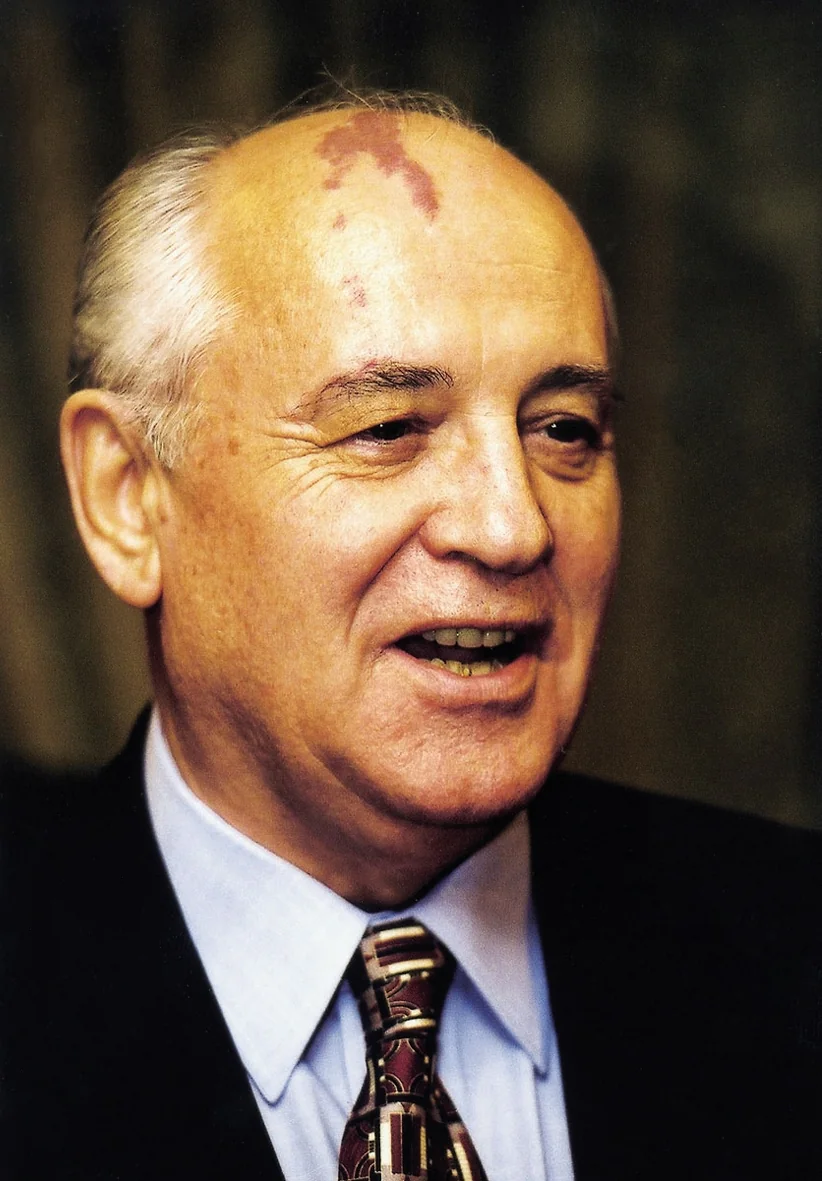
| 23 Quotes | |
| Born as | Mikhail Sergeyevich Gorbachev |
| Occup. | Statesman |
| From | Russia |
| Born | March 2, 1931 Privolnoye, Stavropol Krai, Russian SFSR, Soviet Union |
| Died | August 30, 2022 Moscow, Russia |
| Aged | 91 years |
| Cite | |
Citation Formats
APA Style (7th ed.)
Mikhail gorbachev biography, facts and quotes. (2026, February 11). FixQuotes. https://fixquotes.com/authors/mikhail-gorbachev/
Chicago Style
"Mikhail Gorbachev biography, facts and quotes." FixQuotes. February 11, 2026. https://fixquotes.com/authors/mikhail-gorbachev/.
MLA Style (9th ed.)
"Mikhail Gorbachev biography, facts and quotes." FixQuotes, 11 Feb. 2026, https://fixquotes.com/authors/mikhail-gorbachev/. Accessed 6 Mar. 2026.
Early Life and Background
Mikhail Sergeyevich Gorbachev was born on 1931-03-02 in Privolnoye, Stavropol Krai, in the grain country of southern Russia where Soviet power was felt in the most intimate way - through collectivized fields, quotas, and the sudden violence of politics. His family were peasants caught between the promise of modernization and the terror that enforced it: both grandfathers were arrested during the Stalin years, a domestic fact that taught him early that the state could be both provider and predator. The Second World War arrived as absence and strain - men at the front, harvests under pressure, fear in the background - and the young Gorbachev learned that survival depended on discipline, improvisation, and reading the weather of authority.In adolescence he worked on combines and earned a reputation for diligence, winning a high state award for farm labor while still a teenager - an emblem of the Soviet bargain, in which personal advancement could be purchased by meeting the system on its own terms. Yet the village also gave him a lasting sensitivity to everyday life, the mood of queues, the quiet cynicism toward official slogans, and the aching gap between policy and the kitchen table. These were not abstract impressions: they became the emotional ground of his later conviction that legitimacy could not be coerced forever.
Education and Formative Influences
In 1950 he entered Moscow State University to study law, arriving in a capital still shaped by Stalinism but beginning to loosen at the edges after 1953. He joined the Komsomol and then the Communist Party, absorbing the managerial language of reform that followed Khrushchev's Secret Speech and the cautious cultural thaw. At MSU he met Raisa Titarenko, a philosophically trained student who became his wife and most demanding private interlocutor; their partnership sharpened his belief that politics was not only technique but moral narrative. The law faculty, with its talk of procedure and rights, did not make him a liberal in the Western sense, but it gave him a vocabulary for restraints on power that later surfaced in his emphasis on "glasnost" and constitutional change.Career, Major Works, and Turning Points
Returning to Stavropol, Gorbachev climbed the Party ladder through Komsomol leadership into regional power, building networks in agriculture and administration that later mattered in Moscow; by 1978 he was a Central Committee secretary, and in 1980 he entered the Politburo. After the gerontocracy of Brezhnev, Andropov, and Chernenko, he became General Secretary in March 1985, projecting energy and urgency into a stalled superpower. His program of perestroika (restructuring) and glasnost (openness) began as an attempt to modernize socialism, curb alcohol abuse, and discipline a sclerotic economy, then widened into competitive elections, a stronger Congress of People's Deputies, and a redefinition of Party monopoly. In foreign policy he pursued "new thinking": arms control with Ronald Reagan (INF Treaty, 1987), withdrawal from Afghanistan (completed 1989), and acceptance that Eastern Europe would choose its own course, a stance that helped make 1989 largely nonviolent but also dissolved the empire that had underwritten Soviet identity. Awarded the 1990 Nobel Peace Prize, he struggled with nationalist secessions, economic breakdown, and hardliner backlash; after the failed August 1991 coup, Boris Yeltsin eclipsed him, and the USSR formally ended on 1991-12-26. He later led the Gorbachev Foundation and remained a public voice until his death on 2022-08-30.Philosophy, Style, and Themes
Gorbachev's inner life was marked by a tension between conviction and realism: he wanted to redeem the Soviet project without repeating its crimes, to preserve a shared state while acknowledging plural identities, and to make power answerable without collapsing governance. His language often revealed a leader who experienced time as a moral pressure rather than a neutral backdrop - “If not me, who? And if not now, when?” That sense of urgency was not mere ambition; it was the anxiety of a man who had seen how quickly systems congeal into cruelty, and who believed delay would doom any humane revision from within.His political style mixed persuasion with controlled improvisation. He favored televised argument, public criticism of officials, and negotiated exits over brute suppression, trusting that transparency could generate authority. Yet he remained a Party man, and the contradiction - reforming a monopoly through its own levers - shaped his tragedy. He defended a socialism that could coexist with markets and legal norms, insisting, “The market came with the dawn of civilization and it is not an invention of capitalism. If it leads to improving the well-being of the people there is no contradiction with socialism”. At the level of self-discipline, he framed progress as a daily obligation, warning, “If what you have done yesterday still looks big to you, you haven't done much today”. The psychological undertone is clear: he measured worth by motion, feared stagnation as both personal and national sin, and sometimes underestimated how destabilizing constant motion could be in a brittle state.
Legacy and Influence
Gorbachev remains one of the twentieth century's hinge figures: the last leader of the Soviet Union and the architect of its most far-reaching liberalization. Admirers credit him with reducing nuclear danger, enabling the peaceful revolutions of 1989, and restoring speech and conscience after decades of fear; critics blame him for economic collapse, the loss of superpower status, and the chaos of the 1990s. His enduring influence lies in the example - and warning - of attempted reform from the top: that openness can delegitimize the very institutions it hopes to save, and that refusing mass violence can be historically transformative even when it is politically fatal.Our collection contains 23 quotes written by Mikhail, under the main topics: Witty One-Liners - Motivational - Wisdom - Freedom - Equality.
Other people related to Mikhail: George Schultz (Public Servant), Andrei A. Gromyko (Politician), William Odom (Soldier), Vernon A. Walters (Soldier), Richard von Weizsaecker (Politician), Andrei Sakharov (Physicist), Armand Hammer (Businessman), Wojciech Jaruzelski (Leader), George P. Shultz (Public Servant), Larry Speakes (Public Servant)
Frequently Asked Questions
- Who is Gorbachev's daughter: His daughter's name is Irina Virganskaya.
- What did Mikhail Gorbachev do to end the Cold War: Implemented reforms and improved relations with the West, leading to the Cold War's end.
- What is Mikhail Gorbachev net worth? Estimated to be a few million dollars, though exact figures are unclear.
- Mikhail Gorbachev pronunciation: Pronounced mee-khah-eel gor-bah-choff.
- Was Mikhail Gorbachev a good leader: Opinions vary; credited with ending the Cold War but also faced criticism for the Soviet Union's collapse.
- Mikhail Gorbachev illness: Reportedly suffered from a long illness, specifics not widely disclosed.
- What did Mikhail Gorbachev do: He was the last leader of the Soviet Union, known for policies of glasnost and perestroika.
- Mikhail Gorbachev death cause: He died after a long illness.
- How old was Mikhail Gorbachev? He became 91 years old