
Milton Friedman Biography Quotes 35 Report mistakes
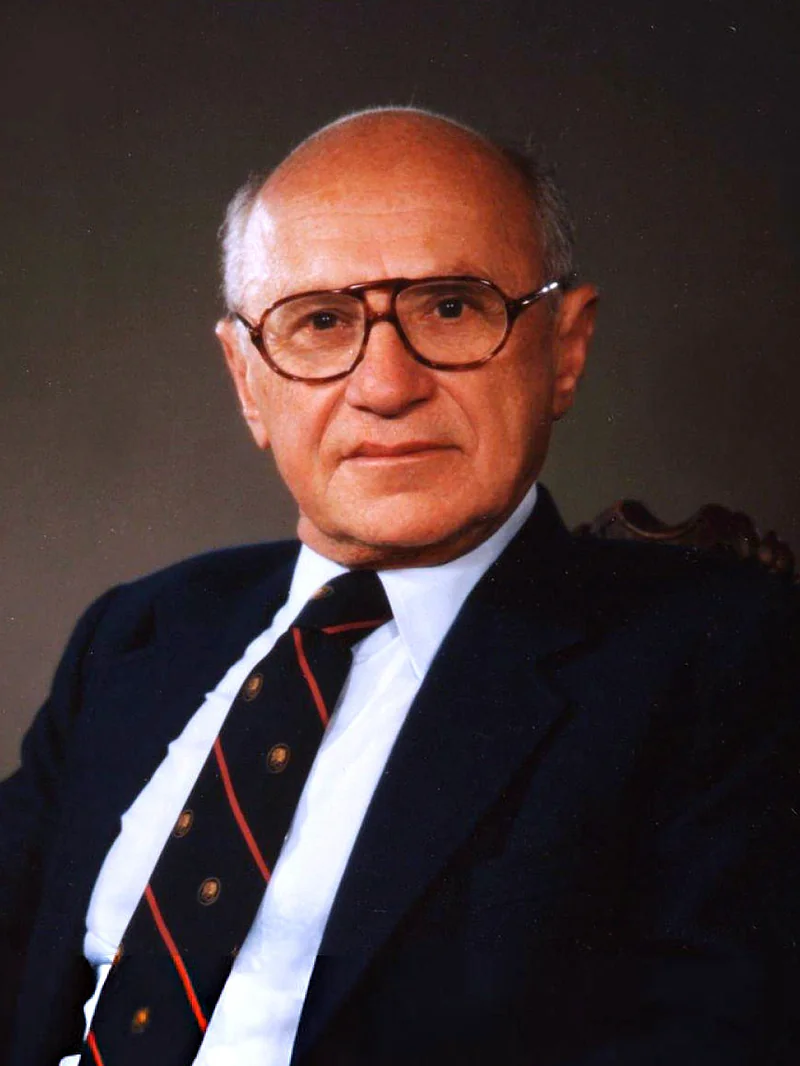
| 35 Quotes | |
| Occup. | Economist |
| From | USA |
| Born | July 31, 1912 Brooklyn, New York City, USA |
| Died | November 16, 2006 San Francisco, California, USA |
| Cause | heart failure |
| Aged | 94 years |
| Cite | |
Citation Formats
APA Style (7th ed.)
Milton friedman biography, facts and quotes. (2026, February 11). FixQuotes. https://fixquotes.com/authors/milton-friedman/
Chicago Style
"Milton Friedman biography, facts and quotes." FixQuotes. February 11, 2026. https://fixquotes.com/authors/milton-friedman/.
MLA Style (9th ed.)
"Milton Friedman biography, facts and quotes." FixQuotes, 11 Feb. 2026, https://fixquotes.com/authors/milton-friedman/. Accessed 26 Mar. 2026.
Early Life and Background
Milton Friedman was born on July 31, 1912, in Brooklyn, New York, the youngest child of Jewish immigrants from the Carpathian region of what was then the Austro-Hungarian Empire. When he was a child the family moved to Rahway, New Jersey, where his father worked as a small merchant and the household learned, in lived detail, what it meant to budget, to improvise, and to face sudden reversals. The immigrant story he inherited was not romantic in his telling; it was practical, a proof that security is fragile and that opportunity depends on rules that do not discriminate by pedigree.The era formed him early. Friedman came of age as the United States moved from the Roaring Twenties into the Great Depression, when unemployment and bank failures made arguments about markets and government intensely personal. He carried a lifelong aversion to complacent authority, shaped by watching ordinary families become dependent on distant decisions. That suspicion later hardened into a moral claim: that concentrated power, even when well meaning, tends to escape accountability and erode freedom.
Education and Formative Influences
Friedman attended Rutgers University (BA, 1932) on scholarship, excelling in mathematics and economics, then studied at the University of Chicago (MA, 1933), where price theory and the discipline of empirical argument became central to his identity. Graduate work at Columbia University linked him to rigorous statistics and measurement. Early mentors included Arthur Burns and Wesley Clair Mitchell, and his later professional partnership with Anna J. Schwartz reflected a conviction that economic history and monetary data could discipline ideology. The Depression, the New Deal, and the rising authority of Keynesian policy formed the intellectual weather against which he defined himself.Career, Major Works, and Turning Points
After government work in the 1940s and wartime statistical service, Friedman taught at the University of Chicago, where he became the most public face of the Chicago School, combining technical work with unusual rhetorical force. His methodological manifesto, "The Methodology of Positive Economics" (1953), argued that the test of an economic model is predictive performance, not the realism of its assumptions. His rehabilitation of the quantity theory and his attack on discretionary macro policy culminated in "A Monetary History of the United States, 1867-1960" (1963, with Schwartz), which famously attributed the depth of the Great Depression to Federal Reserve contraction. Later he advanced the permanent income hypothesis, developed the natural rate of unemployment and expectations-augmented critique of the Phillips curve, and became a public educator through "Capitalism and Freedom" (1962), "Free to Choose" (1980, with Rose Friedman), and a global lecture and television campaign. He received the Nobel Memorial Prize in Economic Sciences in 1976, and his ideas increasingly shaped debate amid 1970s inflation and the market-oriented turn of the 1980s.Philosophy, Style, and Themes
Friedman thought of economics as a moral science without moralistic pose: a way to design institutions so that imperfect human motives yield tolerable outcomes. His psychology leaned toward anti-utopian realism. He was skeptical of appeals to altruism as a basis for policy because he believed systems must work when people are ambitious, fallible, and self-interested. That is why he could say, “The problem of social organization is how to set up an arrangement under which greed will do the least harm, capitalism is that kind of a system”. The line reads less like cynicism than like self-protection - a defense against the recurring human wish to hand difficult choices to authorities who promise virtue.Three themes recur: the limits of knowledge, the dangers of concentrated power, and the hidden costs of well-intended intervention. His prose and speech favored crisp, testable claims and striking examples; his polemical edge served a strategic purpose, forcing listeners to notice trade-offs. The same instinct drove his monetary warnings: “Inflation is the one form of taxation that can be imposed without legislation”. He treated inflation not as a technical nuisance but as a political temptation - an unvoted transfer that corrodes trust. Beneath the confidence was a fear of quiet coercion, captured in his broader warning that “Concentrated power is not rendered harmless by the good intentions of those who create it”. In Friedman's inner life, liberty was not an abstraction; it was a fragile condition sustained by rules, competition, and the ability to say no.
Legacy and Influence
Friedman died on November 16, 2006, in San Francisco, leaving a legacy that spans scholarship, policy, and popular language. Monetarism reshaped central banking debates; even when strict money-growth rules fell out of favor, his insistence on expectations, credibility, and the monetary roots of inflation became standard equipment. His advocacy of school vouchers, voluntary military service, deregulation, and rules-based policy helped steer late-20th-century reform in the United States and beyond, while also drawing sustained criticism over inequality, social insurance, and the political uses of market rhetoric. Yet his enduring influence lies in method as much as doctrine: the demand to quantify, to trace unintended consequences, and to treat freedom as an institutional design problem rather than a sentimental slogan.Our collection contains 35 quotes written by Milton, under the main topics: Witty One-Liners - Ethics & Morality - Wisdom - Freedom - Reason & Logic.
Other people related to Milton: Thomas Sowell (Economist), Gary Becker (Economist), Frank Knight (Economist), Mark Skousen (Economist)