
Mother Teresa Biography Quotes 35 Report mistakes
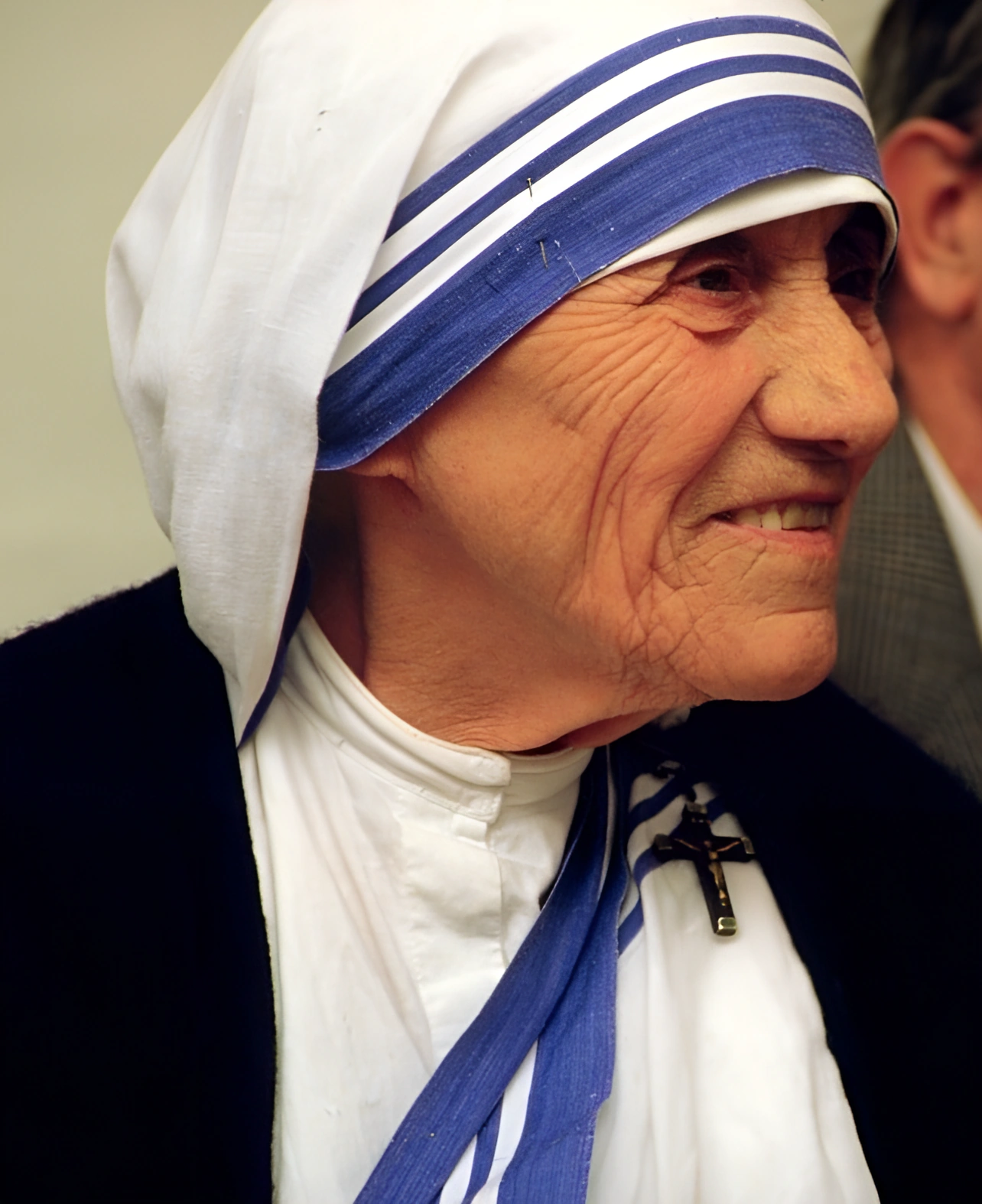
| 35 Quotes | |
| Born as | Agnes Gonxha Bojaxhiu |
| Known as | Saint Teresa of Calcutta |
| Occup. | Leader |
| From | Albania |
| Born | August 26, 1910 Skopje, Ottoman Empire (now North Macedonia) |
| Died | September 5, 1997 Calcutta, India |
| Cause | Cardiac arrest |
| Aged | 87 years |
| Cite | |
Citation Formats
APA Style (7th ed.)
Mother teresa biography, facts and quotes. (2026, February 11). FixQuotes. https://fixquotes.com/authors/mother-teresa/
Chicago Style
"Mother Teresa biography, facts and quotes." FixQuotes. February 11, 2026. https://fixquotes.com/authors/mother-teresa/.
MLA Style (9th ed.)
"Mother Teresa biography, facts and quotes." FixQuotes, 11 Feb. 2026, https://fixquotes.com/authors/mother-teresa/. Accessed 26 Mar. 2026.
Early Life and Background
Agnes Gonxha Bojaxhiu was born on August 26, 1910, in Skopje, then in the Ottoman Empire, to an Albanian Catholic family whose identity was shaped by minority status and Balkan turbulence. Her father, Nikola, was a businessman active in civic life; his sudden death when Agnes was still a child left the household more precarious and intensified the family's reliance on faith, mutual obligation, and the disciplined warmth of her mother, Drane, who practiced a plain, daily charity that Agnes later treated as a template rather than a sentiment.The era that formed her was marked by collapsing empires, rising nationalisms, and, after World War I, new borders that rarely fit the lived realities of language and religion. In that context, Agnes grew up with a strong sense that belonging could be fragile and that moral action had to be portable - something carried within the self rather than guaranteed by institutions. The piety of her parish and the example of missionaries stirred her imagination early, and by her teens she was drawn to a life that would convert inner devotion into outward service.
Education and Formative Influences
Educated in local schools and immersed in the Catholic life of Skopje, she joined the parish youth sodality and encountered missionary stories circulating through European Catholic networks in the 1920s. At 18 she left home to join the Irish-founded Sisters of Loreto, training first in Ireland and taking the name Teresa after Therese of Lisieux, whose "little way" of small acts done with great love would later echo through Teresa's own language of practical sanctity.Career, Major Works, and Turning Points
In 1929 she arrived in India, made her first vows in 1931, and for nearly two decades taught at Loreto schools in Calcutta (Kolkata), including St. Mary's High School, becoming principal and known for strict order joined to attentiveness to the poor beyond the gates. A decisive turning point came on September 10, 1946, during a train journey to Darjeeling, when she reported receiving a "call within a call" to leave the convent and live among the poorest; Vatican permission followed, and after medical training with the Medical Mission Sisters she began work in the slums. In 1950 she founded the Missionaries of Charity, expanding from a single room to homes for the dying (notably Nirmal Hriday, 1952), orphanages, and leprosy outreach such as Shanti Nagar (Town of Peace). International recognition accelerated after the late 1960s, culminating in the Nobel Peace Prize in 1979, while controversies followed - criticism of medical standards in some homes, her public alliances with wealthy donors, and her uncompromising interventions in global debates - yet the order continued to spread worldwide during her lifetime. She died on September 5, 1997, in Kolkata; canonized by the Catholic Church in 2016, she remains one of the most recognizable religious leaders of the 20th century.Philosophy, Style, and Themes
Mother Teresa's leadership fused medieval Catholic devotional categories with the crowded modern city, making the street a kind of chapel and the unwanted body a site of encounter with God. Her psychology was shaped by an intense need to make love concrete and measurable, not as feeling but as attention, cleanliness, touch, and presence. She trained her sisters to look past stigma and see a sacramental identity in the suffering person: “Each one of them is Jesus in disguise”. This was not merely rhetoric - it functioned as a mental discipline, a way to override revulsion, fatigue, and fear by converting them into obedience to a perceived Presence.Her style was austere and tactical: small steps, relentless routine, and a distrust of abstraction. She spoke in short, portable sentences, as if trying to keep charity from dissolving into theory or politics. “We ourselves feel that what we are doing is just a drop in the ocean. But the ocean would be less because of that missing drop”. The line reveals her realism about scale and her determination to sanctify the finite. At the same time, she demanded an interior posture that protected service from becoming self-importance: “Many people mistake our work for our vocation. Our vocation is the love of Jesus”. That insistence, coupled with later revelations of her long experiences of spiritual dryness, suggests a leader who built a life of action partly to remain faithful through inner silence, letting duty carry devotion when emotion would not.
Legacy and Influence
Mother Teresa left a global institution - the Missionaries of Charity and affiliated branches - and an enduring iconography of compassion: the white sari with blue border, the simple smile, the hand on a forehead. Her influence is double-edged in public memory: for admirers, she re-centered the dignity of the dying and the abandoned in an era of bureaucratic welfare and ideological violence; for critics, she exemplified a model of charity that could neglect structural causes and invite scrutiny over care practices and moral preaching. Yet even this tension testifies to her impact: she made the question of what love requires - not in theory, but at the bedside and in the gutter - unavoidable for believers and secular observers alike.Our collection contains 35 quotes written by Mother, under the main topics: Love - Kindness - Faith - Peace - God.
Other people related to Mother: Christopher Hitchens (Author)
Mother Teresa Famous Works
- 2007 Mother Teresa: Come Be My Light (Book)
- 1997 No Greater Love (Book)
- 1997 The Joy in Loving: A Guide to Daily Living (Book)
- 1996 In My Own Words (Book)
- 1975 A Gift for God: Prayers and Meditations (Book)
Source / external links