Muhammad Ali Biography Quotes 51 Report mistakes
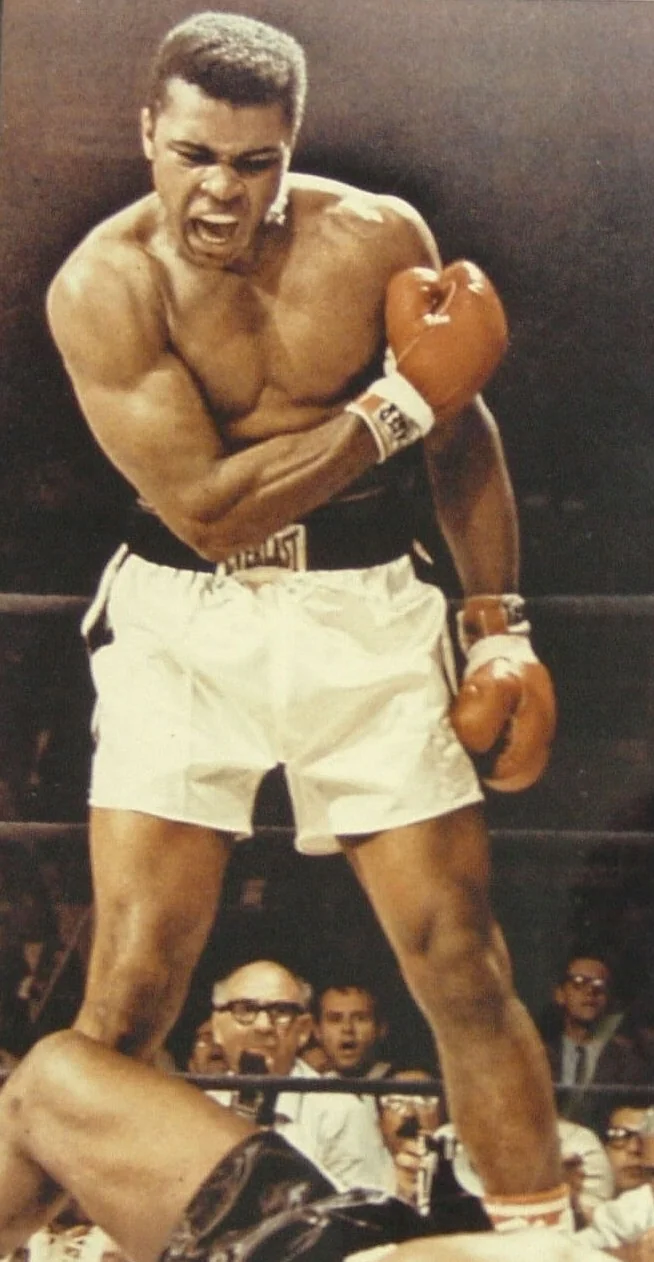
| 51 Quotes | |
| Born as | Cassius Marcellus Clay Jr. |
| Occup. | Athlete |
| From | USA |
| Spouses | Sonji Roi (1964-1966) Belinda Boyd (1967-1977) Veronica Porché Ali (1977-1986) Yolanda Williams (1986) |
| Born | January 17, 1942 Louisville, Kentucky, U.S. |
| Died | June 3, 2016 Scottsdale, Arizona, U.S. |
| Cause | Septic shock due to unspecified natural causes |
| Aged | 74 years |
Muhammad Ali was born Cassius Marcellus Clay Jr. on January 17, 1942, in Louisville, Kentucky, into a working-class family during the era of segregation in the United States. His father, Cassius Marcellus Clay Sr., was a sign painter and musician, and his mother, Odessa Grady Clay, worked as a domestic. Alongside his younger brother, who would later fight professionally as Rahman Ali, Clay grew up in a neighborhood where discipline, pride, and self-belief were essential to pushing past the constraints of the time. His path to boxing was famously sparked when, at age 12, his bicycle was stolen. Vowing to confront the thief, he met police officer and boxing coach Joe Martin, who invited him to learn to fight before seeking revenge. The gym became a sanctuary, and Clay developed an intense work ethic and an unorthodox style defined by speed, reflexes, and footwork.
Amateur Ascent and Olympic Gold
Clay quickly rose through the amateur ranks, winning regional and national Golden Gloves titles and establishing himself as a standout light heavyweight with dazzling movement and a jab that disrupted opponents. In 1960 he earned a place on the U.S. Olympic team bound for Rome. There, he captured the light heavyweight gold medal, a triumph that marked him as one of America's brightest athletic prospects. The victory also gave him a platform on which his personality flourished. He was buoyant with reporters, quick with rhyme and repartee, and already aware that boxing was as much theater as combat. Returning home with gold, he turned professional and aligned with the Louisville Sponsoring Group, a consortium that backed his early career. Before long, he moved his training base to Miami, where trainer Angelo Dundee refined his gifts at the 5th Street Gym.
Professional Rise and the Liston Shock
The young Clay made waves not only by winning but by predicting the round of his victories and by treating press conferences like stages. With cornerman Drew Bundini Brown urging him to float like a butterfly and sting like a bee, his ring style fused speed and bravado. He fought top contenders including Doug Jones and Henry Cooper, surviving tough nights that steeled his confidence. In February 1964 he challenged Sonny Liston, the intimidating heavyweight champion. Few gave him a chance. Clay, faster and more elusive than any heavyweight of the era, bewildered Liston with movement and taunts, and won when Liston retired on his stool. He became the heavyweight champion of the world and the most talked-about athlete in America.
Faith, Identity, and a New Name
In the wake of the Liston victory, he publicly affirmed his association with the Nation of Islam. Under the guidance of figures such as Elijah Muhammad and with the influential, sometimes fraught companionship of Malcolm X, he reframed his identity amid the civil rights struggles of the 1960s. Clay soon announced his new name: Muhammad Ali. The change echoed his assertion of religious conviction and personal dignity at a moment when his stature made him a symbol beyond sports. While his relationship with Malcolm X later ruptured as Malcolm departed the Nation, Ali would reflect in later years with regret about that estrangement, underscoring the complex human networks surrounding his transformation.
Dominance and Exile
As champion, Ali defended his title against former champions and leading contenders, defeating Floyd Patterson and outclassing Sonny Liston in a controversial 1965 rematch. He sharpened his style under Angelo Dundee's watch and built a public persona partly shaped by broadcaster Howard Cosell, whose interviews showcased Ali's showmanship and intelligence. In 1967, at the height of his powers, Ali refused induction into the U.S. military during the Vietnam War, citing his religious beliefs and opposition to the conflict. He was stripped of his title, had his license revoked, and was convicted of draft evasion. For more than three years he could not box in his prime. His stance made him a polarizing figure, but as the national mood shifted, a broader public came to regard his refusal as a principled act. In 1971, the U.S. Supreme Court unanimously overturned his conviction in Clay v. United States.
The Comeback and the Fight of the Century
Ali returned to the ring in 1970, beating Jerry Quarry and Oscar Bonavena. In March 1971, he faced the undefeated champion Joe Frazier at Madison Square Garden in what was billed as the Fight of the Century. Their contrasting styles and the cultural currents swirling around them made the bout an epochal event. Frazier won by unanimous decision, dropping Ali in the 15th round, handing him his first professional loss. The defeat did not diminish Ali's magnetism; instead it deepened his narrative, showing resilience and craft evolving in a body that had lost some youthful speed but gained in guile.
Rumble in the Jungle and Thrilla in Manila
Ali rebuilt through key victories, defeating Frazier in a 1974 rematch, then traveling to Zaire to fight George Foreman in the Rumble in the Jungle. Against the fearsome puncher, Ali introduced the rope-a-dope, absorbing shots on the arms and gloves while conserving energy. In the eighth round he stopped Foreman, reclaiming the heavyweight championship. Promoter Don King helped orchestrate the spectacle, while Angelo Dundee and Bundini Brown guided Ali through the tactical gamble. The following year he faced Frazier for a third time in the brutal Thrilla in Manila. On a sweltering night, Ali prevailed when Frazier, handled by Eddie Futch, could not answer the bell for the 15th round. Both men were pushed to their limits, and their rivalry, though fierce, matured into mutual respect.
Late Career, Losses, and Final Bouts
The late 1970s brought more title defenses and the wear of accumulated punishment. Ali lost the belt to Leon Spinks in 1978, then regained it in a rematch the same year, becoming the first three-time lineal heavyweight champion. He announced retirement but returned in 1980 to face Larry Holmes, trained by Eddie Futch and guided by Don King's promotion. Holmes dominated and stopped Ali, a painful night that concerned friends and observers, including ring physician Ferdie Pacheco, who had earlier urged Ali to retire. One final fight in 1981 against Trevor Berbick ended in defeat. Ali walked away for good, having compiled one of the sport's most storied careers.
Life Beyond the Ring
Outside the ring, Ali's life was marked by family, faith, and public engagement. He was married four times, including to Khalilah (Belinda) and later to Veronica Porsche, with whom he had daughter Laila Ali, who became a champion boxer in her own right. His longtime companion and later wife Yolanda (Lonnie) Williams helped manage his affairs as his public stature grew. Ali's religious journey saw him move from the Nation of Islam toward Sunni Islam under the guidance of leaders such as Imam Warith Deen Mohammed. He traveled widely for humanitarian purposes, advocating for peace and justice, and in 1990 he journeyed to Iraq, where he met Saddam Hussein and secured the release of American hostages. He supported charitable causes and youth programs, and the Muhammad Ali Center opened in Louisville as a museum and education hub celebrating his principles of respect, confidence, and dedication.
Health Challenges and Public Moments
In the mid-1980s, Ali was diagnosed with Parkinson's syndrome, a condition that would gradually affect his speech and movement. Even as his physical voice softened, his symbolic voice grew. He lit the Olympic cauldron at the 1996 Atlanta Games, a moment of global poignancy that affirmed his enduring place in public life. He received numerous honors, including the Presidential Medal of Freedom in 2005. Friends and former rivals, from George Foreman and Joe Frazier to Larry Holmes and Ken Norton, spoke of him with a mixture of awe and affection, acknowledging the fierce competitor and the generous spirit behind the bravado. Broadcaster Howard Cosell, long a foil and ally, helped shape Ali's image for generations, their exchanges blending sport, theater, and social commentary.
Legacy and Passing
Muhammad Ali died on June 3, 2016, in Scottsdale, Arizona. His funeral drew dignitaries, former opponents, family, and fans from around the world to honor a life that transcended boxing. He redefined the parameters of athletic greatness by combining mastery in his craft with a willingness to take moral stands, withstand exile, and return to excellence. He showcased how an athlete's platform could project far beyond the scoreboard, touching conversations on war, race, faith, and personal freedom. In the ring he was a virtuoso of timing and audacity; outside it he became a humanitarian energized by empathy. The people who shaped and challenged him, trainers like Angelo Dundee, rivals like Joe Frazier and George Foreman, mentors and interlocutors such as Malcolm X and Howard Cosell, formed a constellation around which his life and legend revolved. For many, Ali remains not merely the greatest heavyweight, but a global icon of courage, conviction, and charisma whose story continues to inspire.
Our collection contains 51 quotes who is written by Muhammad, under the main topics: Witty One-Liners - Motivational - Wisdom - Justice - Never Give Up.
Other people realated to Muhammad: William F. Buckley, Jr. (Journalist), Phil Donahue (Entertainer), Kareem Abdul-Jabbar (Athlete), Norman Mailer (Novelist), Dick Cavett (Entertainer), Antoine Fuqua (Director), Dean Martin (Actor), Gordon Parks (Photographer), Joe Frazier (Athlete), Floyd Patterson (Athlete)
Source / external links