
Neil Gaiman Biography Quotes 31 Report mistakes
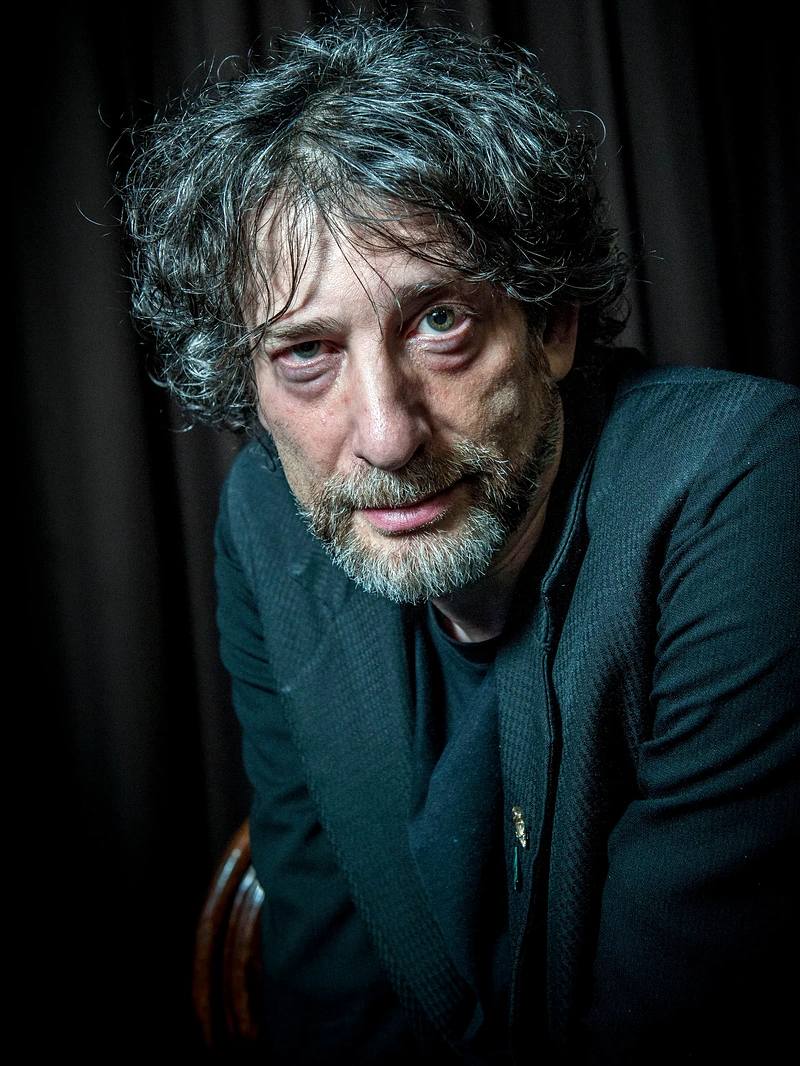
Attr: The New Yorker
| 31 Quotes | |
| Born as | Neil Richard Gaiman |
| Occup. | Author |
| From | United Kingdom |
| Born | November 10, 1960 Portchester, Hampshire, England |
| Age | 65 years |
| Cite | |
Citation Formats
APA Style (7th ed.)
Neil gaiman biography, facts and quotes. (2026, February 11). FixQuotes. https://fixquotes.com/authors/neil-gaiman/
Chicago Style
"Neil Gaiman biography, facts and quotes." FixQuotes. February 11, 2026. https://fixquotes.com/authors/neil-gaiman/.
MLA Style (9th ed.)
"Neil Gaiman biography, facts and quotes." FixQuotes, 11 Feb. 2026, https://fixquotes.com/authors/neil-gaiman/. Accessed 5 Mar. 2026.
Early Life and Background
Neil Richard Gaiman was born on November 10, 1960, in Portchester, Hampshire, in a Britain shifting from postwar austerity to the media-saturated anxieties of the late Cold War. He grew up in a Jewish family with strong ties to Scientology through his parents, a spiritual environment that put belief, narrative, and authority into daily conversation. That mix of inherited tradition and modern movement - and the sense that stories can organize a life - became a lifelong engine for his fiction.Raised largely in Sussex, Gaiman was an early, hungry reader with a taste for myth and the macabre: C.S. Lewis, Tolkien, Edgar Allan Poe, and especially the cinematic terror and dream-logic of horror and fantasy. The inner posture formed early: an outsider by temperament, observant rather than doctrinaire, interested in how communities enforce consensus and how individuals slip the leash. His later work would keep returning to the child who reads as a survival skill, learning that imagination is not escape so much as a second set of tools.
Education and Formative Influences
Gaiman attended Ardingly College and later Whitgift School in Croydon, leaving formal education without university training and choosing instead the apprenticeship of journalism. In late-1970s and early-1980s Britain - when punk had stripped glamour off authority and Thatcher-era politics sharpened class and cultural conflict - he built a working education from deadlines, interviews, and the professional world of editors, contracts, and audience. The combination of literary ambition and tradecraft mattered: he learned to write for strangers, to deliver clean copy, and to observe public personas at close range.Career, Major Works, and Turning Points
He began as a freelance journalist and critic, then wrote the authorized biography of the pop group Duran Duran (1984) and collaborated with Dave McKean on the graphic novel Violent Cases (1987) and the illustrated Black Orchid (1988). The major turning point arrived with DC Comics and The Sandman (1989-1996), which reframed mainstream comics as a venue for literary, allusive, adult storytelling and made him an emblem of the medium's renaissance. That success opened a second career in prose: the novel Good Omens (1990, with Terry Pratchett) proved his comic timing and moral warmth; Neverwhere (1996) translated London into urban myth; Stardust (1999) and Coraline (2002) sharpened his modern fairy-tale voice; American Gods (2001) and Anansi Boys (2005) mapped belief onto migration and consumer culture; The Graveyard Book (2008) reworked Kipling into elegy and adventure. Later he expanded into television and audio - notably with Good Omens (2019-) and The Sandman (2022-) adaptations - while also becoming a public advocate for libraries, literacy, and creative freedom.Philosophy, Style, and Themes
Gaiman's imagination is built on threshold states: doorways, undercities, sleeping gods, and the bureaucracies of the afterlife. His narrators often sound conversational, even cozy, but the comfort is a lure; beneath it is a steady diagnosis of mortality, power, and the bargains people make to feel safe. He is a writer of temptations and costs, insisting that curiosity is not innocence but appetite: “And there never was an apple, in Adam's opinion, that wasn't worth the trouble you got into for eating it”. That line captures his recurring psychology - the desire to know, even when knowledge ends a childhood, a marriage, a faith, or a world.He is equally attentive to how societies tolerate truth only when it is harmless, a theme expressed through fools, children, and marginal figures who can say what others cannot. “It is a fool's prerogative to utter truths that no one else will speak”. In his work, that prerogative often belongs to storytellers themselves: the one who makes a joke, tells a fairy tale, or spins a myth becomes the person allowed to name what is wrong. Yet he rarely romanticizes rebellion; he understands how institutions absorb criticism and keep standing. His distinctive balance - wit paired with dread - surfaces in his mordant metaphysics: “Life - and I don't suppose I'm the first to make this comparison - is a disease: sexually transmitted, and invariably fatal”. Mortality, for Gaiman, is not merely tragedy; it is the pressure that makes kindness urgent and makes stories matter.
Legacy and Influence
Gaiman helped legitimize comics as a literary art for late-20th-century Anglophone culture, with The Sandman becoming a gateway text for readers who had never considered sequential narrative "serious". His novels and children's books normalized a sophisticated, myth-literate fantasy that is simultaneously intimate and widely accessible, influencing writers across fantasy, horror, YA, and graphic storytelling, as well as creators in television, gaming, and audio drama. His public persona - genial, bookish, community-minded - amplified his impact through advocacy for libraries and free expression, while his work continues to function as a modern myth-system: stories about stories, designed to survive translation across media and generations.Our collection contains 31 quotes written by Neil, under the main topics: Witty One-Liners - Funny - Truth - Art - Puns & Wordplay.
Other people related to Neil: Tori Amos (Musician), Matthew Vaughn (Producer), David Thewlis (Actor), Crispin Glover (Actor), Ben Folds (Musician), Gene Wolfe (Writer)
Neil Gaiman Famous Works
- 2017 Norse Mythology (Non-fiction)
- 2016 The View from the Cheap Seats (Collection)
- 2013 Fortunately, the Milk (Children's book)
- 2013 The Sleeper and the Spindle (Novella)
- 2013 The Ocean at the End of the Lane (Novel)
- 2008 The Graveyard Book (Children's book)
- 2008 Odd and the Frost Giants (Children's book)
- 2006 Fragile Things (Collection)
- 2005 Anansi Boys (Novel)
- 2003 A Study in Emerald (Short Story)
- 2002 Coraline (Children's book)
- 2001 American Gods (Novel)
- 1999 Stardust (Novel)
- 1998 Smoke and Mirrors (Collection)
- 1996 Neverwhere (Novel)
- 1990 Good Omens: The Nice and Accurate Prophecies of Agnes Nutter, Witch (Novel)
- 1989 The Sandman (Book)