
Neville Chamberlain Biography Quotes 6 Report mistakes
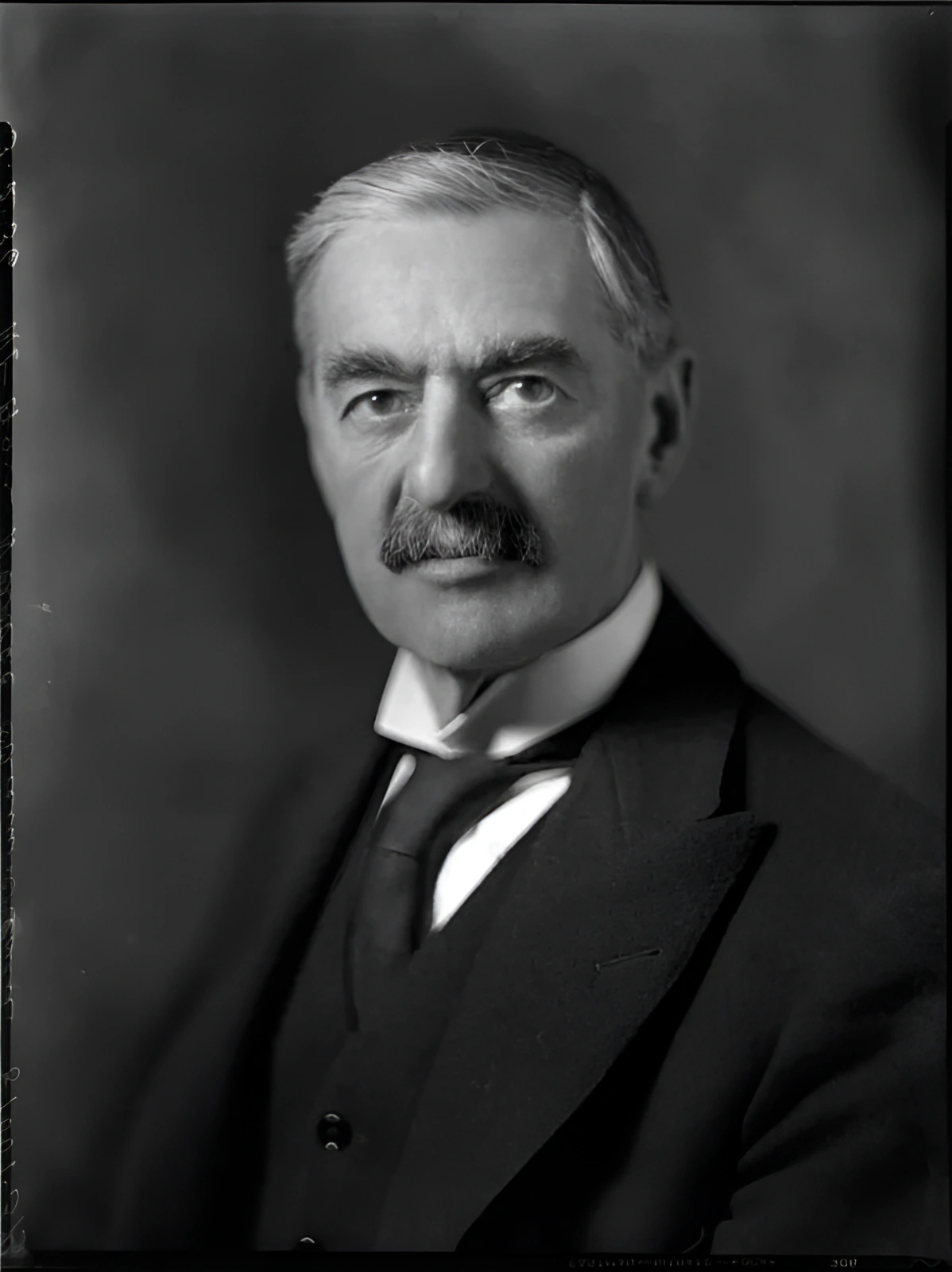
| 6 Quotes | |
| Born as | Arthur Neville Chamberlain |
| Occup. | Politician |
| From | United Kingdom |
| Born | March 18, 1869 Birmingham, England |
| Died | November 9, 1940 Reading, England |
| Cause | Cancer |
| Aged | 71 years |
| Cite | |
Citation Formats
APA Style (7th ed.)
Neville chamberlain biography, facts and quotes. (2026, February 11). FixQuotes. https://fixquotes.com/authors/neville-chamberlain/
Chicago Style
"Neville Chamberlain biography, facts and quotes." FixQuotes. February 11, 2026. https://fixquotes.com/authors/neville-chamberlain/.
MLA Style (9th ed.)
"Neville Chamberlain biography, facts and quotes." FixQuotes, 11 Feb. 2026, https://fixquotes.com/authors/neville-chamberlain/. Accessed 6 Mar. 2026.
Early Life and Background
Arthur Neville Chamberlain was born on March 18, 1869, in Birmingham, the industrial capital of Victorian municipal ambition. He grew up inside a dynasty that treated public service as a family craft: his father, Joseph Chamberlain, remade Birmingham politics before entering imperial Cabinet life, and the household trained its children to read power as something built by organization, persuasion, and relentless attention to detail. Neville was quieter than the volcanic Joseph, yet he absorbed the same belief that administration could be a moral force - that budgets, housing, and tariffs were not abstractions but levers on human life.The era that formed him was one of accelerating modernity: mass newspapers, expanding suffrage, and the memory of the Boer War hardening into arguments about empire, obligation, and cost. Chamberlain developed a private temperament that leaned toward control and method. He disliked theatrics, trusted records and schedules, and carried an almost accountant's suspicion of improvisation. This inner discipline later became both his strength as a domestic reformer and his limitation when faced with an adversary who used diplomacy as camouflage.
Education and Formative Influences
He attended Rugby School and studied at Mason College in Birmingham, but his most formative education came from work and responsibility rather than universities or salons. After an unsuccessful early venture in the Bahamas, he returned to Birmingham and learned the city's civic machinery from the inside, eventually becoming a leading figure in local government. Joseph Chamberlain's example taught him that politics could be managerial and moral at once, and that the state earned legitimacy by delivering tangible improvements - a lesson Neville carried into national office with a reformer's impatience for waste.Career, Major Works, and Turning Points
Chamberlain entered Parliament in 1918 and advanced through the Conservative Party as a specialist in governance: Minister of Health in the early 1920s, Chancellor of the Exchequer (1931-1937), and Prime Minister in 1937. His major domestic achievement was the Housing Act 1923 and later housing and local-government reforms that expanded building and rationalized public health administration; as Chancellor he confronted the Great Depression's constraints and defended rearmament within tight fiscal limits. The turning point that defined him came with the crises of 1938-1939 - Anschluss, Munich, and then the collapse of deterrence after Hitler absorbed the rest of Czechoslovakia. Chamberlain negotiated the Munich Agreement in September 1938, believing he had bought time and avoided catastrophe, but by March 1939 he shifted toward guarantees for Poland and accelerated rearmament. When Germany invaded Poland, he declared war on September 3, 1939; the "Phoney War", Norway debacle, and loss of parliamentary confidence forced his resignation in May 1940. He remained in Churchill's War Cabinet briefly, then died of cancer on November 9, 1940.Philosophy, Style, and Themes
Chamberlain's political psychology was shaped by civic pragmatism: problems existed to be solved, not dramatized. He trusted negotiation because he believed interests could be clarified and managed like municipal disputes over rates and services. His private letters show a man unsettled by the thought that Europe was sliding into mechanized slaughter again; the First World War's shadow made peace not a slogan but a governing imperative. “In war, whichever side may call itself the victor, there are no winners, but all are losers”. That sentence captures both his humanitarian instinct and his tendency to frame conflict as a mutual catastrophe rather than a contest of regimes - a framing that could underestimate ideological aggression.His rhetoric often revealed a blend of moral recoil and parochial incredulity about continental quarrels, as if distance itself were a political argument. "How horrible, fantastic, incredible, it is that we should be digging trenches and trying on gas-masks here because of a quarrel in a faraway country between people of whom we
Our collection contains 6 quotes written by Neville, under the main topics: Peace - War.
Other people related to Neville: Stanley Baldwin (Statesman), Joseph P. Kennedy (Diplomat), David Low (Cartoonist), Michael Foot (Politician), Joseph Lyons (Statesman), Lord Halifax (Politician), Frank Hornby (Inventor)