
Nguyen Cao Ky Biography Quotes 16 Report mistakes
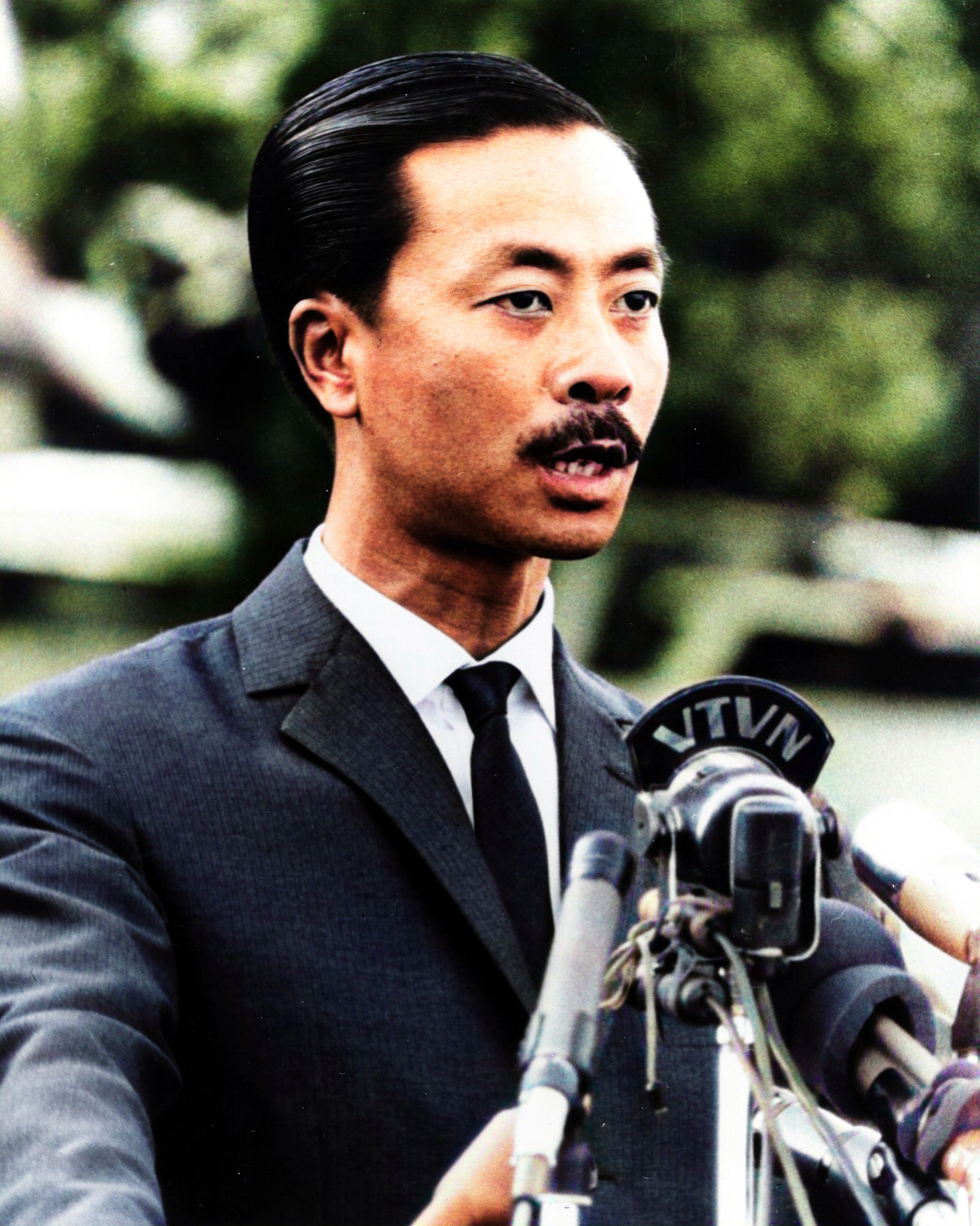
| 16 Quotes | |
| Occup. | Politician |
| From | Vietnam |
| Born | September 8, 1930 Hanoi, Vietnam |
| Age | 95 years |
| Cite | |
Citation Formats
APA Style (7th ed.)
Nguyen cao ky biography, facts and quotes. (2026, February 11). FixQuotes. https://fixquotes.com/authors/nguyen-cao-ky/
Chicago Style
"Nguyen Cao Ky biography, facts and quotes." FixQuotes. February 11, 2026. https://fixquotes.com/authors/nguyen-cao-ky/.
MLA Style (9th ed.)
"Nguyen Cao Ky biography, facts and quotes." FixQuotes, 11 Feb. 2026, https://fixquotes.com/authors/nguyen-cao-ky/. Accessed 12 Feb. 2026.
Early Life and Background
Nguyen Cao Ky was born on September 8, 1930, in Son Tay in the Red River Delta, a region then folded into French Indochina and thick with the contradictions of colonial modernity - Catholic and Buddhist villages, mandarinate memory, French schools, and a growing underground of anticolonial politics. His childhood unfolded under a succession of shocks that trained a generation to think in terms of abrupt regime change: the Japanese coup that toppled French authority in 1945, the famine and upheaval of the late war years, and then the First Indochina War as the Viet Minh pressed for independence and the French fought to restore control.Those early dislocations helped form Ky's core instincts: speed over deliberation, audacity over consensus, and an appetite for the machinery of power rather than its ceremonies. Even before he became a national figure, he belonged to a cohort for whom the state was not an inherited framework but a contested prize, and whose ambitions were shaped by the raw fact that violence and foreign influence were already baked into political life. By the time Vietnam approached partition, Ky's horizon was less ideological purity than the practical question of who could command men, aircraft, and allies.
Education and Formative Influences
Ky gravitated to the military as a ladder in a society where institutions were crumbling and new ones had not yet cohered. He trained as an aviator within the French-sponsored Vietnamese forces and, as the State of Vietnam and later the Republic of Vietnam took shape, he became part of the emerging Air Force officer corps - a technically modern, socially mobile fraternity tied to outside patronage and to the promise of national sovereignty. Aviation offered Ky a worldview of altitude and leverage: the belief that decisive action from above could compensate for fragmentation on the ground, and that personal charisma mattered because formal legitimacy was always in dispute.Career, Major Works, and Turning Points
After the 1954 partition, Ky rose quickly in the Republic of Vietnam Air Force, becoming one of its youngest generals and a prominent figure in the turbulent officer politics that followed the 1963 overthrow of Ngo Dinh Diem. In 1965, amid coups and countercoups, he emerged as prime minister under a military directorate led by Nguyen Van Thieu; from 1967 he served as vice president when a new constitution and election tried to give the regime civilian form. He cultivated an image of swaggering modernity - leather flight jackets, blunt talk, a pilot's confidence - while presiding over a state simultaneously fighting insurgency, managing rival generals, and navigating the immense gravitational pull of the United States. After 1975 he went into exile, later publishing memoirs and political reflections, and in the 2000s made controversial visits back to Vietnam, arguing for reconciliation even as many anti-communist exiles denounced him for it.Philosophy, Style, and Themes
Ky's political psychology was forged by a country split not only by ideology but by the mechanics of state-building under emergency. He understood that legitimacy in South Vietnam was always haunted by origin myths and foreign sponsorship - a point implicit in his own insistence on contingency and coercion. "I never staged a coup. They picked me up. Like I say, they forced me to become premier, maybe hoping that by that way, they send me to the electric chair". The line is more than self-exculpation: it reveals a man who experienced power as a trap as much as a prize, and who believed that leaders in Saigon were often instruments of factions, not masters of events. It also underscores his persistent theme that personal agency was constrained by a political culture in which survival depended on rapid alignment rather than slow institution-building.His rhetoric about allies, too, mixed gratitude with grievance, a duality that mirrored South Vietnam's structural predicament. "South Vietnam had to be built from scratch and, from the very beginning, depended far too much on the Western superpowers. As in the case of a person on public welfare, this dependency, which became greater with each day, was quite difficult to shake". Ky could speak like a hard-headed realist about patron-client dynamics, even as he publicly embraced American support and privately worried about its volatility. That worry sharpened after U.S. domestic crises and the turn toward Vietnamization: "After Watergate, America was a ship without a rudder. Vietnam was left to its own devices, drifting along towards its fate". In Ky's telling, the tragedy was not only battlefield defeat but the mismatch between a revolutionary opponent with a unified command and a southern state that never escaped the centrifugal pull of factionalism and dependence.
Legacy and Influence
Ky remains one of the most vivid and polarizing faces of South Vietnam: to admirers, an energetic modernizer and wartime executive who tried to impose order on chaos; to critics, a symbol of militarized politics and the thin legitimacy of Saigon's revolving governments. His later life - exile, memoir, and the gamble of returning to Vietnam to advocate reconciliation - extended the arguments of his career into the Vietnamese diaspora's unresolved civil war of memory. More than a maker of policy, Ky endures as a case study in leadership under tutelage: a charismatic actor trapped inside a state that struggled to become more than the sum of its patrons, coups, and emergencies, and whose defeat continues to shape how both Vietnamese and Americans narrate the limits of power.Our collection contains 16 quotes written by Nguyen, under the main topics: Witty One-Liners - Justice - Leadership - Peace - Gratitude.
Source / external links