
Niccolo Machiavelli Biography Quotes 48 Report mistakes
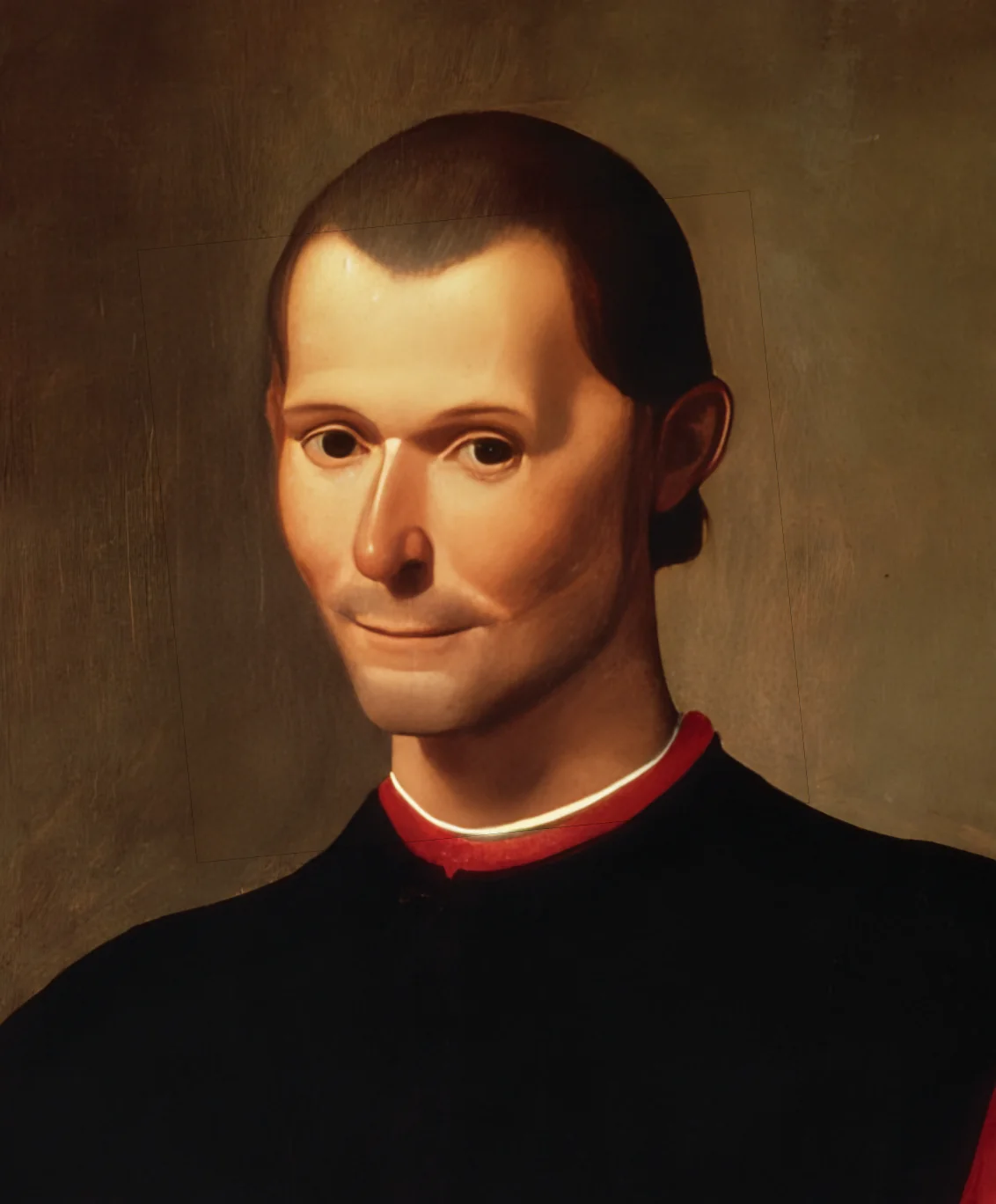
| 48 Quotes | |
| Born as | Niccolò di Bernardo dei Machiavelli |
| Occup. | Writer |
| From | Italy |
| Born | May 3, 1469 Florence, Italy |
| Died | June 21, 1527 Florence, Italy |
| Aged | 58 years |
| Cite | |
Citation Formats
APA Style (7th ed.)
Niccolo machiavelli biography, facts and quotes. (2026, February 11). FixQuotes. https://fixquotes.com/authors/niccolo-machiavelli/
Chicago Style
"Niccolo Machiavelli biography, facts and quotes." FixQuotes. February 11, 2026. https://fixquotes.com/authors/niccolo-machiavelli/.
MLA Style (9th ed.)
"Niccolo Machiavelli biography, facts and quotes." FixQuotes, 11 Feb. 2026, https://fixquotes.com/authors/niccolo-machiavelli/. Accessed 26 Mar. 2026.
Early Life and Background
Niccolo di Bernardo dei Machiavelli was born on 1469-05-03 in Florence, a city where banking wealth, humanist learning, and street-level factionalism coexisted in a tense equilibrium. His family belonged to the lesser nobility: respectable, bookish, and not rich. That position mattered. He grew up close enough to power to study its rituals, yet far enough away to feel its precariousness - an outlook that later made him suspicious of inherited rank and fascinated by how authority is manufactured, defended, and lost.His youth unfolded amid Italy's wars and diplomatic brinkmanship: the Medici's dominance in Florence, their expulsion in 1494, and the establishment of the Florentine Republic under Piero Soderini. The French invasion that same year shattered old certainties, turning the peninsula into a chessboard for France, Spain, the papacy, and the great Italian states. Machiavelli internalized this instability as a moral and psychological climate - a world in which survival often depended less on righteousness than on timing, coalition, and nerve.
Education and Formative Influences
Machiavelli received a humanist education grounded in Latin, rhetoric, and Roman history, absorbing Livy, Cicero, Sallust, and the hard lessons of antiquity about civic virtue and corruption. Florence itself served as his laboratory: sermons like those of Girolamo Savonarola demonstrated the intoxicating power of charisma and the fragility of authority without force, while republican debates taught him to hear politics as argument, interest, and theater. From early on he learned to treat moral language as a political instrument, not a final court of appeal.Career, Major Works, and Turning Points
In 1498, soon after Savonarola's fall, Machiavelli became second chancellor and secretary to the Ten of War, a post that made him a working architect of Florentine diplomacy and military policy. He traveled on missions to Louis XII of France, to the papal court, and to Cesare Borgia, whose swift consolidation in Romagna provided Machiavelli with a living case study in calculated cruelty, propaganda, and administrative reform. He pushed for a citizen militia to replace unreliable mercenaries, a project later set out in The Art of War (1521). The decisive rupture came in 1512 when the Medici returned with Spanish backing; Machiavelli was dismissed, accused of conspiracy, tortured, and exiled to his small property at Sant'Andrea in Percussina. There he composed The Prince (1513) as both analysis and implied job application, and later the Discourses on Livy (begun 1513, published posthumously) as his deeper meditation on republican endurance; he also turned to theater with Mandragola (c. 1518), a comedy that exposes civic hypocrisy as shrewdly as any treatise. He died in Florence on 1527-06-21, as the city again convulsed after the Sack of Rome and another Medici expulsion.Philosophy, Style, and Themes
Machiavelli wrote as a civil servant trained to compress experience into usable rules. His style is spare, concrete, and unusually unpious for his age: princes and peoples appear as predictable mixtures of appetite, fear, and vanity, and institutions matter because they channel those forces. The inner drama of his work is the tension between admiration for republican liberty and a cold recognition that emergencies reward decisive, even brutal, command. His exile sharpened this edge. Shut out from office, he reread Rome at night and reentered politics on the page, converting personal humiliation into a theory of how power actually behaves when it is threatened.In that theory, ethics is not ignored so much as relocated. He treats morality as one language among others - useful for legitimacy, dangerous when mistaken for strategy - which is why the blunt claim “Politics have no relation to morals”. rings less like cynicism than like a field note from a wounded republic. His famous preference for coercive stability over sentimental allegiance is captured in “It is better to be feared than loved, if you cannot be both”. , a sentence that reveals his psychological realism about fragile coalitions and the volatility of public gratitude. Yet he also understands that force used clumsily breeds hatred and revolt; the warning “When you disarm the people, you commence to offend them and show that you distrust them either through cowardice or lack of confidence, and both of these opinions generate hatred”. shows his sensitivity to civic pride and the emotions of the governed. Across The Prince and the Discourses, the recurring theme is not cruelty for its own sake but political workmanship: the crafting of fear, trust, institutions, and timing into durable order.
Legacy and Influence
After his death, "Machiavellian" became a moral accusation even as his books became unavoidable. The Prince circulated across Europe as both manual and warning; the Discourses nourished later republican thinkers who wanted liberty secured by law, arms, and civic habits rather than sermons. From early modern statecraft to modern political science, Machiavelli endures because he insists that the public world runs on motives people prefer not to confess - and because, beneath the hard counsel, he remains a Florentine patriot trying to imagine how a weak, divided Italy might finally become strong enough to govern itself.Our collection contains 48 quotes written by Niccolo, under the main topics: Witty One-Liners - Motivational - Ethics & Morality - Wisdom - Justice.
Niccolo Machiavelli Famous Works
- 1532 The Prince (Book)
- 1531 Discourses on Livy (Book)
- 1521 The Art of War (Book)
- 1520 The Seven Books on the Art of War (Book)
- 1520 The Life of Castruccio Castracani (Novella)
- 1518 Mandragola (Play)
Source / external links