
Nicholas II Biography Quotes 2 Report mistakes
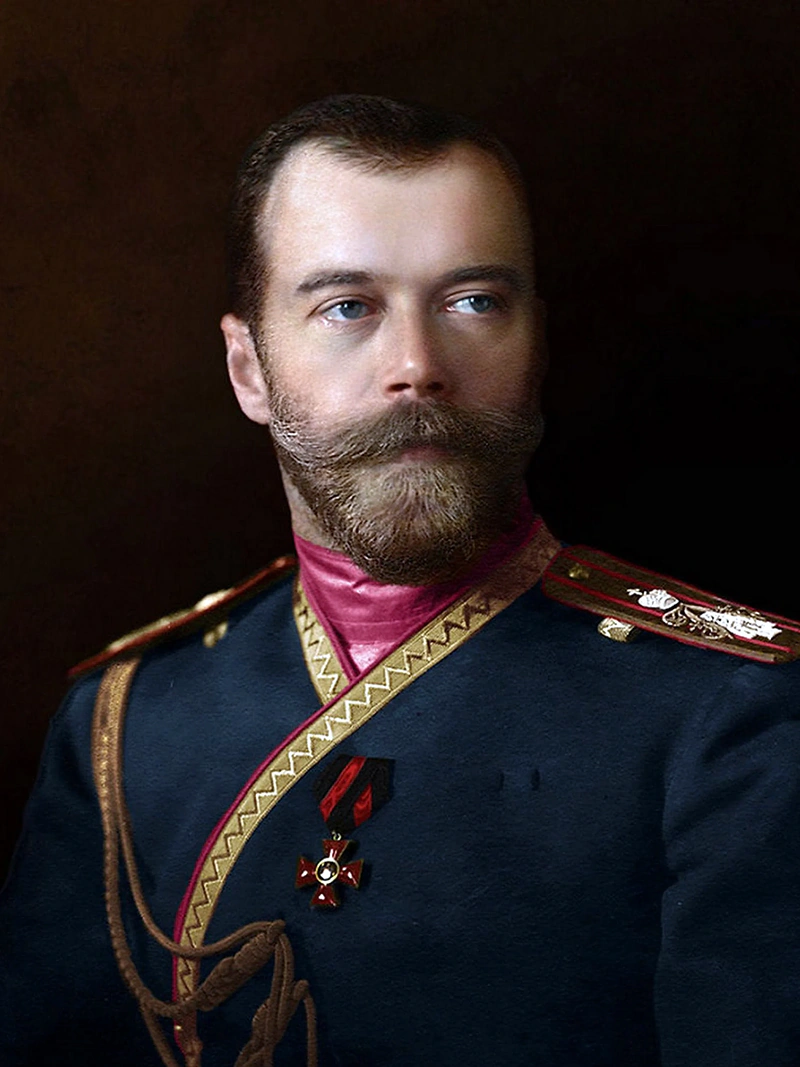
| 2 Quotes | |
| Born as | Nicholas Alexandrovich Romanov |
| Known as | Nicholas II of Russia |
| Occup. | Royalty |
| From | Russia |
| Born | May 18, 1868 Tsarskoye Selo (now Pushkin), Russian Empire |
| Died | July 17, 1918 Ipatiev House, Yekaterinburg, Russian SFSR |
| Cause | Executed by Bolsheviks |
| Aged | 50 years |
| Cite | |
Citation Formats
APA Style (7th ed.)
Nicholas ii biography, facts and quotes. (2026, February 11). FixQuotes. https://fixquotes.com/authors/nicholas-ii/
Chicago Style
"Nicholas II biography, facts and quotes." FixQuotes. February 11, 2026. https://fixquotes.com/authors/nicholas-ii/.
MLA Style (9th ed.)
"Nicholas II biography, facts and quotes." FixQuotes, 11 Feb. 2026, https://fixquotes.com/authors/nicholas-ii/. Accessed 26 Mar. 2026.
Early Life and Background
Nicholas Alexandrovich Romanov was born 1868-05-18 at Tsarskoye Selo near St. Petersburg into the late-imperial splendor and anxiety of the House of Romanov. His father, Alexander III, had reacted to the assassination of Alexander II with a program of autocratic consolidation, tightened policing, and suspicion of constitutional experiment. Nicholas grew up amid that recoil - an empire stretching from Poland to the Pacific, industrializing unevenly, and riven by peasant poverty, rising labor unrest, and nationalist movements that challenged the idea of a single, Orthodox, autocratic state.The young heir was personally gentle, conscientious, and private, formed by a court culture that prized restraint and duty over self-revelation. Yet the setting was never merely ceremonial: the regime relied on the mystique of the throne, and the heir was trained to be the vessel of that mystique. In 1894, as Alexander III died unexpectedly, Nicholas inherited not only a crown but a political theology of personal rule that left little room for apprenticeship by error.
Education and Formative Influences
Nicholas was educated at home by tutors in languages, history, law, and military subjects, with a strong emphasis on Orthodoxy and dynastic responsibility. Konstantin Pobedonostsev, Ober-Procurator of the Holy Synod and a key conservative ideologue, helped fix the moral grammar of Nicholas's world: suspicion of parliamentarism, faith in paternal rule, and fear that political openness would dissolve the empire. Military service and travel within Russia familiarized him with ceremony and command, but the training was narrow for the scale of crisis that modern mass politics would soon impose.Career, Major Works, and Turning Points
Nicholas became Tsar in 1894 and married Princess Alix of Hesse (Empress Alexandra Feodorovna), binding his private life tightly to a marriage of intense mutual loyalty. Early reign symbolism - including the Khodynka Field tragedy during the 1896 coronation festivities, when mass crowding led to over a thousand deaths - shadowed his image as fatefully unlucky. Under Sergei Witte, industrial growth accelerated and Russia pursued great-power aims, but the Russo-Japanese War ended in humiliating defeat (1904-1905), igniting the Revolution of 1905. Nicholas conceded the October Manifesto and the creation of the Duma, then repeatedly curtailed its power, preserving autocracy in form while hollowing the experiment in representation. World War I magnified every weakness: supply breakdowns, staggering casualties, and political paralysis. In 1915 he took personal command at the front, leaving the capital to Alexandra and the discrediting influence of Grigori Rasputin; by February 1917, strikes and mutiny forced his abdication. Held first by the Provisional Government and then by the Bolsheviks, Nicholas and his family were executed at Yekaterinburg on 1918-07-17.Philosophy, Style, and Themes
Nicholas's inner life was marked by a painful mismatch between temperament and office. His diaries and correspondence reveal a man who sought harmony, family routine, and spiritual reassurance, yet was trapped in a system that demanded decisive political imagination. The most revealing self-assessment attributed to him is blunt: “I am not yet ready to be Tsar. I know nothing of the business of ruling”. Whether spoken in private shock at accession or preserved through later recollection, it fits a pattern - he leaned on inherited formulas of duty and on intimate counsel rather than building a modern apparatus of persuasion and compromise.His governing style favored sincerity over strategy: he could be personally courteous while making fateful, isolating choices, interpreting opposition less as a constituency to manage than as a moral violation of sacred order. That moral lens hardened under stress. The empire's violence - from repression after 1905 to wartime collapse - pressed him toward fatalism, and the bleak sentence “There is no justice among men”. captures the despairing edge of his worldview when events refused to honor his sense of providence. In that psychological space, steadfastness became indistinguishable from rigidity: he clung to autocracy not only as policy, but as an identity that made his personal sacrifices meaningful.
Legacy and Influence
Nicholas II endures as a tragic hinge between imperial Russia and the Soviet century: to critics, the last Romanov embodies indecision, misrule, and the catastrophic refusal to share power; to admirers, he is a devoted husband and father destroyed by revolution and war. The execution of the imperial family became a potent symbol in emigre memory and later in post-Soviet Russia, where the Russian Orthodox Church canonized Nicholas and his family as passion-bearers in 2000. His reign remains a case study in how personal character, institutional design, and historical acceleration can converge into collapse - and how the private virtues of a man can be politically insufficient when an empire demands transformation.Our collection contains 2 quotes written by Nicholas, under the main topics: Justice - Leadership.
Other people related to Nicholas: Pope Gregory VII (Clergyman)