
Nikita Khrushchev Biography Quotes 31 Report mistakes
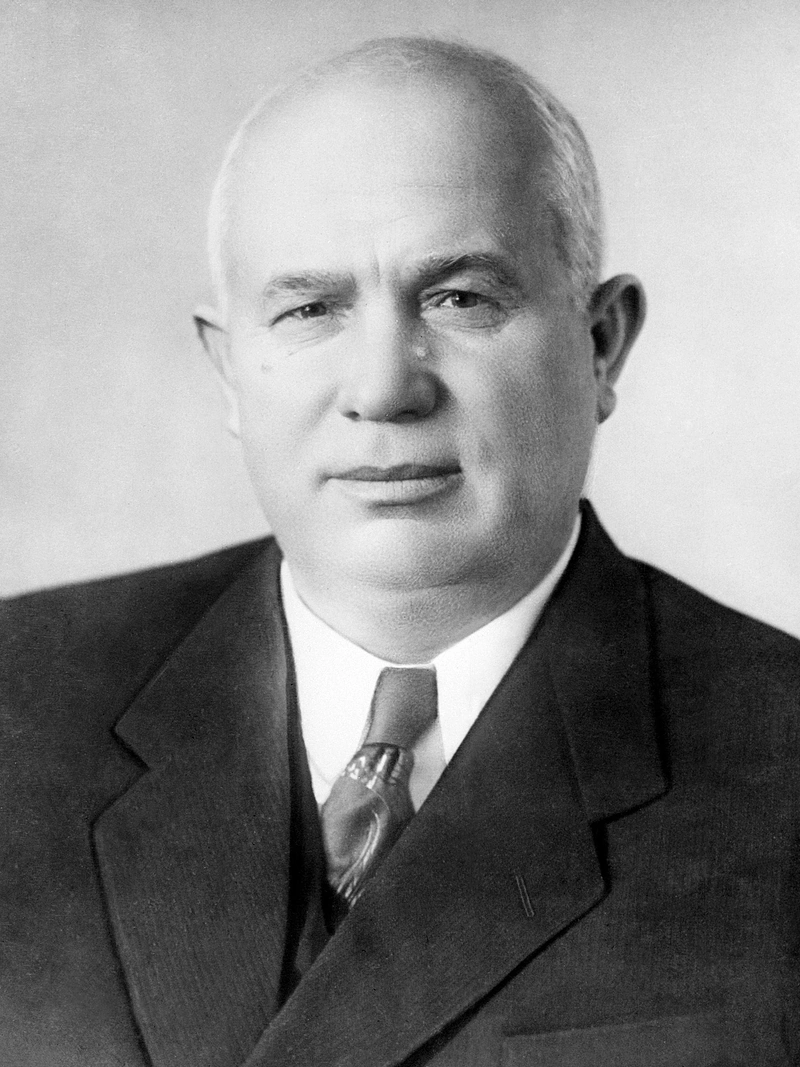
Attr: TASS, Public domain
| 31 Quotes | |
| Born as | Nikita Sergeyevich Khrushchev |
| Occup. | Statesman |
| From | Russia |
| Born | April 17, 1894 Kalinovka, Kursk Governorate, Russian Empire |
| Died | September 11, 1971 Moscow, Russia |
| Cause | heart attack |
| Aged | 77 years |
| Cite | |
Citation Formats
APA Style (7th ed.)
Nikita khrushchev biography, facts and quotes. (2026, February 11). FixQuotes. https://fixquotes.com/authors/nikita-khrushchev/
Chicago Style
"Nikita Khrushchev biography, facts and quotes." FixQuotes. February 11, 2026. https://fixquotes.com/authors/nikita-khrushchev/.
MLA Style (9th ed.)
"Nikita Khrushchev biography, facts and quotes." FixQuotes, 11 Feb. 2026, https://fixquotes.com/authors/nikita-khrushchev/. Accessed 25 Mar. 2026.
Early Life and Background
Nikita Sergeyevich Khrushchev was born on April 17, 1894, in Kalinovka, Kursk Governorate, a poor village on the western edge of the Russian Empire. His family were peasants with the thin margins and seasonal hunger typical of late-tsarist rural life; the world he entered was one of land shortage, debt, and a widening gulf between village custom and the disruptive pull of industry. That social pressure pushed the young Khrushchev early into wage labor, and it gave him a lifelong, almost visceral, suspicion of privilege and a performer-politician's feel for the resentments of ordinary people.As a teenager he moved with his family to the Donbas, the coal-and-steel basin of the empire, and found work amid the smoke and discipline of the mines and factories around Yuzovka (later Stalino, now Donetsk). There the Revolution of 1917 was not an abstract doctrine but a struggle over bread, authority, and survival, and Khrushchev's political identity formed in workshops and barracks rather than salons. He joined the Bolsheviks in 1918 during the Civil War period and served the new order as a political worker, learning the essentials of Soviet power at the ground level: loyalty, organization, and a talent for reading the wind before it became a storm.
Education and Formative Influences
Khrushchev had little formal schooling, but he pursued the party's ladder of education and promotion, including training at the Stalin Industrial Academy in Moscow in the late 1920s, a setting where technical ambition and ideological conformity fused. His formative influences were less books than patrons and institutions: Lazar Kaganovich's machine in Moscow politics, the culture of the Communist Party as a career structure, and the brutal lessons of Stalinism in the 1930s, when advancement and personal safety often depended on anticipating the center's demands. He absorbed Marxist-Leninist vocabulary, but more importantly he internalized how policy, fear, and patronage actually worked inside a one-party state.Career, Major Works, and Turning Points
Rising through the Ukrainian party apparatus, Khrushchev became First Secretary of the Communist Party in Ukraine, survived the Great Purge years in positions of authority, and played a senior role during World War II as a political commissar and party leader during the defense and recovery of key fronts and cities. After Stalin's death in March 1953, he maneuvered against rivals and consolidated power, becoming First Secretary in 1953 and, by 1958, Chairman of the Council of Ministers as well. His defining turning point was the 20th Party Congress in February 1956, when he delivered the "Secret Speech" condemning Stalin's cult of personality and terror, launching de-Stalinization and a partial thaw. The era also carried sharp contradictions: ambitious domestic campaigns like the Virgin Lands project and a push to raise living standards, alongside crises that shook the world - the crushing of the Hungarian uprising in 1956, the Berlin confrontation, and the Cuban Missile Crisis of 1962, which brought the superpowers to the brink before a negotiated withdrawal. By 1964, after policy zigzags and elite fatigue with his improvisational style, he was removed in a party coup led by Leonid Brezhnev and others, and he spent his final years in enforced political retirement, dying on September 11, 1971, in Moscow.Philosophy, Style, and Themes
Khrushchev's inner life was a braid of peasant shrewdness, revolutionary faith, and a survivor's instinct formed in an atmosphere where politics could turn lethal overnight. His blunt, earthy language was not theater alone; it was a worldview that treated power as a habitat with its own rules. “If you live among wolves you have to act like a wolf”. The sentence reads like autobiography: a man who rose under Stalin, who had watched comrades vanish, and who concluded that moral purity without tactical hardness was simply another road to defeat.At the same time, he was not a cynic in the simple sense. He believed the system could be made to work better - less terror, more consumption, more legitimacy - and he spoke as a manager of material constraints. “Economics is a subject that does not greatly respect one's wishes”. That pragmatism informed both his reforms and his failures: he could admit shortages and bottlenecks, yet he often tried to out-run them with administrative reorganizations and headline campaigns. His international posture mixed genuine fear of nuclear war with combative bravado, a paradox captured in the grim arithmetic of deterrence: “The more bombers, the less room for doves of peace”. The Khrushchev theme, again and again, was the attempt to humanize an inhumane inheritance without surrendering the empire of ideology that made him.
Legacy and Influence
Khrushchev left a divided legacy: he helped break the spell of Stalin's infallibility and opened space - however limited - for cultural and intellectual thaw, rehabilitation of many victims, and a less terror-saturated party life; yet he also reaffirmed the party's monopoly, used force to hold the bloc together, and demonstrated how reform from above could lurch between candor and coercion. Internationally, the Cuban Missile Crisis established a template for crisis management and direct superpower communication even as it exposed the dangers of personal brinkmanship. For later Soviet leaders, he became both warning and precedent: proof that change was possible, and proof that unstable improvisation could provoke backlash. In the broader 20th century narrative, Khrushchev remains the face of post-Stalin transition - a man trying to steer a nuclear superpower with a miner's instincts, an ideologue's certainties, and an acute awareness that the wolves were never far away.Our collection contains 31 quotes written by Nikita, under the main topics: Witty One-Liners - Ethics & Morality - Truth - Wisdom - Justice.
Other people related to Nikita: Richard M. Nixon (President), Valentina Tereshkova (Astronaut), Andrei Sakharov (Physicist), Yuri Gagarin (Astronaut), Daniel Schorr (Journalist), Leonid I. Brezhnev (Statesman), U Thant (Statesman)