
Noam Chomsky Biography Quotes 29 Report mistakes
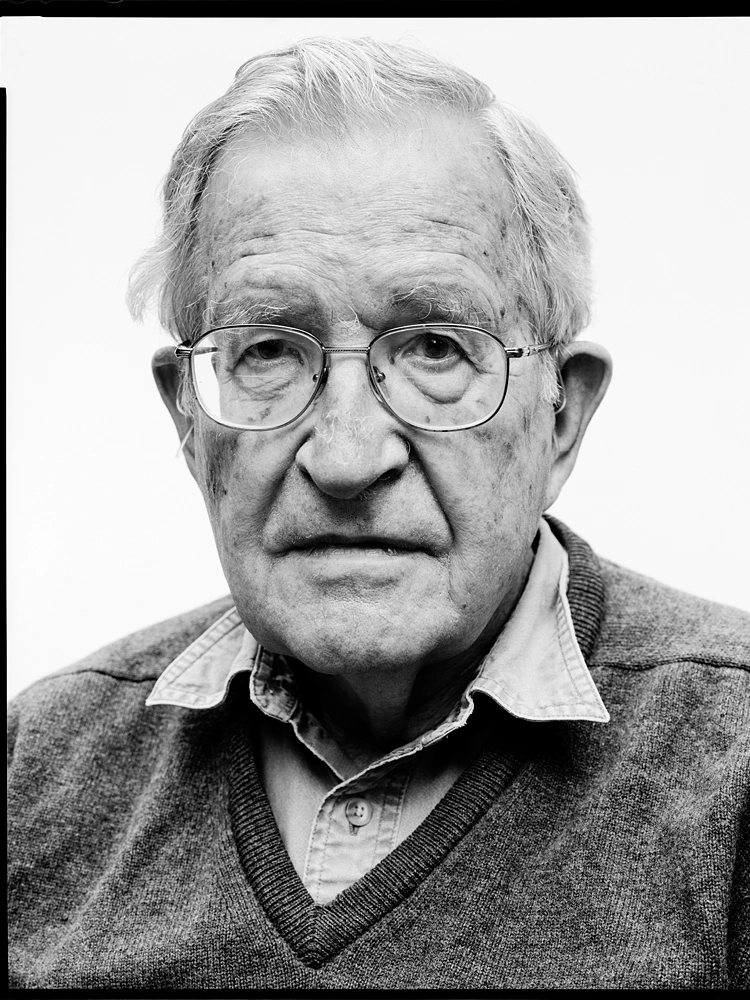
| 29 Quotes | |
| Born as | Avram Noam Chomsky |
| Occup. | Activist |
| From | USA |
| Born | December 7, 1928 Philadelphia, Pennsylvania, United States |
| Age | 97 years |
| Cite | |
Citation Formats
APA Style (7th ed.)
Noam chomsky biography, facts and quotes. (2026, February 11). FixQuotes. https://fixquotes.com/authors/noam-chomsky/
Chicago Style
"Noam Chomsky biography, facts and quotes." FixQuotes. February 11, 2026. https://fixquotes.com/authors/noam-chomsky/.
MLA Style (9th ed.)
"Noam Chomsky biography, facts and quotes." FixQuotes, 11 Feb. 2026, https://fixquotes.com/authors/noam-chomsky/. Accessed 1 Apr. 2026.
Early Life and Background
Avram Noam Chomsky was born on December 7, 1928, in Philadelphia, Pennsylvania, into a Jewish immigrant milieu shaped by languages, labor politics, and the aftershocks of European catastrophe. His father, William (Zev) Chomsky, a Hebrew scholar from what is now Belarus, and his mother, Elsie (Simonofsky) Chomsky, instilled in him an early sense that words were never merely private - they were civic instruments and historical inheritances. The household valued books, argument, and ethical obligation, a temperament reinforced by the Philadelphia of his youth: a city of factories and unions, but also of entrenched segregation and class hierarchy.Chomsky later recalled himself as an unusually early political reader and writer, drawn to anti-fascist and anti-authoritarian currents rather than to party loyalties. As a teenager during World War II and the dawn of the Cold War, he watched public fear become policy and propaganda become normal speech. That formative contrast - between the declared ideals of democracy and the everyday operations of power - would become the emotional engine of his adult life: a moral impatience with cruelty made bureaucratic, and a suspicion of soothing narratives offered by states, media, and intellectuals.
Education and Formative Influences
He entered the University of Pennsylvania in 1945, initially drifting through philosophy and linguistics before finding mentors who sharpened both his formal rigor and his heterodox instincts: most notably the linguist Zellig Harris, whose structural methods and left political commitments offered a model of scholarship without deference. Chomsky also encountered the older anarchist tradition through reading and discussion, absorbing a view of freedom as a practice rooted in institutions - schools, workplaces, parties, media - not a slogan. Graduate study at Penn culminated in a doctoral dissertation that helped set the stage for his later break with behaviorism, and in 1955 he joined the Massachusetts Institute of Technology, where the postwar alliance among government, industry, and research formed an ironic backdrop for a scholar who would become one of America's most famous internal critics.Career, Major Works, and Turning Points
At MIT Chomsky ignited a revolution in linguistics and cognitive science: Syntactic Structures (1957) and Aspects of the Theory of Syntax (1965) argued that language is underwritten by an innate generative capacity, shifting the field away from stimulus-response accounts of learning and toward a mind-centered theory of grammar. His 1959 review of B.F. Skinner's Verbal Behavior became a turning point, widely read as a demolition of behaviorism's explanatory reach. In parallel, the Vietnam War pushed him into visible dissent - essays later collected in American Power and the New Mandarins (1969) framed U.S. intervention as systematic, not accidental. Across decades he paired technical work (including The Minimalist Program, 1995) with political analysis such as Manufacturing Consent (1988, with Edward S. Herman), creating an unusual public profile: a leading academic who treated imperial violence, propaganda, and institutional design as topics requiring the same cold clarity as syntax.Philosophy, Style, and Themes
Chomsky's inner life, as it emerges across interviews and essays, is governed by two commitments that rarely coexist so stubbornly: a faith in human creativity and a refusal to romanticize institutions. His linguistics treats the mind as structured but not scripted - a set of constraints that enables freedom. The famous sentence “Colorless green ideas sleep furiously”. was not a joke but a scalpel: it showed that grammatical well-formedness and meaningfulness are distinct, implying an internal generative system that cannot be reduced to habit. From that base he built a broader moral argument: if humans can generate and judge novel expressions, they are not the passive clay of power.His politics extends the same logic to civic life: he insists that accountability must run upward, toward concentrated authority, and that the comforting language of virtue often masks coercion. “States are not moral agents, people are, and can impose moral standards on powerful institutions”. That sentence captures both his severity and his hope - severity toward institutional excuses, hope in ordinary agency. Chomsky's tone is famously plain, almost prosecutorial, but psychologically it reads as a form of self-discipline: a refusal to let outrage become theater. He distrusts intellectual glamour and treats dissent as a duty rather than an identity, crystallized in the provocation, “The intellectual tradition is one of servility to power, and if I didn't betray it I'd be ashamed of myself”. The line is less boast than confession: he sees comfort as the true seduction, and work as the antidote.
Legacy and Influence
Chomsky's enduring influence is double and mutually reinforcing. In the sciences of mind, his generative approach helped found modern linguistics and reshaped psychology, philosophy of language, and AI debates by forcing serious theories of internal structure and competence. In public life, he became a benchmark for adversarial citizenship, modeling how a scholar can interrogate war, media, and elite consensus without outsourcing judgment to party, nation, or credential. Admirers cite his moral consistency; critics accuse him of ideological blindness - but even critics often argue on terrain he helped define: propaganda, institutional incentives, and the gap between professed ideals and operational policy. Few figures have so persistently joined technical brilliance to moral witness, and fewer still have made that conjunction feel, to so many readers, like intellectual hygiene rather than mere radicalism.Our collection contains 29 quotes written by Noam, under the main topics: Ethics & Morality - Truth - Justice - Writing - Freedom.
Other people related to Noam: Steven Pinker (Scientist), Robert McChesney (Critic), Chris Hedges (Journalist)