
Odd Nerdrum Biography Quotes 3 Report mistakes
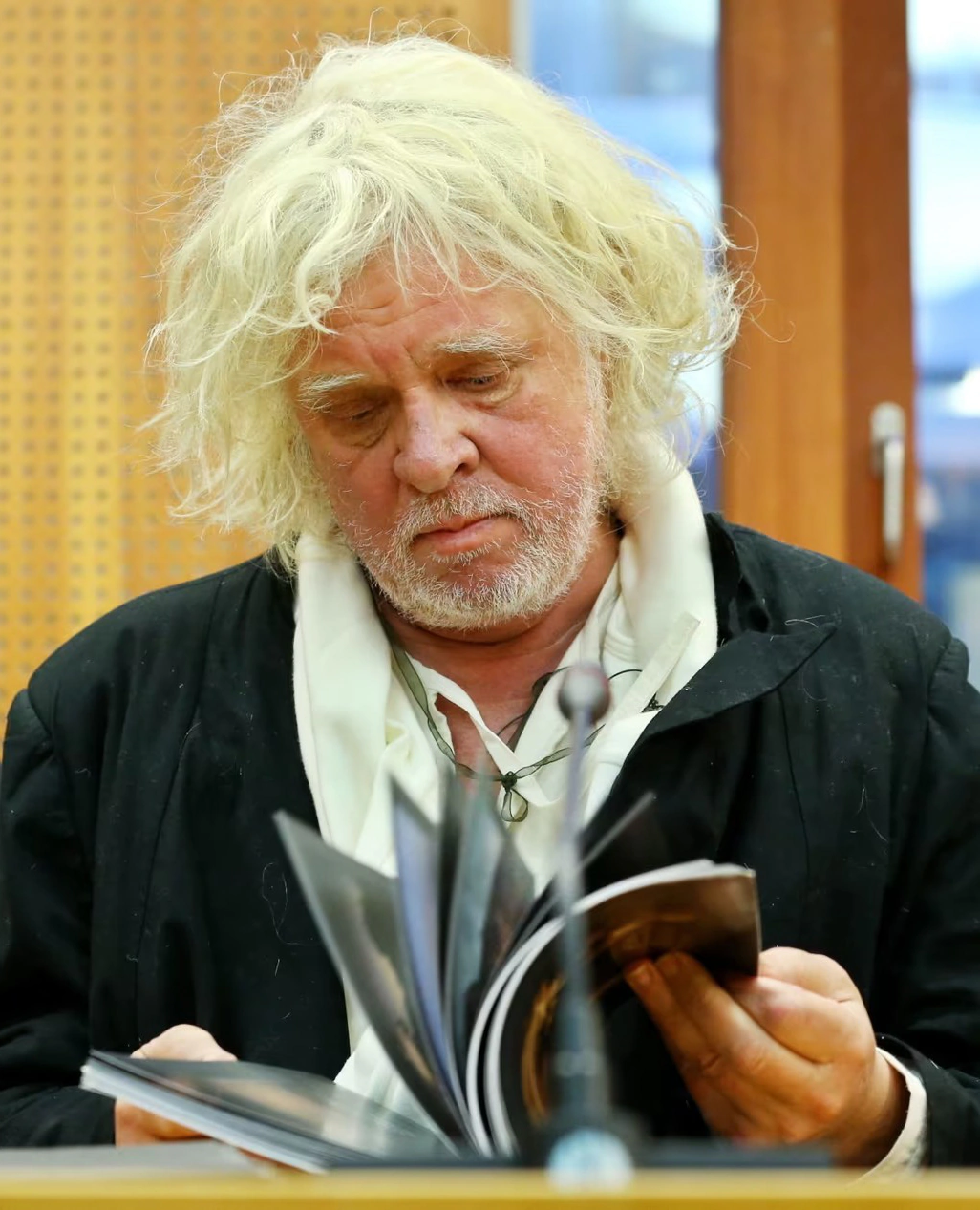
| 3 Quotes | |
| Occup. | Painter |
| From | Norway |
| Born | April 8, 1944 Helsingborg, Sweden |
| Age | 81 years |
| Cite | |
Citation Formats
APA Style (7th ed.)
Odd nerdrum biography, facts and quotes. (2026, February 11). FixQuotes. https://fixquotes.com/authors/odd-nerdrum/
Chicago Style
"Odd Nerdrum biography, facts and quotes." FixQuotes. February 11, 2026. https://fixquotes.com/authors/odd-nerdrum/.
MLA Style (9th ed.)
"Odd Nerdrum biography, facts and quotes." FixQuotes, 11 Feb. 2026, https://fixquotes.com/authors/odd-nerdrum/. Accessed 22 Mar. 2026.
Early Life and Background
Odd Nerdrum was born on April 8, 1944, in Norway, into a country emerging from occupation and rationing into the anxious calm of the early Cold War. He grew up amid the postwar promise of Scandinavian social democracy, where public culture increasingly favored modernism as the visual language of progress. Against that backdrop, his later insistence on figurative painting would read not as nostalgia but as dissent - a refusal to accept that the human body, myth, and craft had been made obsolete by theory.His family life was marked by complexity and an early sense of being out of joint with his surroundings, a psychological stance that would later surface in his paintings as solitary figures, shipwrecked communities, and mute confrontations. Norway in the 1950s and 1960s offered safety and institutional stability, yet for an artist inclined toward existential drama, it could feel airless. Nerdrum absorbed the tension between a society confident in consensus and his own pull toward older, darker narratives where fate, shame, tenderness, and survival remain unresolved.
Education and Formative Influences
Nerdrum trained at the Norwegian Academy of Fine Arts in Oslo in the 1960s, where modernist currents were dominant and where the moral prestige of abstraction and conceptual approaches often came bundled with skepticism toward traditional technique. He reacted by turning decisively toward the Old Masters - especially Rembrandt, whose chiaroscuro and psychological compression became a lifelong touchstone - and by seeking instruction and looking abroad to study painterly method at close range. The formative influence was not only stylistic but ethical: he came to treat oil painting as a discipline of attention, a way to build meaning through flesh, light, and time rather than through manifestos.Career, Major Works, and Turning Points
From the late 1960s onward, Nerdrum established himself as a provocative figurative painter, first known in Norway through controversial public attention and then internationally through exhibitions and a devoted circle of students. Works such as The Murder of Andreas Baader (1977-78) brought political and psychological violence into a style indebted to Baroque realism, refusing the era's neat separation between "contemporary content" and "historic technique". Over the following decades he developed an increasingly post-apocalyptic iconography - ragged figures, scavenged objects, firelit gatherings, maternal scenes, and staged rituals - painted with heavy impasto and a warm, grave palette. A turning point came with his explicit embrace of "kitsch" as a counter-category to modern art, culminating in his public arguments and his book On Kitsch, and with the growth of a studio-based pedagogy that made him not only a painter but a leader of an alternative tradition.Philosophy, Style, and Themes
Nerdrum's inner life is legible in his suspicion of art-world language and his faith in craft as confession. “You cannot sit down and write about your own paintings. You have to paint them. That's the only way to express what you really feel”. The remark doubles as a psychological self-portrait: he treats speech as inadequate, even evasive, and painting as the one arena where he can risk sincerity without rhetoric. In his studio practice, this becomes a kind of moral austerity - repeated sittings, slow construction, and a preference for tangible problems (skin, shadow, weight) over intellectual posture.His most debated idea is his reclamation of kitsch as a value category. “I am a kitsch painter. It means that I am working on human reactions, and I have found out that I am not alone”. In Nerdrum's hands, "kitsch" is not sentimentality but an insistence on shared emotional reflexes: fear of abandonment, hunger for protection, the longing to be seen. That is why his canvases often feel like dreams remembered from before language - tableaux in which the figures huddle, accuse, mourn, or cradle one another under an indifferent sky. The ethic behind this is stubborn perseverance: “The only thing I can say to young painters is that they should just continue painting no matter what. Because it's not about success or money. It's about following the path you believe in”. Read against his own career-long quarrel with orthodox modernism, the line becomes less advice than self-justification: endurance as a form of freedom.
Legacy and Influence
Odd Nerdrum's enduring influence lies in reopening a door many institutions tried to close: that serious contemporary painting can be figurative, technically rigorous, and spiritually ambitious without apologizing to modernist doctrine. He helped legitimize atelier methods for a new generation, not as academic revivalism but as an insurgent practice, and his students and admirers have carried forward his emphasis on drawing, controlled light, and the primacy of the human figure. His "kitsch" thesis continues to provoke, but the larger legacy is clearer: he made craft into a philosophical position, and he gave late-20th- and early-21st-century viewers an alternative canon where vulnerability, mortality, and tenderness are painted at full scale.Our collection contains 3 quotes written by Odd, under the main topics: Art.
Source / external links