
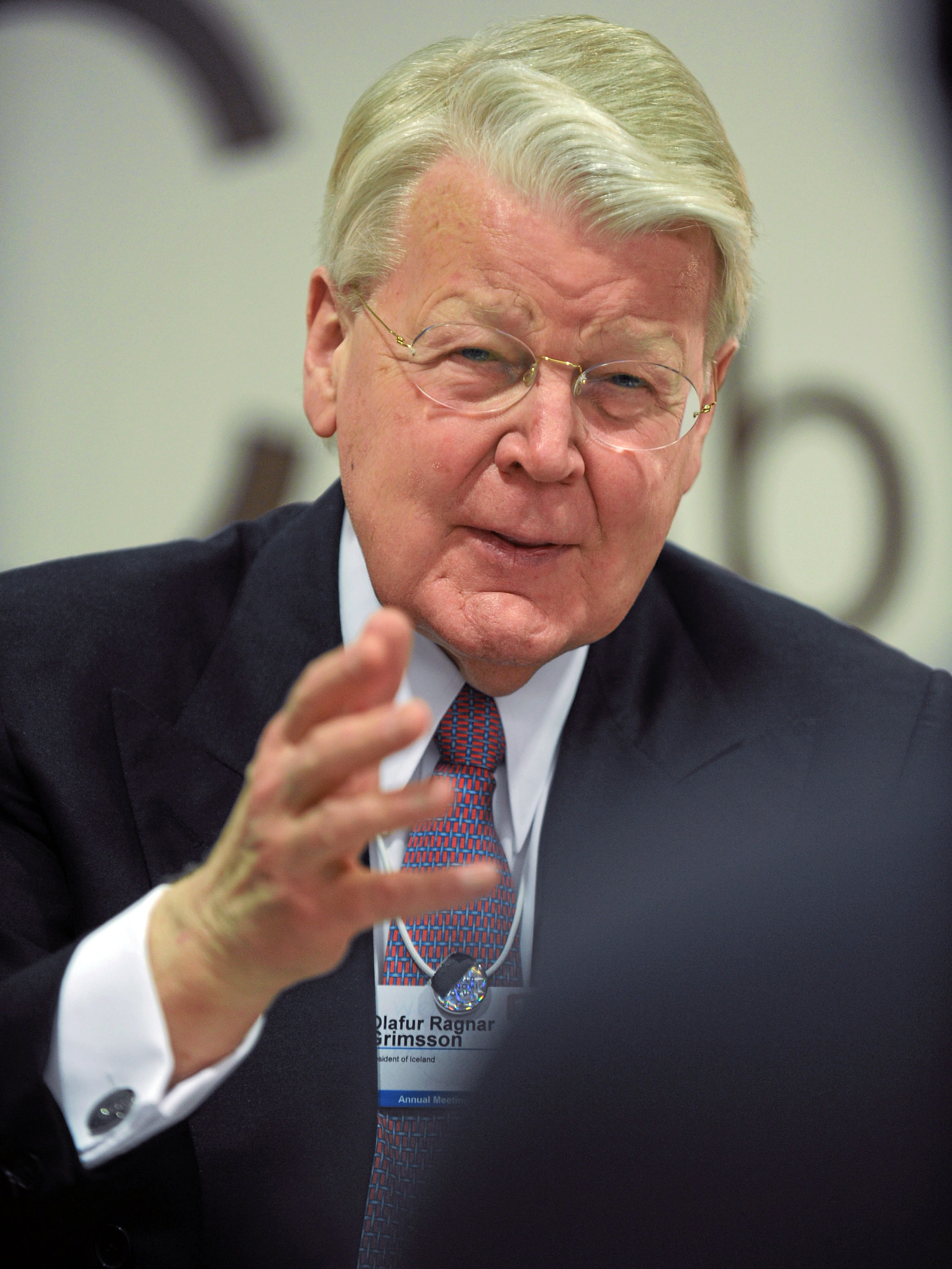
Ólafur Ragnar Grímsson Biography Quotes 8 Report mistakes
| 8 Quotes | |
| Occup. | President |
| From | Iceland |
| Spouses | Guðrún Katrín Þorbergsdóttir Dorrit Moussaieff |
| Born | May 14, 1943 Ísafjörður, Westfjords, Iceland |
| Age | 82 years |
| Cite | |
Citation Formats
APA Style (7th ed.)
Ólafur ragnar grímsson biography, facts and quotes. (2026, March 15). FixQuotes. https://fixquotes.com/authors/olafur-ragnar-grimsson/
Chicago Style
"Ólafur Ragnar Grímsson biography, facts and quotes." FixQuotes. March 15, 2026. https://fixquotes.com/authors/olafur-ragnar-grimsson/.
MLA Style (9th ed.)
"Ólafur Ragnar Grímsson biography, facts and quotes." FixQuotes, 15 Mar. 2026, https://fixquotes.com/authors/olafur-ragnar-grimsson/. Accessed 6 Apr. 2026.
Early Life and Background
Olafur Ragnar Grimsson was born on May 14, 1943, in Isafjordur, in Iceland's Westfjords, a remote region where weather, sea routes, and fish stocks shaped daily existence more forcefully than abstract ideology. He grew up in a small republic that had only recently become fully sovereign, in 1944, and his generation inherited both the pride and insecurity of a young nation situated between Europe and North America, tradition and modernization. His parents, Grimur Kristgeirsson and Sigridur Olafsdottir, were educated, civically engaged people, and the household joined learning to public purpose. From the beginning, Iceland was for him not merely a homeland but a living political experiment: a tiny democracy forced to think strategically about culture, resources, and independence.That early setting mattered. Iceland in the 1940s and 1950s was moving from a poor, semi-rural society toward urbanization, expanded education, and a more self-conscious role in world affairs, even as Cold War pressures and disputes over fishing limits kept sovereignty intensely practical. Grimsson's imagination was formed by this contrast between small scale and large consequence. The island's volcanic landscape, dependence on the sea, and eventual harnessing of geothermal and hydropower all fed a political temperament unusually alert to the links among nature, economics, and national destiny. What later appeared as presidential eloquence about climate, the Arctic, and energy security had roots in an upbringing where environment was never scenery alone - it was the framework of survival and the basis of freedom.
Education and Formative Influences
He studied political science at the University of Manchester, earning a BA and later a PhD, and those years in Britain widened both his intellectual range and his sense of Iceland's place in larger systems of power. Manchester exposed him to comparative politics, labor history, decolonization debates, and the fierce ideological arguments of postwar Europe; it also sharpened his interest in constitutional authority, party organization, and the uses of democratic legitimacy. Returning to Iceland, he taught political science at the University of Iceland and became known not only as an academic but as a public interpreter of politics. This combination - scholar, broadcaster, polemicist, nationalist critic, and modernizer - shaped the style he would carry throughout his career: analytically equipped, rhetorically forceful, and unusually willing to test the boundaries of convention in a country whose political class had often preferred restraint.Career, Major Works, and Turning Points
Grimsson entered frontline politics through the People's Alliance, the democratic socialist and left-nationalist current that drew support from anti-militarists, labor radicals, and those suspicious of concentrated financial and geopolitical power. He served in the Althing, became a prominent opposition figure, and from 1988 to 1991 was minister of finance in the government of Steingrimur Hermannsson, where he confronted the difficult arithmetic of inflation, fiscal management, and social compromise in a small vulnerable economy. In 1996 he made the decisive leap from party politics to the presidency and won, succeeding Vigdis Finnbogadottir. Over the next 20 years - re-elected in 2000, 2004, 2008, and 2012 - he transformed what had often been treated as a ceremonial office into an activist moral and constitutional platform. The defining turning point came after the 2008 financial collapse, when Iceland's oversized banking sector imploded. Grimsson refused to sign legislation tied to the Icesave dispute and sent the matter to referendum, invoking the president's reserve powers in a way that recast the office for a new era. Admirers saw democratic courage; critics saw populist constitutional theater. Either way, he became an international symbol of Iceland's struggle to recover sovereignty, legitimacy, and economic balance after catastrophe.Philosophy, Style, and Themes
At the center of Grimsson's worldview was a conviction that Iceland's experience - precarious, inventive, and ecological by necessity - had lessons for a planet entering an age of climate stress and geopolitical fragmentation. He spoke less like a ceremonial head of state than like a strategic advocate for a model of development grounded in renewable energy, public resilience, and scientific literacy. “Respect for the facts and scientific evidence has been more important than displays of political and economic power”. That sentence reveals a recurring trait in his political psychology: impatience with prestige detached from reality. His rhetoric often framed small nations as capable of moral and technological leadership precisely because they could not afford illusion. In this sense, the volcanically active, energy-conscious Iceland of his imagination became a rebuttal to grandiose but unsustainable systems.His style joined national pride to missionary persuasion. “An abundance of clean energy gives countries a strategic advantage in the 21st century global economy”. For Grimsson, energy was never only an environmental concern; it was a civilizational instrument, linked to independence, prosperity, and democratic stability. He repeatedly argued that Iceland's geothermal path offered practical hope beyond its shores: “But Iceland, as was mentioned in the introduction, can also serve as an inspiration, as an example of how to battle climate change through comprehensive transformation of our energy systems”. The insistence on example rather than abstraction is telling. He preferred demonstration to doctrine, forums to manifestos, and coalition-building across regions, which later found expression in his Arctic advocacy and in the Arctic Circle assembly he helped launch after leaving office. Beneath the public confidence was a consistent inner drive: to make a small country's hard-won adaptations count in the larger history of the century.
Legacy and Influence
Grimsson left office in 2016 as Iceland's longest-serving president, and his legacy remains double-edged in the most consequential way: he expanded the moral and political reach of the presidency while tying it more closely to public conflict and plebiscitary legitimacy. Domestically, he is remembered as the president who forced constitutional questions into the open during crisis and who gave voice to a wounded public after elite financial failure. Internationally, he became one of the most visible advocates for geothermal energy, Arctic governance, and climate realism, repositioning Iceland from North Atlantic marginality to niche influence. His after-presidency continued that pattern through global convening rather than retirement. What endures is not simply tenure but a distinct model of leadership - intellectually assertive, ecologically strategic, and rooted in the belief that small states can shape world debates when they turn vulnerability into knowledge.Our collection contains 8 quotes written by Ólafur, under the main topics: Science - Change - Vision & Strategy - Business - Thank You.
Source / external links