
Orville Wright Biography Quotes 19 Report mistakes
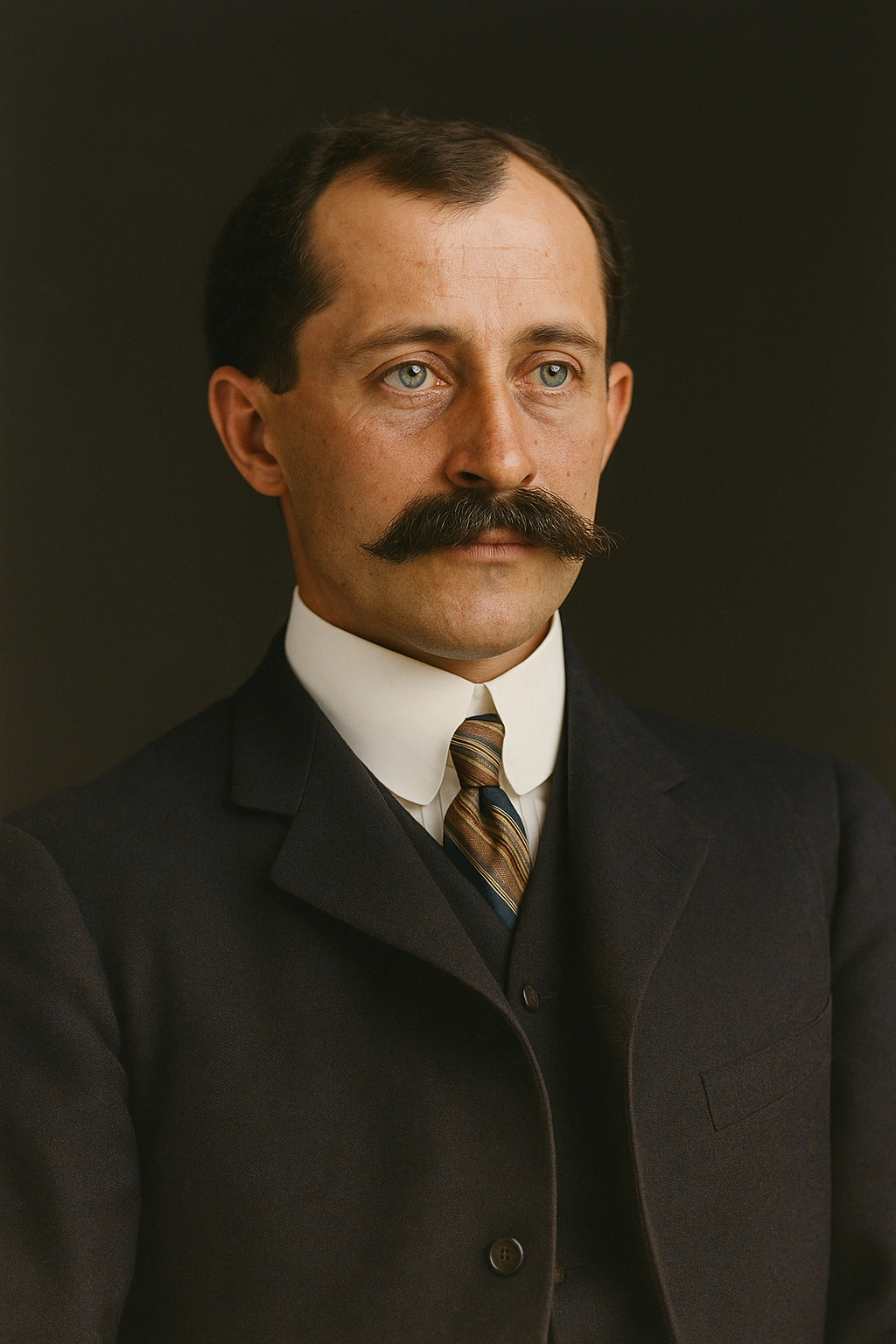
Attr: Library of Congress
| 19 Quotes | |
| Occup. | Inventor |
| From | USA |
| Born | August 19, 1871 Dayton, Ohio, United States |
| Died | January 30, 1948 Dayton, Ohio, United States |
| Cause | heart attack |
| Aged | 76 years |
| Cite | |
Citation Formats
APA Style (7th ed.)
Orville wright biography, facts and quotes. (2026, February 11). FixQuotes. https://fixquotes.com/authors/orville-wright/
Chicago Style
"Orville Wright biography, facts and quotes." FixQuotes. February 11, 2026. https://fixquotes.com/authors/orville-wright/.
MLA Style (9th ed.)
"Orville Wright biography, facts and quotes." FixQuotes, 11 Feb. 2026, https://fixquotes.com/authors/orville-wright/. Accessed 27 Mar. 2026.
Early Life and Background
Orville Wright was born August 19, 1871, in Dayton, Ohio, the younger surviving son of Bishop Milton Wright and Susan Catherine Koerner Wright. The family moved with Milton's church postings before settling again in Dayton, and the household blended strict Protestant discipline with an unusual tolerance for intellectual curiosity. Orville absorbed both: a private, stubborn independence and a taste for tinkering that his mother, mechanically adept and quietly exacting, encouraged.The Wrights grew up in the late-19th-century Midwest, where railroads, telegraph lines, and machine shops made invention feel practical rather than mythical. Orville, slighter and more reticent than his older brother Wilbur, learned early to communicate through work. The brothers formed a near-sealed partnership, shaped by family loyalty, by their sister Katharine's steady mediation, and by the era's faith that careful craft could tame modern forces.
Education and Formative Influences
Orville did not complete high school and never attended college, but he educated himself in the most American way of the Gilded Age: through tools, reading, and iterative trial. As a teenager he built printing equipment and, with Wilbur, ran the West Side News and later the Dayton Evening Item, becoming fluent in precision, deadlines, and the logic of mechanisms. In the 1890s the bicycle boom offered both income and an engineering laboratory; their Wright Cycle Company taught them balance, lightweight structures, chain-and-sprocket power transfer, and the habit of measuring everything - all foundations for flight.Career, Major Works, and Turning Points
In 1899 the brothers turned decisively to aeronautics, studying Otto Lilienthal, Octave Chanute, and Samuel Langley while refusing to outsource judgment. At Kitty Hawk, North Carolina, they refined wing-warping and three-axis control through gliders (1900-1902), then solved propulsion and structure for the 1903 Wright Flyer, achieving powered, controlled flight on December 17, 1903. The 1904-1905 Flyers at Huffman Prairie near Dayton transformed brief hops into sustained maneuvering, but secrecy and patent protection complicated public acceptance. After demonstrations in France and at Fort Myer in 1908-1909, contracts followed, as did the painful crash that killed Lt. Thomas Selfridge and injured Orville. Wilbur's death in 1912 ended the central partnership; Orville became guardian of their legacy, pursuing patents, advising the National Advisory Committee for Aeronautics, and later distancing himself from the increasingly industrialized airplane business he had helped ignite.Philosophy, Style, and Themes
Orville's mind worked like a shop - empirical, modest in tone, ruthless in revision. His accounts of the 1903 season sound less like triumphal mythology than field notes: “We left Dayton, September 23, and arrived at our camp at Kill Devil Hill on Friday, the 25th”. The plain chronology is revealing. He saw invention not as lightning, but as logistics: weather, sand, supply lines, and the stamina to return after failure. Even in moments that later generations romanticized, he emphasized procedure and fairness, as in the coin toss that assigned risk and first attempt between brothers.His deepest theme was control - the belief that flight was not primarily about engines but about managing instability. When he later quipped, “The airplane stays up because it doesn't have the time to fall”. , he was compressing a hard-won insight: lift is dynamic, contingent on speed, angles, and constant correction. And when he admitted, “The course of the flight up and down was exceedingly erratic, partly due to the irregularity of the air, and partly to lack of experience in handling this machine. The control of the front rudder was difficult on account of its being balanced too near the center”. , he exposed his psychology - an inventor who distrusted drama and instead searched for the specific misalignment, the exact source of wobble, the fix that turns terror into repeatable method.
Legacy and Influence
Orville Wright died January 30, 1948, in Dayton, living long enough to see aircraft evolve from canvas-and-spruce experiments into global instruments of commerce and war. His enduring influence lies in the Wright model of innovation: a small, interdisciplinary workshop using theory, wind-tunnel data, and rigorous testing to solve a systems problem - aerodynamics, control, propulsion, and pilot technique as one. Less publicly charismatic than many aviation pioneers, he nonetheless shaped how modern engineering speaks: in measurements, failure analysis, and the conviction that even the sky yields to patient, accountable craft.Our collection contains 19 quotes written by Orville, under the main topics: Witty One-Liners - Truth - Knowledge - Science - Technology.
Other people related to Orville: David McCullough (Historian)
Frequently Asked Questions
- Wright brothers first flight: December 17, 1903, at Kitty Hawk, North Carolina.
- Orville Wright wife: He never married.
- Orville Wright brothers: Wilbur Wright; also Reuchlin and Lorin Wright.
- Wright Brothers: Orville and Wilbur Wright, American aviation pioneers who made the first powered flight in 1903.
- Orville Wright death: January 30, 1948, in Dayton, Ohio (heart attack).
- Wilbur Wright: Orville’s older brother and co‑inventor of the airplane (1867–1912).
- How old was Orville Wright? He became 76 years old
Source / external links