
Orville Wright Biography Quotes 19 Report mistakes
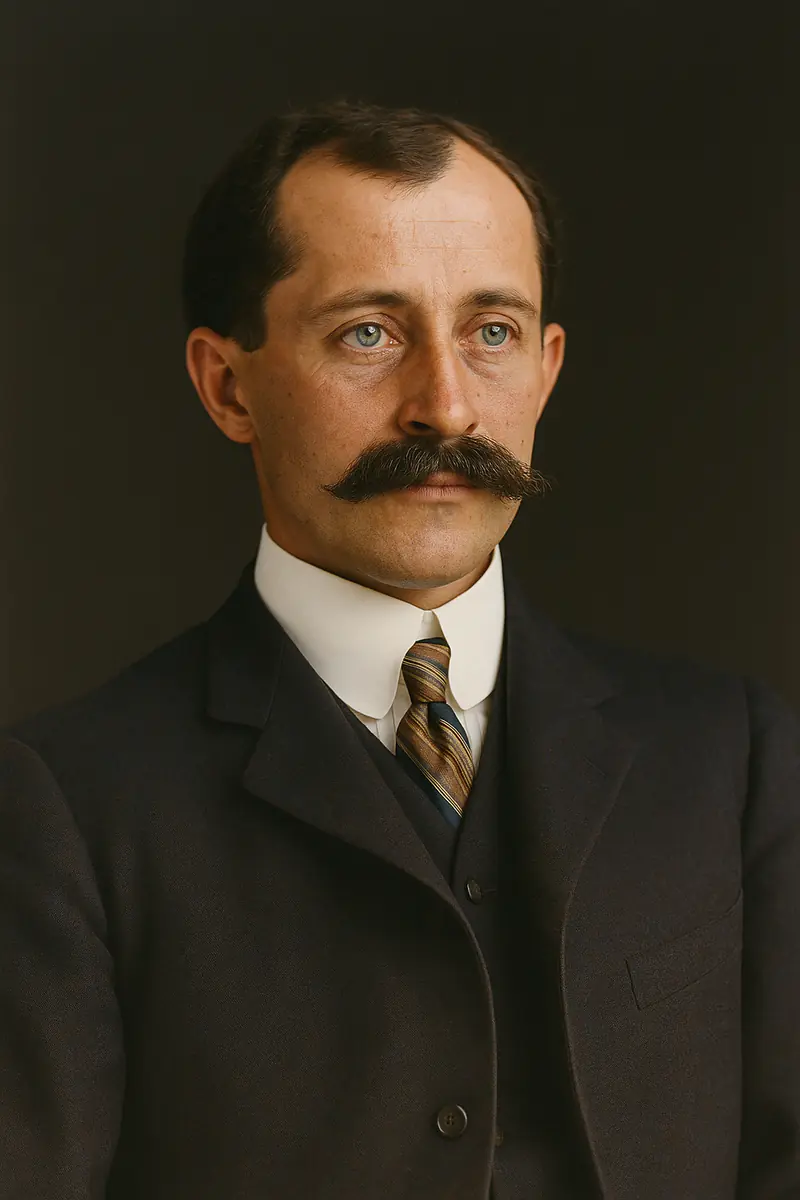
Attr: Library of Congress
| 19 Quotes | |
| Occup. | Inventor |
| From | USA |
| Born | August 19, 1871 Dayton, Ohio, United States |
| Died | January 30, 1948 Dayton, Ohio, United States |
| Cause | heart attack |
| Aged | 76 years |
Orville Wright was born on August 19, 1871, in Dayton, Ohio, the son of Milton Wright, a United Brethren bishop known for his independent mind, and Susan Catherine Koerner Wright, a mechanically adept mother who made toys and household devices for her children. The household prized reading, craftsmanship, and discussion. Among Orville's siblings, Wilbur Wright became his closest collaborator, while their sister Katharine Wright provided crucial emotional steadiness and organizational help throughout their adult lives. Brothers Lorin and Reuchlin were part of the extended family network that sustained the Wrights in Dayton.
From Printing and Bicycles to Aeronautics
As a teenager, Orville showed a gift for design and enterprise. He started a small printing business, building his own press and producing the West Side News. In Dayton's vibrant literary community, he befriended poet Paul Laurence Dunbar, and Orville's shop printed some of Dunbar's early work, including the short-lived Dayton Tattler. By 1892 Orville and Wilbur opened a bicycle sales and repair shop that became the Wright Cycle Company. They designed and manufactured their own lines of bicycles and used the proceeds, tools, and machine skills from the shop as a foundation for their experiments in flight. The shop also became a workshop where ideas about steering, balance, and structural efficiency matured.
Learning to Fly: Gliders and the Wind Tunnel
Encouraged by reading accounts of Otto Lilienthal's glides and by correspondence with the civil engineer and aviation advocate Octave Chanute, Orville and Wilbur turned systematically to aeronautics in 1899, 1900. They studied the problem not as a stunt but as a science of control. After early glider tests at Kitty Hawk, North Carolina, in 1900 and 1901, the brothers confronted unexpected aerodynamic behavior. This led Orville to build, with Wilbur, a small wind tunnel in Dayton in 1901. Using carefully crafted balances and hundreds of tested wing shapes, they produced reliable data on lift and drag, corrected errors in published tables, and clarified how to couple yaw, pitch, and roll. Their idea of wing warping for roll control, combined with a movable rudder to harmonize turns, and an adjustable elevator for pitch, framed their approach to three-axis control.
First Powered Flights at Kitty Hawk
Power was the next hurdle. With no suitable engine available, the brothers turned to their machinist, Charles E. Taylor, who designed and built a lightweight gasoline engine in the bicycle shop. On December 17, 1903, near Kitty Hawk, Orville made the first controlled, sustained flight of a powered, heavier-than-air machine. He flew 120 feet in 12 seconds. The brothers made four flights that day; the last, by Wilbur, covered 852 feet in 59 seconds before a gust damaged the Flyer. The achievement rested as much on control and propeller design as on power; Orville and Wilbur had devised efficient, twisted propellers based on their own theory rather than treating them as mere screws.
Perfecting the Airplane at Huffman Prairie
Back in Ohio at Huffman Prairie in 1904, 1905, they transformed a breakthrough into a practical craft. Orville and Wilbur taught themselves to take off, circle, and land repeatedly, eventually flying figure-eights with the 1905 Flyer III. These were not public spectacles but disciplined tests, refining responses to gusts and perfecting coordinated turns. The brothers alternated as pilot and ground crew, sharing insights and dividing tasks in ways that made their partnership unusually productive.
Public Demonstrations, Triumph and Tragedy
By 1908, 1909 the Wrights demonstrated their airplanes to the United States Army and to European audiences. In France, Wilbur captivated observers with precise banked turns and extended flights, while Orville's U.S. Army trials at Fort Myer, Virginia, showed the military potential of the machine. During those trials in September 1908, a propeller failure caused a crash that killed passenger Lieutenant Thomas E. Selfridge and seriously injured Orville. He recovered and resumed flying, and demonstrations continued. Honors, contracts, and international acclaim followed, with Katharine joining her brothers in Europe and helping manage a demanding schedule of negotiations and public appearances.
Business, Patents, and Controversies
To protect and commercialize their work, the brothers secured a U.S. patent in 1906 covering their method of control. The Wright Company was formed in 1909, with Wilbur as president and Orville as a principal engineer and director. After Wilbur's death from typhoid in 1912, leadership burdens fell heavily on Orville. He became the custodian of the partnership's technical reputation, pursuing infringement suits during the contentious patent wars that pitted the Wrights against competitors such as Glenn Curtiss. The disputes reflected more than pride; they turned on fundamental questions of what constituted the essence of an airplane and how innovation should be rewarded. With the onset of World War I, the U.S. government encouraged a patent pool in 1917 to ease production, effectively ending the fiercest legal battles.
Orville sold his interest in the Wright Company in 1915, stepping away from daily corporate management. Although no longer a manufacturer, he remained a respected authority, consulting on technical issues and evaluating new designs. His voice carried weight in debates about safety, research priorities, and the preservation of accurate historical records.
Public Service and the Smithsonian Dispute
Orville's later public service centered on research and standards. He served for decades on the National Advisory Committee for Aeronautics, where his practical experience balanced academic theory and industrial ambition. He pressed for methodical testing and for policies that would keep aeronautics a disciplined science.
His most protracted controversy involved the Smithsonian Institution's treatment of Samuel Langley's Aerodrome. After modifications by others led to flights in 1914, the Smithsonian credited the Aerodrome in a way Orville believed obscured the Wrights' priority in achieving controlled, powered flight. In protest, he sent the original 1903 Flyer to the Science Museum in London in 1928 instead of to a U.S. display. Only after the Smithsonian revised its position and publicly clarified the historical record did Orville agree to return the Flyer; it came back to the United States in 1948, shortly after his death.
Character, Relationships, and Daily Work
Orville never married. His closest confidante for many years was his sister Katharine, whose energy and diplomacy complemented his meticulous, sometimes reserved temperament. When she married Henry Haskell in 1926, a period of estrangement with Orville followed, later healed before her death in 1929. He remained deeply connected to family and to Dayton, where he maintained the careful workshop habits that had marked his youth. Visitors often found him curious, precise, and generous with advice, yet wary of spectacle and impatient with careless claims.
Legacy
Orville Wright's legacy is inseparable from that of his brother Wilbur, but his individual contributions are clear: disciplined experimentation, wind-tunnel measurement, propeller theory, and the insistence that control is the core problem of flight. He shepherded their achievement from shop-floor idea to a mature technology and then defended its history through difficult legal and institutional battles. He lived to see the airplane evolve from a fragile wooden craft to an essential instrument of commerce, science, and national defense. Orville died in Dayton on January 30, 1948, at age 76, leaving behind not only artifacts and papers but a model of how curiosity, collaboration, and patient testing can change the world.
Our collection contains 19 quotes who is written by Orville, under the main topics: Witty One-Liners - Truth - Science - Knowledge - Technology.
Other people realated to Orville: David C. McCullough (Historian), David McCullough (Historian)
Frequently Asked Questions
- Wright brothers first flight: December 17, 1903, at Kitty Hawk, North Carolina.
- Orville Wright wife: He never married.
- Orville Wright brothers: Wilbur Wright; also Reuchlin and Lorin Wright.
- Wright Brothers: Orville and Wilbur Wright, American aviation pioneers who made the first powered flight in 1903.
- Orville Wright death: January 30, 1948, in Dayton, Ohio (heart attack).
- Wilbur Wright: Orville’s older brother and co‑inventor of the airplane (1867–1912).
- How old was Orville Wright? He became 76 years old
Source / external links