
Pablo Picasso Biography Quotes 67 Report mistakes
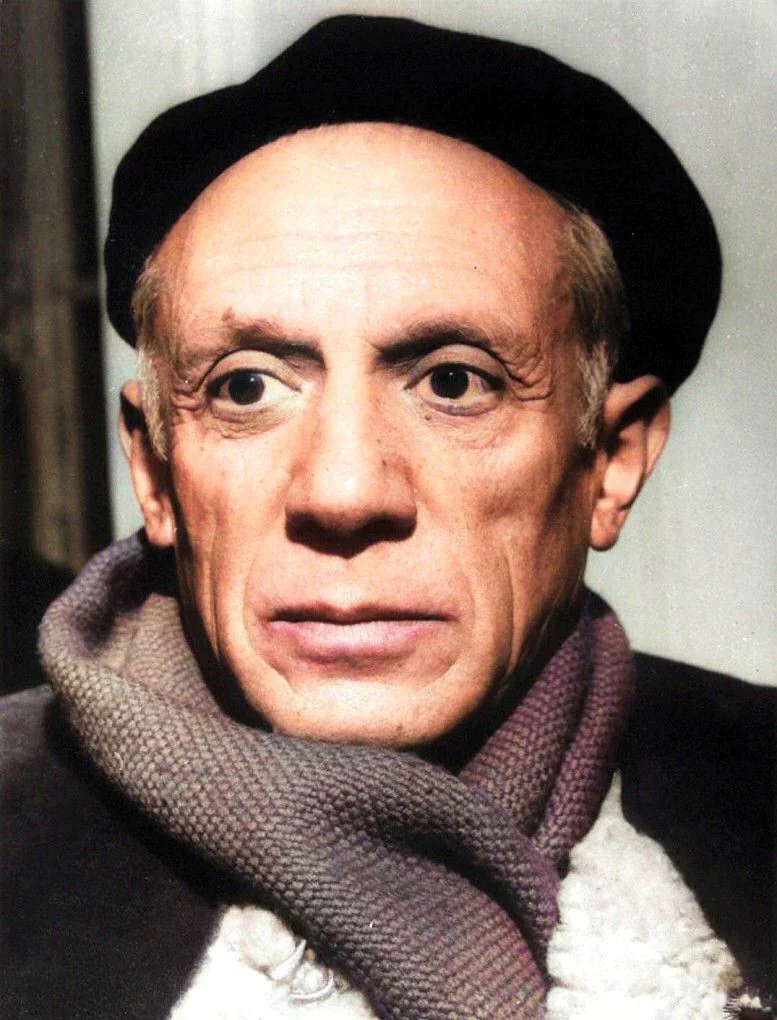
| 67 Quotes | |
| Born as | Pablo Diego José Francisco de Paula Juan Nepomuceno María de los Remedios Cipriano de la Santísima Trinidad Ruiz y Picasso |
| Known as | Pablo Picasso |
| Occup. | Artist |
| From | Spain |
| Born | October 25, 1881 Málaga, Spain |
| Died | April 8, 1973 Mougins, France |
| Aged | 91 years |
| Cite | |
Citation Formats
APA Style (7th ed.)
Pablo picasso biography, facts and quotes. (2026, February 2). FixQuotes. https://fixquotes.com/authors/pablo-picasso/
Chicago Style
"Pablo Picasso biography, facts and quotes." FixQuotes. February 2, 2026. https://fixquotes.com/authors/pablo-picasso/.
MLA Style (9th ed.)
"Pablo Picasso biography, facts and quotes." FixQuotes, 2 Feb. 2026, https://fixquotes.com/authors/pablo-picasso/. Accessed 5 Mar. 2026.
Early Life and Background
Pablo Picasso was born Pablo Diego Jose Francisco de Paula Juan Nepomuceno Maria de los Remedios Cipriano de la Santisima Trinidad Ruiz y Picasso on 1881-10-25 in Malaga, a port city where Catholic ritual, bullfighting spectacle, and street life offered early lessons in drama and form. His father, Jose Ruiz y Blasco, painted and taught drawing and kept the household close to the craft of images; his mother, Maria Picasso y Lopez, gave him the surname that would become his signature. From the beginning he absorbed an almost physical confidence in seeing, paired with a fear of stagnation that would later drive him to invent and abandon styles with ruthless speed.Spain at the end of the 19th century was marked by political volatility and cultural self-scrutiny after imperial decline, and Picasso grew up inside that larger mood of reinvention. Childhood moves through La Coruna and then Barcelona exposed him to different light, different social textures, and the contrast between bourgeois respectability and urban poverty. That split - between hunger and privilege, tenderness and cruelty - would become not just subject matter but a private engine, shaping his relationships, his appetite for work, and his lifelong need to control the room in which he created.
Education and Formative Influences
Picasso trained early and intensely: he studied in La Coruna and Barcelona, entered the Escola de Belles Arts de la Llotja as a teenager, and later attended the Real Academia de Bellas Artes de San Fernando in Madrid, though he found academic routine stifling and learned more from museums and the street. Barcelona's Els Quatre Gats circle, with its modernista talk and bohemian posturing, helped him see art as a life stance, not a profession; El Greco, Goya, and Velazquez offered models of distortion, psychological portraiture, and painterly authority. By 1900 he was traveling to Paris, where the pull of Montmartre, new poetry, and the competitive churn of the avant-garde gave him an arena large enough for his ambition.Career, Major Works, and Turning Points
Paris catalyzed Picasso's early Blue Period (1901-1904), haunted by poverty and the suicide of his friend Carlos Casagemas, followed by the warmer Rose Period (1904-1906). In 1907 he painted Les Demoiselles d'Avignon, a rupture that fed directly into Cubism with Georges Braque, a method that treated objects as problems in perception rather than scenes to be described. As Europe convulsed through World War I, Picasso shifted restlessly - to classicizing figures, to collage, to Surrealist proximity - while building a global market and a private empire of studios, lovers, children, and rivalries. The Spanish Civil War and the bombing of Guernica produced his most public moral statement, Guernica (1937), turning fragmentation into indictment; later decades at Vallauris and Cannes brought ceramics, prints, and late paintings that were fast, blunt, and erotically charged, as if to outpace age. He died on 1973-04-08 in Mougins, France, leaving an oeuvre so vast it resembles a climate more than a catalog.Philosophy, Style, and Themes
Picasso's inner life was defined by urgency: the sense that time was an enemy, and that work was the only durable defense. His studio practice treated the day like an arena - drawings, paintings, cut papers, sculptures, and editions accumulating as evidence of lived intensity. “Inspiration exists, but it has to find us working”. That line captures his psychology: creativity as discipline, not mood, and productivity as a way to quiet anxiety. He cultivated myth around himself, but the deeper myth was procedural - that the self could be rebuilt by making, and that each new series could erase the one before it.Stylistically, he pursued a controlled instability: tenderness rendered with brutality, beauty engineered out of dislocation, and portraits that double as power maps of his relationships. “Every act of creation is first an act of destruction”. The statement is not just about aesthetics; it describes how he moved through people and periods, breaking inherited form to free new form, and sometimes breaking intimacy to keep artistic sovereignty. Yet he also returned obsessively to memory - mothers and children, musketeers, the bull, the studio - using repetition as autobiography. “Painting is just another way of keeping a diary”. In that diary, Spain remains a substrate, Paris a crucible, and the human body a battleground where desire, fear, and invention never fully resolve.
Legacy and Influence
Picasso changed what it meant to be an artist in the 20th century: he made reinvention a career strategy, turned the studio into a public legend, and showed that modern art could be simultaneously intellectual, visceral, and commercially powerful. Cubism reshaped painting, sculpture, design, and architecture by altering the grammar of representation; Guernica became a portable symbol of civilian suffering and the moral reach of images. His influence is inseparable from controversy - about power, gender, authorship, and the costs of genius - yet the work endures because it keeps modeling freedom under pressure, proving that form can think, and that an individual imagination can refract an era back to itself with unsettling clarity.Our collection contains 67 quotes written by Pablo, under the main topics: Witty One-Liners - Motivational - Wisdom - Art - Mortality.
Other people related to Pablo: Jean Cocteau (Director), Max Jacob (Poet), Yousuf Karsh (Photographer), Jonathan Richman (Musician), Joan Miro (Artist), Albert Barnes (Theologian), William S. Paley (Businessman), Henri Rousseau (Artist), Fernand Leger (Artist), Josephine Baker (Dancer)
Frequently Asked Questions
- Why is Pablo Picasso famous? Picasso is famous for being a pioneering artist in the development of Cubism and for his significant influence on modern art.
- Who was Pablo Picasso wife? He had two wives - Olga Khokhlova and Jacqueline Roque.
- Who was Pablo Picasso family? His family included his parents, two sisters, four children, and several partners and wives.
- What is Pablo Picasso full name? Pablo Diego José Francisco de Paula Juan Nepomuceno María de los Remedios Cipriano de la Santísima Trinidad Martyr Patricio Clito Ruíz y Picasso.
- Who was Pablo Picasso parents? His parents were José Ruiz Blasco and María Picasso López.
- What caused Pablo Picasso death? Pablo Picasso died due to heart failure.
- How old was Pablo Picasso? He became 91 years old
Source / external links