
Pappy Boyington Biography Quotes 3 Report mistakes
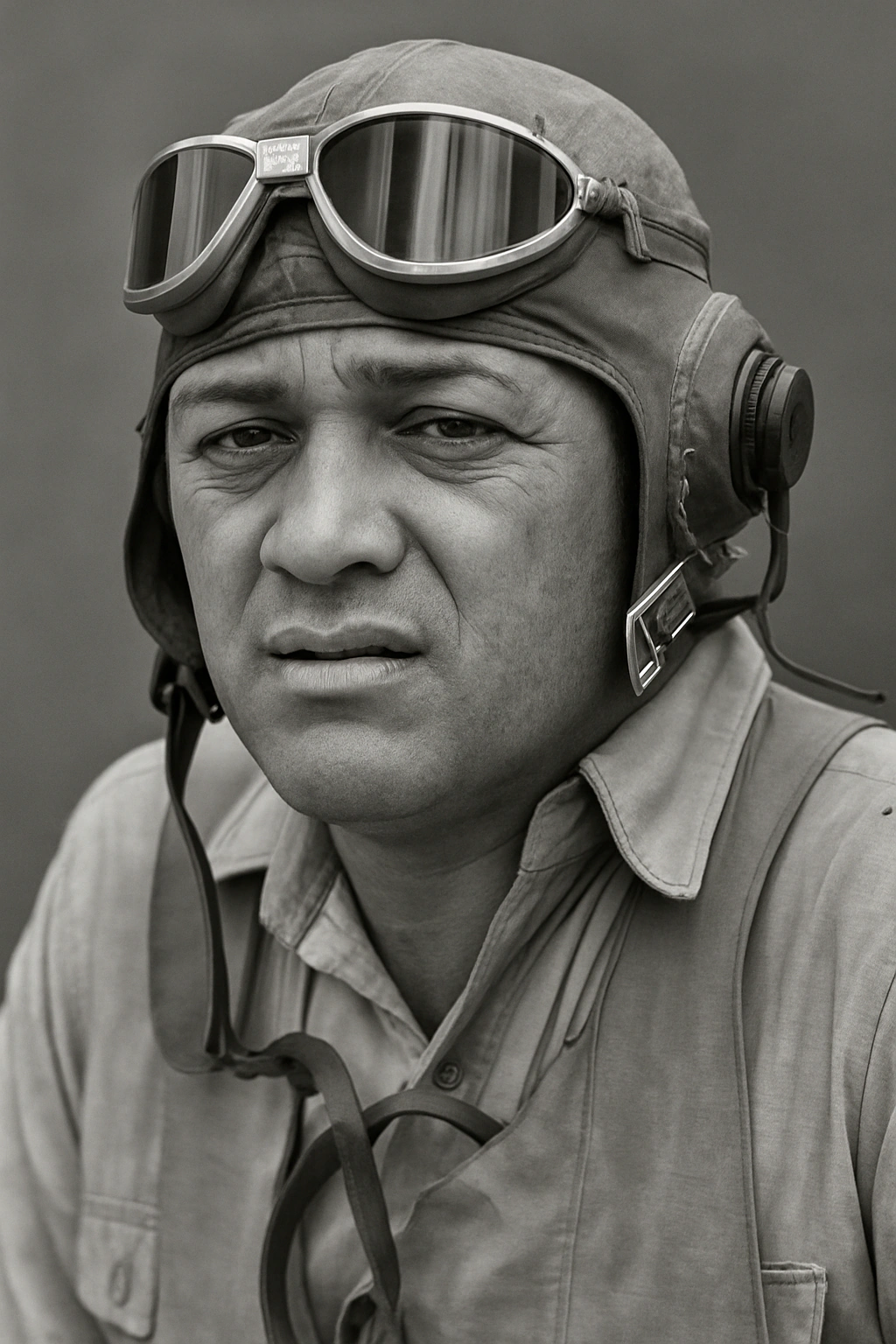
| 3 Quotes | |
| Born as | Gregory Boyington |
| Known as | Gregory Hallenbeck |
| Occup. | Soldier |
| From | USA |
| Born | December 4, 1912 Coeur d'Alene, Idaho, United States |
| Died | January 11, 1988 Fresno, California, United States |
| Cause | Cancer |
| Aged | 75 years |
| Cite | |
Citation Formats
APA Style (7th ed.)
Pappy boyington biography, facts and quotes. (2026, February 11). FixQuotes. https://fixquotes.com/authors/pappy-boyington/
Chicago Style
"Pappy Boyington biography, facts and quotes." FixQuotes. February 11, 2026. https://fixquotes.com/authors/pappy-boyington/.
MLA Style (9th ed.)
"Pappy Boyington biography, facts and quotes." FixQuotes, 11 Feb. 2026, https://fixquotes.com/authors/pappy-boyington/. Accessed 13 Feb. 2026.
Early Life and Background
Gregory "Pappy" Boyington was born on December 4, 1912, in Coeur d'Alene, Idaho, and spent much of his childhood in the logging-and-mining towns of the Inland Northwest. His parents separated early, and he was raised largely under the surname of his stepfather, a detail that later fed his complicated relationship to authority and identity. The Pacific Northwest between the wars offered little romance - hard work, hard weather, and a hard masculinity - and Boyington learned to perform toughness even as he carried a private restlessness that would later seek an outlet in speed, risk, and the clean arithmetic of aerial victory.He grew into a large, physically imposing young man with a quick mind and a quicker temper, drawn to competitive outlets and allergic to routine. The Great Depression narrowed the respectable paths available, while aviation - still new enough to feel like a frontier - promised a meritocracy of nerve and skill. That mix of limited prospects and expansive imagination helps explain why he would accept the military's discipline while simultaneously resisting it, a tension that became central to both his legend and his troubles.
Education and Formative Influences
Boyington attended the University of Washington in Seattle and earned a degree in aeronautical engineering in 1934 while participating in ROTC, a pairing that fused math-and-metal practicality with a pilot's appetite for the air. Engineering trained him to think in performance margins - climb rate, turn radius, structural limits - and ROTC introduced the institutional language of command. Those influences sharpened his tactical intelligence, but they also made him acutely aware of the gap between how systems were supposed to work and how men actually behaved under pressure, a realism that later informed his insistence that outcomes were forged long before the first shots.Career, Major Works, and Turning Points
Commissioned in the U.S. Marine Corps Reserve and brought onto active duty, Boyington became a naval aviator and entered World War II with a reputation for exceptional flying and uneven discipline. In 1941 he resigned his commission and joined the American Volunteer Group in China - the "Flying Tigers" - flying P-40s against Japanese aircraft and claiming several victories amid disputes over exact totals. Returning to the Marines, he helped forge VMF-214, the "Black Sheep Squadron", in the South Pacific in 1943, molding a collection of experienced but nonconforming pilots into an aggressive unit flying F4U Corsairs. Boyington became a leading Marine ace, credited with 28 victories, but on January 3, 1944, he was shot down over Rabaul and spent the remainder of the war as a Japanese prisoner. His survival - and the mythmaking that followed - culminated in the Medal of Honor and Navy Cross, awarded after his return, while the postwar years exposed the cost: fame, alcoholism, multiple marriages, and a life spent negotiating the distance between a public hero and a private man.Philosophy, Style, and Themes
Boyington's combat philosophy was brutally empirical. He did not romanticize dogfights as continuous adventure; he framed them as long stretches of tension, fatigue, and self-control punctuated by moments when instinct and training must fuse. "Flying is hours and hours of boredom sprinkled with a few seconds of sheer terror". That sentence reads like confession as much as instruction: he understood that fear is not the opposite of courage but its fuel, and that the real test is whether a pilot can keep boredom from eroding vigilance before terror arrives. His own biography - volatile ashore, focused aloft - suggests a man who found emotional clarity in the cockpit that he struggled to maintain on the ground.He also argued that aces are manufactured by preparation and by the moral weight of tiny decisions. "Months of preparation, one of those few opportunities, and the judgment of a split second are what makes some pilot an ace, while others think back on what they could have done". In this view, swagger is useless without rehearsal, and heroism is less a personality trait than a practiced reflex. "The air battle is not necessarily won at the time of the battle. The winner may have been determined by the amount of time, energy, thought and training an individual has previously accomplished in an effort to increase his ability as a fighter pilot". The insistence on training also exposes his inner unease: if victory can be earned before the battle, then the chaos of war becomes survivable, even controllable - a comforting idea for someone who lived with chaos in himself.
Legacy and Influence
Boyington endures as one of the most recognizable U.S. Marine fighter aces, his wartime record inseparable from the larger story of American airpower maturing in the Pacific and from the cultural hunger for rough-edged heroes. The television series "Baa Baa Black Sheep" amplified his image as a rule-breaking natural leader, sometimes flattening the darker truths of captivity, addiction, and postwar drift, yet it also kept alive a portrait of combat leadership built on competence, loyalty, and pressure-tested judgment. For military aviation, his most durable influence is the lesson beneath the legend: that daring must be scaffolded by preparation, and that the cost of war is measured not only in missions flown but in the long work of living afterward.Our collection contains 3 quotes written by Pappy, under the main topics: Witty One-Liners - Training & Practice - Decision-Making.
Frequently Asked Questions
- Pappy'' Boyington book: Baa Baa Black Sheep (1958 autobiography).
- Pappy Boyington dog: Meatball, the VMF-214 bulldog mascot.
- Pappy Boyington plane: Vought F4U Corsair (VMF-214 'Black Sheep').
- Who shot down Pappy' Boyington: Often credited to Japanese pilot Masajiro 'Mike' Kawato (disputed).
- How tall was Pappy Boyington: About 5 ft 8 in (173 cm).
- Pappy Boyington spouse: Helen Clark; Frances Baker; Dolores 'Dee' Tatum.
- Pappy Boyington grandson: Not publicly documented; family details are private.
- How old was Pappy Boyington? He became 75 years old
Source / external links