
Paul von Hindenburg Biography Quotes 8 Report mistakes
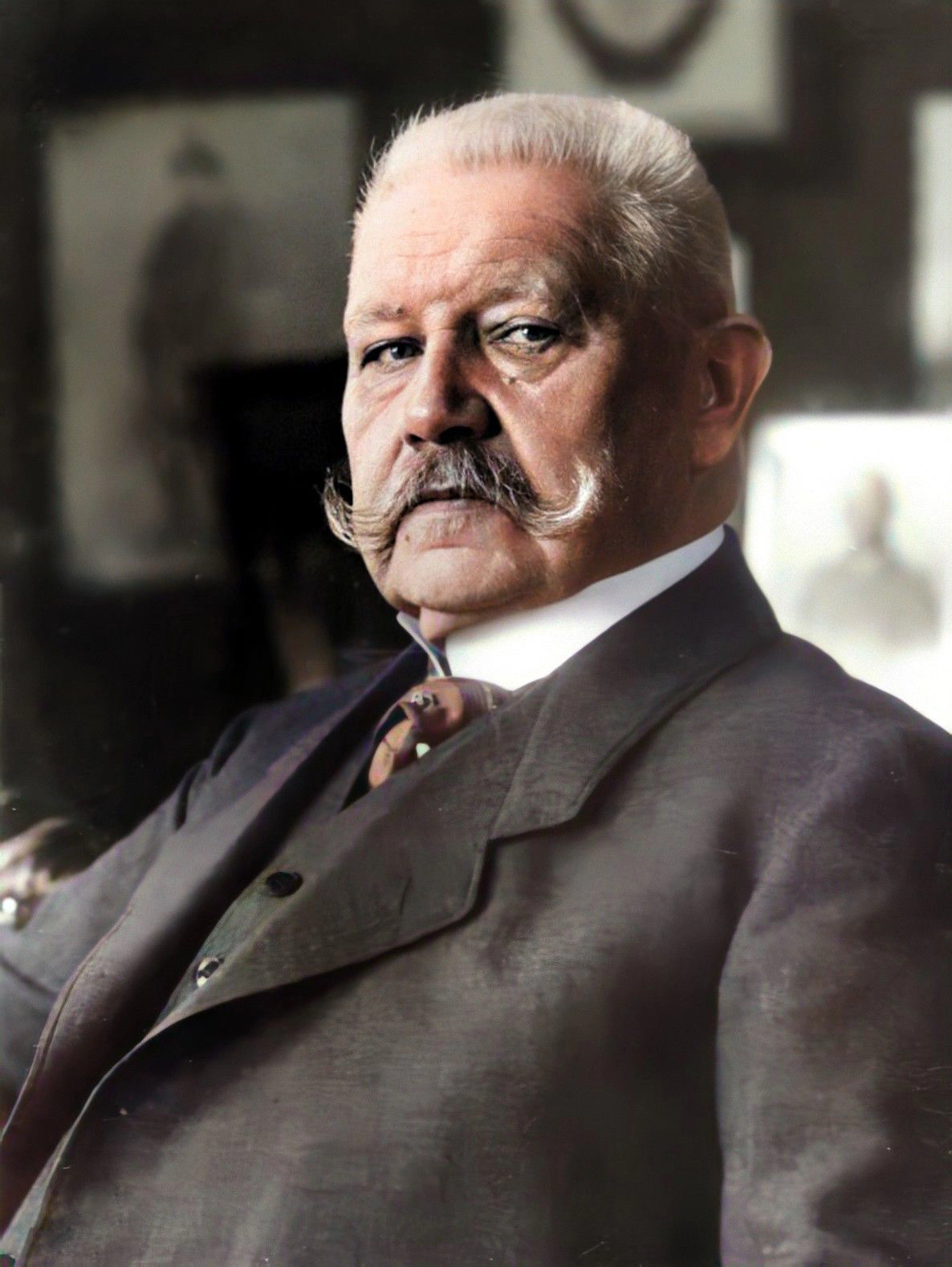
| 8 Quotes | |
| Born as | Paul Ludwig Hans Anton von Hindenburg |
| Occup. | President |
| From | Germany |
| Spouse | Gertrud von Sperling |
| Born | October 2, 1847 Posen, Prussia, Germany |
| Died | August 2, 1934 Neudeck, East Prussia, Germany |
| Cause | Natural Causes |
| Aged | 86 years |
| Cite | |
Citation Formats
APA Style (7th ed.)
Paul von hindenburg biography, facts and quotes. (2026, March 14). FixQuotes. https://fixquotes.com/authors/paul-von-hindenburg/
Chicago Style
"Paul von Hindenburg biography, facts and quotes." FixQuotes. March 14, 2026. https://fixquotes.com/authors/paul-von-hindenburg/.
MLA Style (9th ed.)
"Paul von Hindenburg biography, facts and quotes." FixQuotes, 14 Mar. 2026, https://fixquotes.com/authors/paul-von-hindenburg/. Accessed 27 Mar. 2026.
Early Life and Background
Paul Ludwig Hans Anton von Beneckendorff und von Hindenburg was born on October 2, 1847, in Posen, in the Prussian province that lay on the shifting frontier between German and Polish worlds. He came from the landed Junker nobility, a caste that fused Protestant piety, estate management, military service, and monarchical loyalty into a total social ethic. His father, Robert von Beneckendorff und von Hindenburg, had served as a Prussian officer; his mother, Luise Schwickart, came from a family tied to state service. In that milieu, the army was less a profession than a hereditary vocation. Hindenburg grew up in a kingdom that had been shaken by the revolutions of 1848 and was hardening into the disciplined, bureaucratic power that Otto von Bismarck would soon use to unify Germany.
That background formed the central tension of his life. He was not an original thinker, nor a charismatic ideologue in youth, but a vessel of Prussian habits: obedience, reserve, duty, and a powerful confidence that history was made by steel, hierarchy, and endurance. He entered adolescence as Prussia fought Denmark, Austria, and France, and the victories of 1864, 1866, and 1870-71 gave his generation an almost religious faith in the state and the army as instruments of national destiny. Hindenburg's later authority rested partly on this biographical timing. He seemed to embody imperial Germany's upward march from provincial kingdom to continental empire, and millions would later project onto his impassive face the image of the incorruptible old Prussia.
Education and Formative Influences
Educated in cadet schools at Wahlstatt and Berlin, Hindenburg was molded early into the officer corps. He received a commission in the Third Guards Regiment of Foot and fought in the Austro-Prussian War and the Franco-Prussian War, witnessing the operational efficiency and morale that became articles of faith for him. Staff training and subsequent service taught him method rather than brilliance: patience, logistics, chain of command, and the conviction that national survival depended on disciplined organization from top to bottom. He moved through the General Staff world of the new German Empire, absorbing the assumptions of Helmuth von Moltke's system and the social conservatism of the officer elite. Even his retirement in 1911 did not sever him from that world; it merely paused a career whose deepest influence was the belief that monarchy, army, and nation were naturally fused.
Career, Major Works, and Turning Points
Recalled from retirement at the outbreak of World War I, Hindenburg achieved instant fame in 1914 after the German victory at Tannenberg, won with his chief of staff Erich Ludendorff and operational officer Max Hoffmann against invading Russian armies in East Prussia. Tannenberg, followed by the Masurian Lakes campaign, made him a national savior and living monument. In 1916 he and Ludendorff effectively took control of Germany's war effort through the Third Supreme Command, pushing total mobilization, the Hindenburg Program, and unrestricted submarine warfare while overshadowing Kaiser Wilhelm II. Their rule deepened militarization and tied his name to both battlefield endurance and strategic overreach. After Germany's defeat, Hindenburg testified to the Reichstag committee and lent prestige to the "stab-in-the-back" legend, which shifted blame from the army to civilians and republicans. Elected president of the Weimar Republic in 1925 after the death of Friedrich Ebert, he was a monarchist serving a democracy he did not love. In the crises after 1930 he governed increasingly through emergency decrees under Article 48, relying on presidential cabinets. His gravest turning point came on January 30, 1933, when, amid elite intrigue and conservative miscalculation, he appointed Adolf Hitler chancellor. Hindenburg remained head of state until his death on August 2, 1934, but by then the republic had been destroyed under the cover of his name.
Philosophy, Style, and Themes
Hindenburg's cast of mind was less philosophical than institutional, yet his words reveal a psychology of stoic fatalism joined to administrative alarm. “It does not seem to me to be sufficiently recognized everywhere among the officials that the existence or non-existence of our people and Empire is at stake”. That sentence exposes his habit of treating politics, economics, and society as subordinate fronts in a single war of national survival. Even food policy became an index of military stamina: “It is impossible for our working people to maintain their full strength if they do not succeed in obtaining a sufficient supply of fat, allotted to them on a proper basis”. Beneath the granite public image stood a commander obsessed with endurance, supply, and the fear of internal collapse.
His style was monumental, impersonal, and curiously passive in moral terms. He rarely appeared self-doubting; instead he framed catastrophe as a test of staying power. “I also believed that our public at home would be strong enough to survive even the present crisis”. The key word is "believed": Hindenburg consistently trusted abstract entities - army, people, empire - more than pluralist politics or popular sovereignty. That trust made him reassuring in wartime and dangerous in peacetime. He could symbolize unity because he simplified history into duty and perseverance, but the same simplification made him vulnerable to myths, especially the notion that national will, properly led, could override social conflict and constitutional restraint. His silence often functioned as power; his authority came not from argument but from the aura of a man who seemed to stand above argument altogether.
Legacy and Influence
Hindenburg's legacy is inseparable from Germany's passage from empire to republic to dictatorship. To many contemporaries he was the victor of Tannenberg and the last great field marshal of old Prussia; to historians he is also the conservative elder whose prestige legitimized anti-democratic forces. Streets, towers, and myths once bore his name, but memory has become harsher because his presidency helped normalize emergency rule and because his appointment of Hitler was decisive, whatever his age, frailty, or reservations. He did not invent Nazism, yet he opened the constitutional door through which it entered power. His life therefore remains a study in how personal honor, military glory, and political shortsightedness can coexist in one commanding figure - and how the virtues of one era, when carried unexamined into another, can become instruments of disaster.
Our collection contains 8 quotes written by Paul, under the main topics: Resilience - War - Food.
Other people related to Paul: George Seldes (Journalist), Franz von Papen (Politician), Ernst Thalmann (Politician)
Paul von Hindenburg Famous Works
- 1920 Out of My Life (Aus meinem Leben) (Autobiography)
Source / external links