
Peace Pilgrim Biography Quotes 30 Report mistakes
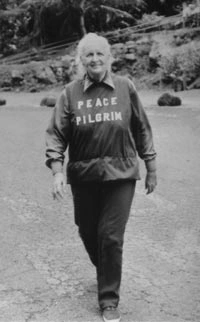
| 30 Quotes | |
| Occup. | Activist |
| From | USA |
| Born | July 18, 1908 |
| Died | July 7, 1981 |
| Aged | 72 years |
| Cite | |
Citation Formats
APA Style (7th ed.)
Peace pilgrim biography, facts and quotes. (2026, February 11). FixQuotes. https://fixquotes.com/authors/peace-pilgrim/
Chicago Style
"Peace Pilgrim biography, facts and quotes." FixQuotes. February 11, 2026. https://fixquotes.com/authors/peace-pilgrim/.
MLA Style (9th ed.)
"Peace Pilgrim biography, facts and quotes." FixQuotes, 11 Feb. 2026, https://fixquotes.com/authors/peace-pilgrim/. Accessed 27 Mar. 2026.
Early Life and Background
Peace Pilgrim was born Mildred Norman on July 18, 1908, in the Pine Ridge area of Egg Harbor City, New Jersey, the eldest of three children in a modest farming family shaped by Quaker plainness and the hard arithmetic of early-20th-century rural life. The United States she entered was industrializing fast but still carried the moral aftershocks of the Progressive Era: temperance, settlement work, and new ideas about social responsibility. In that atmosphere, she absorbed an ethic of usefulness and self-discipline, along with an early sense that inner life and public life were not separate rooms.The Great Depression and the approach of global war pressed on her generation with unusual force. Norman worked in New York City as a secretary and later in advertising and business, learning the machinery of persuasion from the inside while watching insecurity and competition reorder human values. She married and later divorced - a decisive fracture that coincided with a longer, quieter break from conventional ambition. By the 1940s, as World War II and then the Cold War normalized mass violence as policy, she gravitated toward peace activism and spiritual practice, searching for a way of living that did not merely oppose war but refused to cooperate with its underlying habits of fear and grasping.
Education and Formative Influences
Her formal schooling was limited compared to many later reformers, but her education was cumulative and practical: Quaker-inflected simplicity, self-directed reading in religion and ethics, and the volunteer networks of mid-century America. She participated in groups such as the Women's International League for Peace and Freedom, and she walked portions of the Appalachian Trail, experiences that distilled her into a disciplined long-distance walker and listener. By the early 1950s she described a prolonged inner crisis culminating in what she called a spiritual awakening in 1953, after which she resolved to devote her life wholly to peace, not as a campaign but as a vocation.Career, Major Works, and Turning Points
In January 1953 she began her long pilgrimage, eventually walking more than 25, 000 miles across the United States on foot, often wearing a dark tunic, carrying little, and accepting food and shelter as offered. She adopted the name Peace Pilgrim and refused money, possessions, and organizational affiliation, relying instead on personal contact and small acts of hospitality as her infrastructure. Her method was both ancient and radically modern: a lone figure crossing an age of highways, television, nuclear fear, and suburban plenty, insisting that peace required inner transformation as much as treaties. She spoke wherever invited - schools, churches, civic groups - and her message circulated through pamphlets, especially "Steps Toward Inner Peace", and later through compilations of her talks and letters published after her death. She died in a car accident near Knox, Indiana, on July 7, 1981, still traveling to speak, leaving no estate but a body of remembered conversations.Philosophy, Style, and Themes
Peace Pilgrim's public persona - steady gaze, plain dress, tireless walking - was a deliberate style of moral clarity. She treated the self as the primary battleground: not self-absorption, but self-scrutiny meant to disarm aggression at its source. Her activism was therefore psychological as well as political. When she insisted, “There is a criterion by which you can judge whether the thoughts you are thinking and the things you are doing are right for you. The criterion is: Have they brought you inner peace?” she offered an interior test that cut across ideology: a way to evaluate motives before they harden into crusades. The point was not serenity as escape, but inner peace as the condition for nonviolent power.She also attacked the material logic of postwar America with uncommon bluntness, diagnosing possessions as a form of captivity: “Anything you cannot relinquish when it has outlived its usefulness possesses you, and in this materialistic age a great many of us are possessed by our possessions”. The line reads like social criticism, but it is also autobiography - the justification for her radical renunciation and her credibility as she spoke to audiences surrounded by abundance. Underneath was a metaphysics of human unity that made war not merely tragic but irrational: “We are all cells in the same body of humanity”. Her conversations were typically gentle rather than confrontational; she preferred receptive attention and the slow conversion of example, persuading less by argument than by the unsettling fact of a person who had stripped life down to essentials and still looked free.
Legacy and Influence
Peace Pilgrim became an enduring American archetype: part Quaker witness, part pilgrim-mystic, part grassroots organizer without an organization. In the long arc from the nuclear anxieties of the 1950s through the Vietnam era and into the modern mindfulness movement, her life anticipated later blends of spirituality and social action, minimalism and environmental ethics, trauma-aware peace education, and person-to-person dialogue as politics. Because she left no institution, her influence travels through story, quotation, and imitation - in the continued distribution of "Steps Toward Inner Peace", in peace walks and interfaith communities, and in the persistent idea that disarmament begins as a private discipline practiced in public, one step at a time.Our collection contains 30 quotes written by Peace, under the main topics: Motivational - Wisdom - Love - Meaning of Life - Kindness.
Source / external links