
Pee Wee Reese Biography Quotes 7 Report mistakes
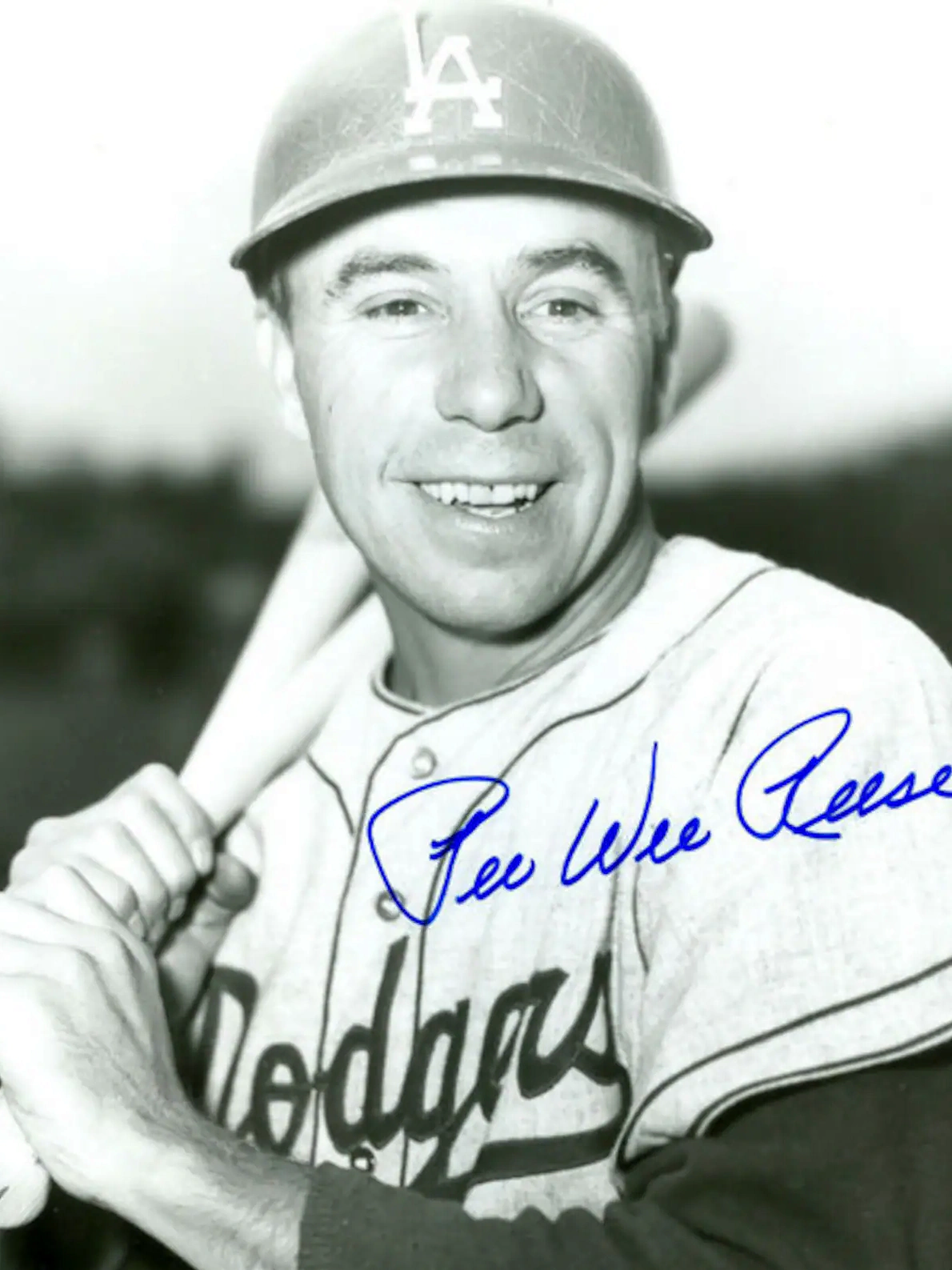
| 7 Quotes | |
| Occup. | Athlete |
| From | USA |
| Born | July 23, 1918 Ekron, Kentucky, United States |
| Died | August 14, 1999 Louisville, Kentucky, United States |
| Aged | 81 years |
| Cite | |
Citation Formats
APA Style (7th ed.)
Pee wee reese biography, facts and quotes. (2026, February 11). FixQuotes. https://fixquotes.com/authors/pee-wee-reese/
Chicago Style
"Pee Wee Reese biography, facts and quotes." FixQuotes. February 11, 2026. https://fixquotes.com/authors/pee-wee-reese/.
MLA Style (9th ed.)
"Pee Wee Reese biography, facts and quotes." FixQuotes, 11 Feb. 2026, https://fixquotes.com/authors/pee-wee-reese/. Accessed 28 Mar. 2026.
Early Life and Background
Harold Peter "Pee Wee" Reese was born on July 23, 1918, in Louisville, Kentucky, a river city shaped by industrial work, churchgoing neighborhoods, and the practical codes of the Upper South. He grew up during the lean years between the First World War and the Great Depression, in a household where steadiness mattered more than display. The nickname "Pee Wee" stuck early, a marker of the undersized boy who learned to compensate with nerve, quick hands, and a sharp read of people.Baseball in Louisville was both recreation and ladder - sandlots, school teams, and semi-pro circuits that tested whether a kid could keep his head when older men played hard. Reese was small enough to be dismissed, and that early underestimation became part of his inner fuel: a quiet pride in preparation, and a lifelong sensitivity to status and belonging in clubhouses that could be affectionate one moment and merciless the next. Over time, his calm manner would become a kind of armor - not aloofness, but a practiced steadiness.
Education and Formative Influences
Reese attended duPont Manual High School in Louisville, where he did not arrive as a can-not-miss phenom so much as a late-developing shortstop who kept finding ways to stay on the field. He later recalled how little physical advantage he had and how quickly baseball can close doors on boys who are not ready on schedule: “I had only played five games in my senior year in high school. I was not large enough. Hell, when I graduated, I was about five foot four and weighed 120 pounds. I didn't go with the Dodgers until spring training of 1940 and I weighed all of 155 pounds soaking wet”. The lesson he carried from that climb was not romantic - it was procedural: get better, be dependable, and earn trust in small repetitions.Career, Major Works, and Turning Points
Signed originally in the late 1930s, Reese reached the majors in 1940 and soon became the defining shortstop of the Brooklyn Dodgers, serving as team captain and infield anchor through an era when the National League was reinventing itself around speed, defense, and integration. His career was interrupted by World War II military service, after which he returned to help drive Brooklyn to repeated pennants and, finally, the long-awaited 1955 World Series championship. An All-Star regular, Reese was a table-setter rather than a slugger, valued for range, leadership, and the measured authority he carried on chaotic days. The most fateful turning point in his public life came in 1947, when Jackie Robinson joined the Dodgers and the field became a national stage for American racial conflict; Reese, a southerner by upbringing and a captain by role, was forced to decide what kind of man leadership would require.Philosophy, Style, and Themes
Reese played shortstop like a man translating noise into order: quick first step, clean transfer, and a calm throw that said the moment would not beat him. His baseball mind was clubhouse-centered - he believed that routine and attention to the daily human temperature were part of winning, not extras. “If you rush in and out of the clubhouse, you rush in and out of baseball”. That line reveals his psychology: he distrusted shortcuts, and he understood that teams are made as much in conversation, care, and accountability as in box scores.His leadership style was practical rather than preachy, and it could contain contradictions typical of his era. He saw Brooklyn not simply as a home park but as a civic alliance between players and working-class fans: “Brooklyn was the most wonderful city a man could play in, and the fans there were the most loyal there were”. Yet his most enduring moral test came with Robinson. Reese did not pretend the abuse was abstract; he tried to keep Robinson inside the circle of the team when the world tried to push him out, at times speaking with blunt locker-room realism: “I used to tell Jackie (Robinson) sometimes when they were throwing at him, 'Jackie, they aren't throwing at you because you are black. They are throwing at you because they don't like you”. The remark can read as deflection, but it also shows a captain trying to return agency to a teammate - insisting Robinson belonged to baseballs ordinary cruelties because he belonged, period.
Legacy and Influence
Reese died on August 14, 1999, but his imprint remains: a model of the shortstop as organizer, and the captain as stabilizer in an age when baseball was becoming a national referendum on American life. His Hall of Fame standing rests on skill and longevity, yet his cultural memory is braided with the Dodgers decision to integrate and the daily courage required to make that decision real inside a dugout. Reese was not a saint and never sold himself as one; he was a working ballplayer whose best moments came when leadership meant showing up, slowing the moment down, and making room for someone else to stand on the same field.Our collection contains 7 quotes written by Pee, under the main topics: Witty One-Liners - Sports - Equality - Training & Practice - Teamwork.
Other people related to Pee: Roger Kahn (Writer), Duke Snider (Athlete), Gil Hodges (Athlete)