
Pete Maravich Biography Quotes 6 Report mistakes
| 6 Quotes | |
| Born as | Peter Press Maravich |
| Known as | Pistol Pete |
| Occup. | Athlete |
| From | USA |
| Born | June 22, 1947 Aliquippa, Pennsylvania |
| Died | January 5, 1988 Pasadena, California |
| Cause | Heart failure |
| Aged | 40 years |
| Cite | |
Citation Formats
APA Style (7th ed.)
Pete maravich biography, facts and quotes. (2026, February 11). FixQuotes. https://fixquotes.com/authors/pete-maravich/
Chicago Style
"Pete Maravich biography, facts and quotes." FixQuotes. February 11, 2026. https://fixquotes.com/authors/pete-maravich/.
MLA Style (9th ed.)
"Pete Maravich biography, facts and quotes." FixQuotes, 11 Feb. 2026, https://fixquotes.com/authors/pete-maravich/. Accessed 12 Feb. 2026.
Early Life and Background
Peter Press Maravich was born June 22, 1947, in Aliquippa, Pennsylvania, a steel-town landscape that produced tough, working-class athletes and a hunger for escape. His parents, Helen and Press Maravich, were Serbian-American; the family moved with Press's coaching jobs, and basketball became both language and refuge for a boy whose imagination ran ahead of his surroundings. The nickname "Pistol" came early, tied to his hair-trigger release and the sense that the ball left his hands like a shot.His childhood was inseparable from his father, a demanding coach who turned driveways and empty gyms into classrooms. Their closeness created intensity as much as intimacy: Pete was rehearsing creativity inside a disciplined system, improvisation inside a drill. The 1950s and early 1960s were years when fundamentals and conformity ruled the sport, and his showmanship - behind-the-back feeds, no-look darts, quicksilver handle - developed as a personal signature and a private defiance against plainness.
Education and Formative Influences
Maravich starred at Daniel High School in Central, South Carolina, after the family's move to Clemson; his scoring and flair made him a regional phenomenon, but the real formative influence remained Press, who had him dribble, pass, and shoot for hours, shaping touch and timing rather than mere strength. When Press took the head coaching job at Louisiana State University, Pete followed to LSU in 1967, arriving in the middle of the South's cultural upheavals - integration, generational rebellion, televised sport - and stepping into a campus and conference ready-made for a new kind of basketball celebrity.Career, Major Works, and Turning Points
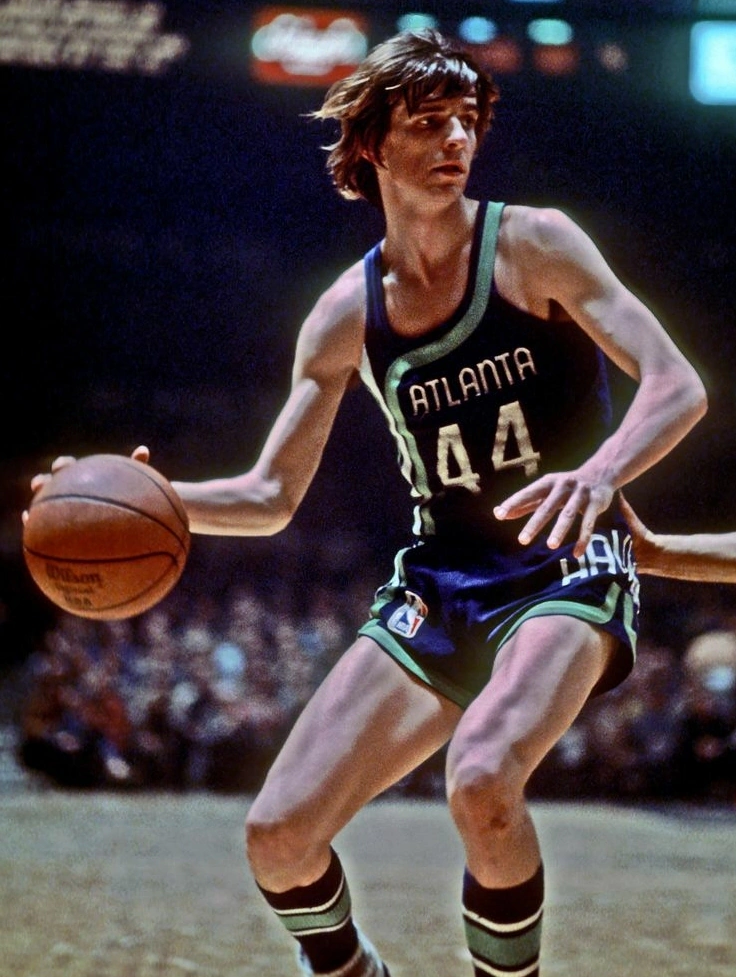
At LSU (1967-1970), Maravich became a national obsession: 44.2 points per game across his college career without the benefit of a three-point line, three straight SEC scoring titles, and a style that made routine possessions feel like theater. He entered the NBA as the 3rd pick in the 1970 draft by the Atlanta Hawks, later becoming the face of the New Orleans Jazz (1974-1979), where he won the 1976-77 scoring title (31.1 ppg) and reached his peak as a scorer-creator amid the league's shifting identity of the 1970s. Knee injuries and a thinning roster around him accelerated decline; after a stint with the Boston Celtics (1979-1980) and brief comebacks, he retired young, increasingly aware of physical fragility. In 1988, he died suddenly at 40 during a pickup game in Pasadena, California, from a cardiac condition later linked to a congenital coronary abnormality.Philosophy, Style, and Themes
Maravich played as if the court were a stage and the ball a prop that could reveal personality. His passing was not ornament but attack - angles, pace, deception - a way to bend defenders' expectations until they broke. He understood entertainment as a professional obligation and as a shield: "They don't pay you a million dollars for two-hand chest passes". The line sounds cocky, but it also exposes a worker's logic beneath the artistry: if the game is labor, then invention is value. In the 1970s NBA, with arenas half-full and the league fighting for cultural space, he embodied a kind of basketball modernism - improvisational, camera-friendly, and a step closer to the guard-driven spectacle that would later dominate.Yet the same intensity that made him magnetic could make him lonely. The persona of "Pistol" sometimes consumed the person of Pete, and he later described the emotional cost in unusually stark terms: "My life had no meaning at all. I found only brief interludes of satisfaction. It was like my whole life had been about my whole basketball career". That confession reframes his highlights as coping mechanisms - moments of control and applause in a life otherwise defined by pressure, injuries, and the burden of being singular. It also hints at why, in his post-NBA years, he spoke of spiritual renewal and redirected ambition toward family, faith, and mentoring: "I lived my life one way for 35 years, for me. And then the focus came in on what I really was". Legacy and Influence
Maravich's influence is visible every time a guard weaponizes creativity as efficiency - the live-dribble passing, the reluctance to accept "safe" options, the belief that flair can be functional. He helped normalize the idea that a backcourt player could be both primary scorer and primary playmaker, and his college scoring remains a benchmark precisely because it was achieved under rules that punished spacing and rewarded predictability. More than highlights, his story endures as a parable about talent and identity: the costs of being a spectacle, the fragility beneath genius, and the lifelong search for meaning beyond the roar of a gym.
Our collection contains 6 quotes written by Pete, under the main topics: Mortality - Meaning of Life - Sports - Father - Humility.
Other people related to Pete: Pete Sampras (Athlete)
Source / external links