
Phil Donahue Biography Quotes 33 Report mistakes
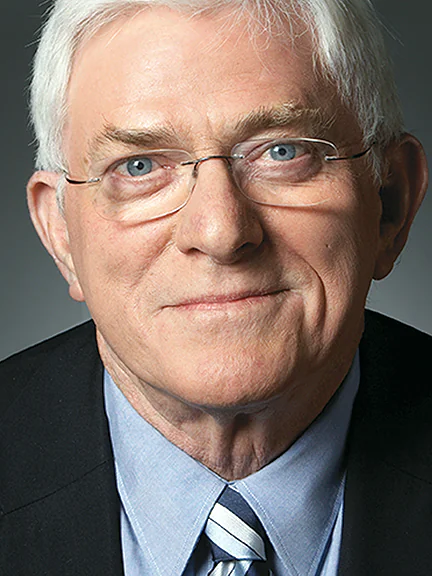
| 33 Quotes | |
| Born as | Phillip John Donahue |
| Occup. | Entertainer |
| From | USA |
| Born | December 21, 1935 Cleveland, Ohio |
| Died | August 18, 2024 New York City, USA |
| Aged | 88 years |
| Cite | |
Citation Formats
APA Style (7th ed.)
Phil donahue biography, facts and quotes. (2026, February 11). FixQuotes. https://fixquotes.com/authors/phil-donahue/
Chicago Style
"Phil Donahue biography, facts and quotes." FixQuotes. February 11, 2026. https://fixquotes.com/authors/phil-donahue/.
MLA Style (9th ed.)
"Phil Donahue biography, facts and quotes." FixQuotes, 11 Feb. 2026, https://fixquotes.com/authors/phil-donahue/. Accessed 6 Mar. 2026.
Early Life and Background
Phillip John Donahue was born on December 21, 1935, in Cleveland, Ohio, and grew up on the citys West Side in a Catholic, working-to-middle-class household shaped by the Depression generation and postwar confidence. The social world around him was ethnically mixed, union-influenced, and intensely parish-centered - a setting that trained him early to listen for subtext: what people admitted in public versus what they carried privately.From the beginning, he was less interested in performance than in permission. Friends and early colleagues described him as curious, quick to laugh, and unusually willing to ask questions that polite company avoided. That temperament - part neighborhood sociability, part Catholic examination of conscience - became the core of a later public persona that felt informal while it pressed relentlessly toward confession, accountability, and empathy.
Education and Formative Influences
Donahue attended the University of Notre Dame and later earned a degree at the University of Detroit, a Jesuit institution, absorbing a blend of rhetorical discipline and social ethics that fit the mid-century Midwest. He entered broadcasting when radio and local TV still depended on community trust, and he studied the craft from the inside out - announcing, reporting, producing - learning that the real drama was not spectacle but stakes: who is harmed, who benefits, and who gets to speak.Career, Major Works, and Turning Points
After early work in radio and local television, Donahue found his defining format in Dayton, Ohio, in the late 1960s, when a show built around audience questions and unscreened confrontation evolved into The Phil Donahue Show (later Donahue). National syndication followed in the 1970s, and for more than two decades he helped invent the modern daytime talk show: audience microphones, live moral argument, and a host who moved through the crowd like an energetic mediator. He tackled feminism, consumer fraud, race, religion, AIDS, war, and abuse at a time when many broadcasters treated such subjects as ratings poison, and his blend of populism and inquiry opened a lane later occupied - and expanded - by Oprah Winfrey and others. A late-career second act included political commentary; his primetime MSNBC program ended in 2003 amid the Iraq War climate, and he later co-directed the 2007 documentary Body of War, deepening his public identification with antiwar critique.Philosophy, Style, and Themes
Donahue believed television could be more than comfort food, but he never forgot its commercial gravity. “The Tube is a vehicle for selling things, not for exploring ideas”. That skepticism shaped his on-air manner: genial, plainspoken, and fast-moving, yet always alert to who was being marketed - the guest, the audience, or the host himself. He walked a tightrope between accessibility and seriousness, translating policy and ethics into the language of everyday life, then letting ordinary people interrogate power on-camera.Psychologically, his work was driven by a near-compulsive respect for the unvoiced interior life of strangers, especially around loneliness, masculinity, and shame. “Is it any wonder that for millions of men the only intimacy is physical, silent, and predictable?” Even when the show flirted with sensational topics, his deeper theme was civic intimacy: the idea that a democracy requires citizens who can speak honestly in public without losing their humanity. His media criticism also carried a reporters bias toward conflict and consequence - “To a journalist, good news is often not news at all”. - a confession that explains both his ratings-era instincts and his discomfort with what television rewards.
Legacy and Influence
Donahue died on August 18, 2024, in the United States, leaving behind a template for participatory television that permanently altered public conversation. He normalized live audience challenge, treated daytime viewers as capable of serious debate, and made the hosts role less that of entertainer than moderator, advocate, and sometimes prosecutor. The genre later drifted toward spectacle, but the original Donahue ideal - that ordinary people, given a microphone, can test ideas in real time - remains one of televisions most consequential democratic experiments.Our collection contains 33 quotes written by Phil, under the main topics: Witty One-Liners - Ethics & Morality - Art - Justice - Sarcastic.
Other people related to Phil: Danny Thomas (Actor), Maury Povich (Celebrity)
Source / external links