
Pierre Laplace Biography Quotes 1 Report mistakes
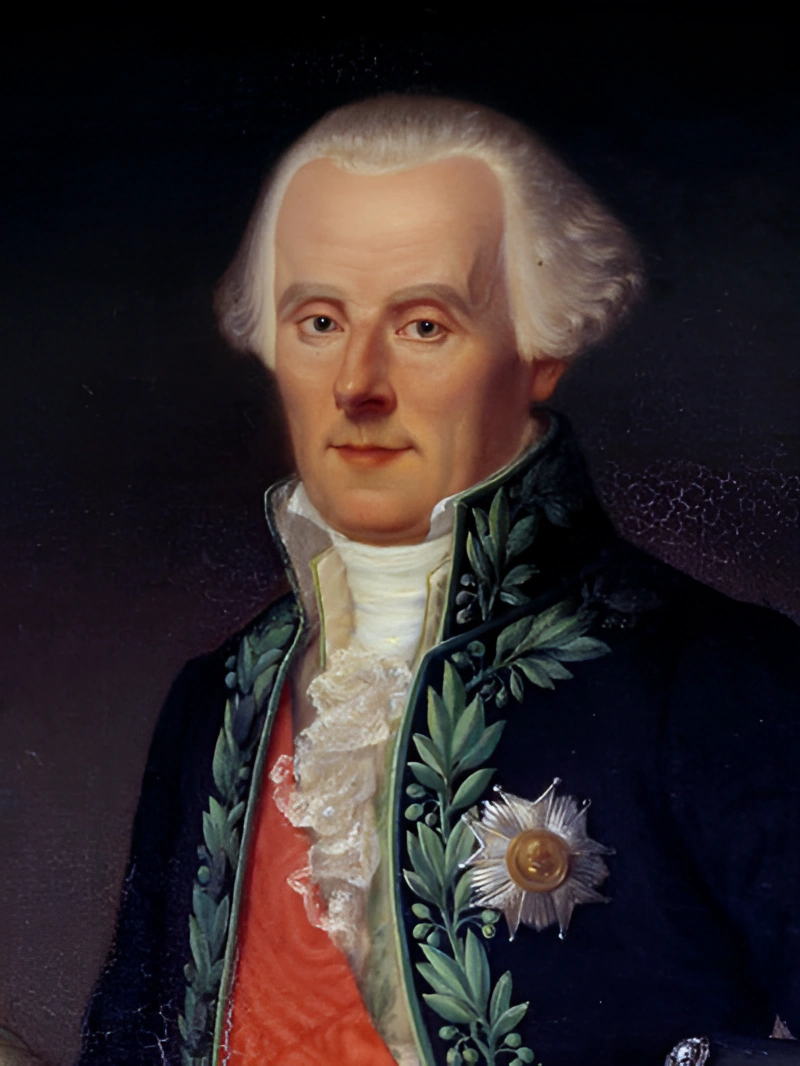
Attr: meisterdrucke.us
| 1 Quotes | |
| Born as | Pierre-Simon Laplace |
| Occup. | Mathematician |
| From | France |
| Born | March 23, 1749 Beaumont-en-Auge, Normandy, France |
| Died | March 5, 1827 Paris, France |
| Aged | 77 years |
| Cite | |
Citation Formats
APA Style (7th ed.)
Pierre laplace biography, facts and quotes. (2026, February 11). FixQuotes. https://fixquotes.com/authors/pierre-laplace/
Chicago Style
"Pierre Laplace biography, facts and quotes." FixQuotes. February 11, 2026. https://fixquotes.com/authors/pierre-laplace/.
MLA Style (9th ed.)
"Pierre Laplace biography, facts and quotes." FixQuotes, 11 Feb. 2026, https://fixquotes.com/authors/pierre-laplace/. Accessed 27 Mar. 2026.
Early Life and Background
Pierre-Simon Laplace was born on 23 March 1749 in Beaumont-en-Auge, Normandy, a small market town whose rhythms were agricultural, Catholic, and provincial, far from the salons of Paris. His family was respectable but not elite; the security of modest means and the constraints of limited prospects shaped the early tension that would define him: a hunger for intellectual ascent paired with a cool, almost impersonal discipline. In a France still ordered by estates and patronage, ambition required a mask of practicality, and Laplace learned to present talent as usefulness.The France of his youth was entering the late Enlightenment, when Newtonian science promised a universal grammar for nature and when state power increasingly relied on experts - engineers, astronomers, surveyors - to administer territory and war. Laplace would become one of the era's purest embodiments of that expert ideal: a mind convinced that the world could be rendered into equations, and that mastery of those equations could move a person from obscurity to the center of power without ever needing theatrical charisma.
Education and Formative Influences
Laplace was educated first in local schools and then at the University of Caen, where he was steered toward theology before mathematics asserted itself as his true vocation. The decisive turn was his leap to Paris in the late 1760s and his successful approach to Jean le Rond d'Alembert, to whom he sent mathematical work that impressed enough to open doors. In the orbit of the Academie des Sciences, Laplace absorbed the Enlightenment style of research: problems framed as general laws, proved with analytic rigor, and valued for their capacity to predict and control phenomena - an intellectual ethic that matched his temperament.Career, Major Works, and Turning Points
By the 1770s Laplace was publishing on differential equations, probability, and celestial mechanics, rising quickly within the academicians who governed French science; he became a member of the Academie des Sciences in 1773. His life work culminated in the five-volume "Mecanique celeste" (1799-1825), which recast Newtonian gravitation in the language of analysis and provided a systematic account of planetary motions, perturbations, tides, and stability - a mathematical architecture for the solar system. In parallel he advanced the nebular hypothesis (with echoes of Kant) for the solar system's origin and built a quantitative theory of probability in "Theorie analytique des probabilites" (1812), later distilled in the more accessible "Essai philosophique sur les probabilites" (1814). The Revolution and Napoleonic era forced every public intellectual into politics; Laplace navigated it with a technician's instinct, briefly serving as Minister of the Interior in 1799 (an ill-suited post he lost within weeks), then working within the reorganized scientific and administrative institutions of the Consulate and Empire. After 1815 he retained status under the restored monarchy, dying in Paris on 5 March 1827, having outlived the political worlds that alternately used and mistrusted his certainty.Philosophy, Style, and Themes
Laplace's inner life is best read through his method: ambitious, austere, and oriented toward closure. He sought not merely to solve problems but to dissolve contingency into law, preferring general formalisms over anecdote, and prediction over explanation by story. The most famous vignette captures both his tact and his intellectual hardness. When Napoleon questioned the absence of God from his celestial mechanics, Laplace replied, “Your Highness, I have no need of this hypothesis”. The line is often reduced to bravado, but its psychology is more revealing: Laplace needed a universe that did not require discretionary interventions, because discretionary interventions would imply that even perfect calculation might fail.This same drive appears in his probabilistic worldview, where uncertainty is not a metaphysical fog but a measure of ignorance. For Laplace, probability was a calculus of partial knowledge, a bridge between finite minds and deterministic laws; it offered a disciplined way to reason when causes were too numerous to track, without surrendering the ideal of necessity. His style, correspondingly, is compressed and impersonal - dense analytic derivations, minimal autobiography, and an insistence that nature can be rewritten as mathematics. The theme running through his work is the conversion of the heavens, the state, and even judgment itself into systems that can be computed, compared, and optimized.
Legacy and Influence
Laplace became a central architect of modern mathematical physics and of what later generations called Laplacian determinism: the conviction that, given complete information, the future and past are in principle calculable. His tools - the Laplace transform, Laplacian operator, perturbation methods, and asymptotic reasoning - became staples across physics, engineering, and applied mathematics; his probability theory helped set the agenda for statistics, Bayesian inference, and error analysis in astronomy and geodesy. Yet his legacy is not only technical: it is a cultural stance, the Enlightenment faith that disciplined calculation can replace metaphysical comfort, and that explanation can be made commensurate with prediction - a stance that subsequent science would both inherit and complicate in the face of chaos, quantum mechanics, and limits of knowledge.Our collection contains 1 quotes written by Pierre, under the main topics: God.
Other people related to Pierre: Simeon Poisson (Mathematician), Marquis de Condorcet (Philosopher)
Pierre Laplace Famous Works
- 1814 A Philosophical Essay on Probabilities (Essay)
- 1812 Analytical Theory of Probabilities (Book)
- 1799 Celestial Mechanics (Book)
- 1796 Exposition of the System of the World (Book)
- 1785 Research on the Secular Inequalities of Jupiter and Saturn (Essay)