
Plato Biography Quotes 112 Report mistakes
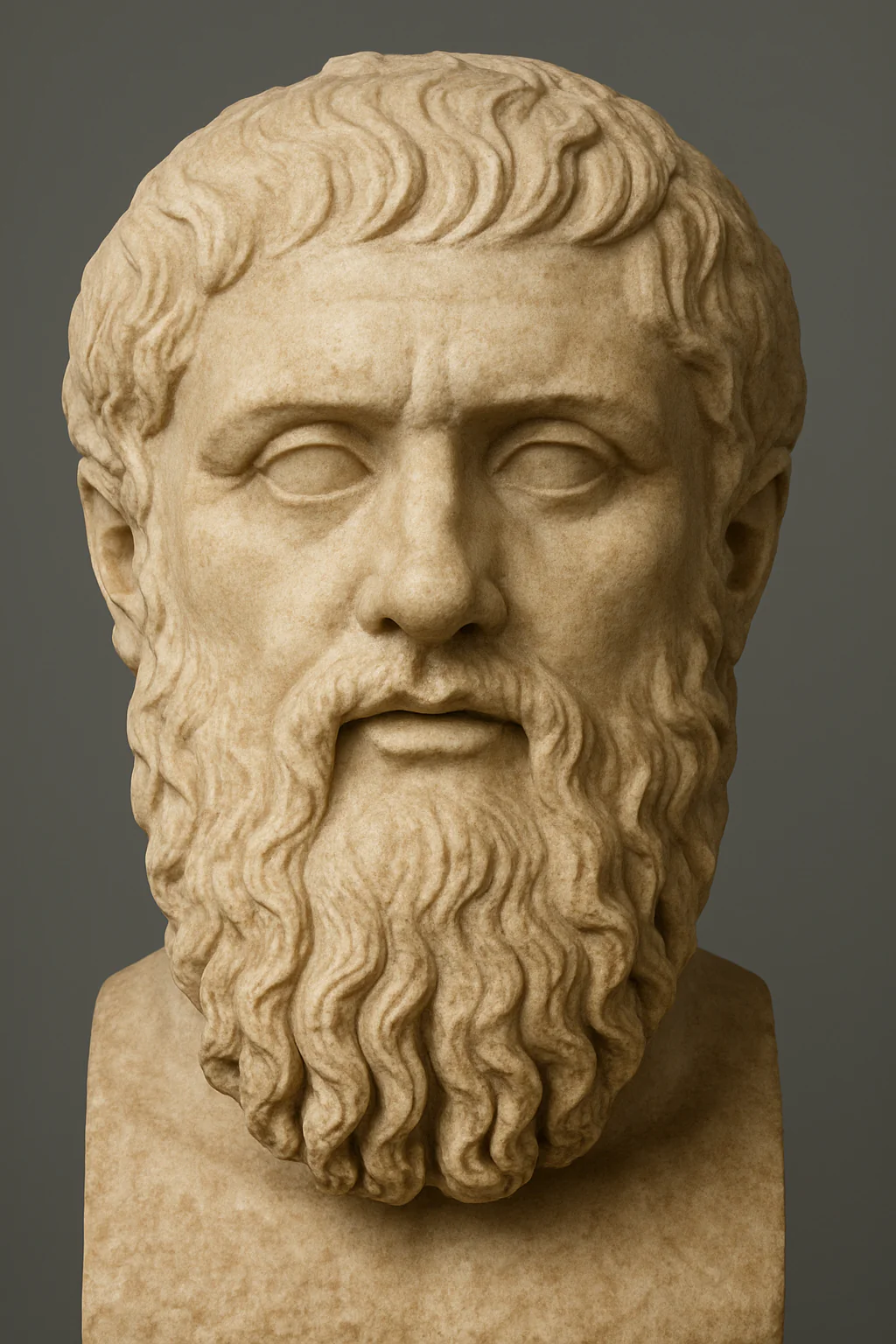
| 112 Quotes | |
| Occup. | Philosopher |
| From | Greece |
| Born | 427 BC Athens, Greece |
| Died | 347 BC |
| Cite | |
Citation Formats
APA Style (7th ed.)
Plato biography, facts and quotes. (2026, February 2). FixQuotes. https://fixquotes.com/authors/plato/
Chicago Style
"Plato biography, facts and quotes." FixQuotes. February 2, 2026. https://fixquotes.com/authors/plato/.
MLA Style (9th ed.)
"Plato biography, facts and quotes." FixQuotes, 2 Feb. 2026, https://fixquotes.com/authors/plato/. Accessed 5 Mar. 2026.
Early Life and Background
Plato was born around 427 BCE into an aristocratic Athenian family during the long trauma of the Peloponnesian War. Ancient testimony links his lineage to prominent clans - later biographers name his father Ariston and his mother Perictione, with kinship ties to figures such as Critias and Charmides, men who would briefly help lead the oligarchic regime of the Thirty in 404-403 BCE. The Athens of his youth was both dazzling and fraying: imperial ambition, naval power, and tragic drama existed alongside factional violence, courtroom politics, and the corrosive insecurity of war.The inner drama of his biography is inseparable from civic collapse. When Athens lost to Sparta in 404 BCE, it lurched between oligarchy and restored democracy, each phase marked by reprisals. Plato appears to have been drawn early toward public life, yet the political world he observed rewarded persuasion more than truth. In later dialogues he would memorialize a young man learning that the city can educate or deform the soul - and that the wrong education can turn gifted citizens into dangerous ones.
Education and Formative Influences
His decisive formation came through Socrates, whom he encountered in early adulthood and followed through the citys intellectual marketplaces. Socratic questioning offered a rival model of excellence: rigorous self-examination, moral seriousness, and indifference to status. The trial and execution of Socrates in 399 BCE, on charges of impiety and corrupting the youth, became Platos permanent wound and organizing motive - a personal bereavement and a philosophical scandal. After Socrates death, Plato traveled in the Greek world; later tradition places him in southern Italy, where Pythagorean mathematics and metaphysical speculation likely reinforced his sense that order and measure could anchor ethics and politics.Career, Major Works, and Turning Points
Back in Athens he founded the Academy, traditionally dated to the 380s BCE, an enduring institution near the grove of Akademos that trained thinkers in dialectic, mathematics, and political theory. Platos works were not treatises but dialogues - Apology, Crito, and Phaedo staging Socrates final days; Symposium and Phaedrus exploring love and the education of desire; Meno and Theaetetus probing knowledge; Gorgias confronting rhetoric and power; and the Republic building his most influential picture of justice, the tripartite soul, and the philosopher-ruler under the light of the Form of the Good. A key turning point was his repeated involvement with Syracuse in Sicily, attempting to educate Dionysius II under the patronage of Dion; the effort ended in disappointment and danger, sharpening his skepticism about whether philosophers can reliably reform tyrants. Late works such as Timaeus, Statesman, and Laws show a sober, architectonic mind revising earlier hopes, trading utopian purity for institutional detail.Philosophy, Style, and Themes
Platos philosophy begins with a psychological diagnosis: humans drift toward appetite, honor, and opinion unless disciplined by reason. He treats ignorance as not merely a lack of information but a moral condition that breeds injustice and self-deception - the city mirrors the soul, and both can be sick. His dialogues turn on the conviction that knowledge is the hinge of right action, not the mere counting of votes or tallying of wealth: “A good decision is based on knowledge and not on numbers”. This stance, forged in democratic Athens but hardened by Socrates execution, explains his suspicion of demagoguery and his insistence that education is the first political question.The form of his writing - characters in conflict, arguments that test their own limits, myths offered as ladders when proof fails - reveals a man wary of dogma yet unwilling to abandon metaphysical ambition. He repeatedly links ethical formation to beauty, rhythm, and disciplined desire; the Symposium and Republic treat eros and music as forces that can elevate or corrupt, depending on guidance. “Music is a moral law. It gives soul to the universe, wings to the mind, flight to the imagination, and charm and gaiety to life and to everything”. Even his sternest politics is anchored in the hope that inner freedom is possible: “The man who makes everything that leads to happiness depends upon himself, and not upon other men, has adopted the very best plan for living happily. This is the man of moderation, the man of manly character and of wisdom”. In that line lies his lifelong tension - the soul must become self-governing, yet it can rarely do so without a city, teachers, and practices that cultivate virtue.
Legacy and Influence
Plato died around 347 BCE, likely in Athens, leaving a school that outlived city-states and empires. Through Aristotle, Middle Platonism, and the Neoplatonists, his concepts of Forms, the immortality of the soul, and the ascent from opinion to knowledge shaped late antique theology and, later, Christian, Jewish, and Islamic philosophy; in the Latin West, Augustine absorbed a Platonized interiority that still frames moral psychology. His political thought became a permanent reference point - admired for its aspiration to justice, criticized for its hierarchy and surveillance - while his dialogue form became a model for thinking in public without reducing thought to slogans. Across centuries, Plato endures less as a system-builder than as an architect of questions: what is a good life, what is knowledge, and what kind of education can make a person - and a city - worthy of freedom.Our collection contains 112 quotes written by Plato, under the main topics: Witty One-Liners - Ethics & Morality - Wisdom - Truth - Justice.
Other people related to Plato: Pythagoras (Mathematician), Heraclitus (Philosopher), Anaxagoras (Philosopher), Democritus (Philosopher), Aristophanes (Poet), Hesiod (Poet), Marcus Terentius Varro (Author), Xenophon (Soldier), Philo (Philosopher), Parmedides (Philosopher)
Frequently Asked Questions
- Plato, education: Founded the Academy; advocated staged education, music, gymnastics, mathematics, and dialectic, to train philosopher-rulers.
- What is Plato known for: Athenian philosopher; founder of the Academy; Theory of Forms; Socratic dialogues; political philosophy in The Republic.
- Plato books: Key dialogues: The Republic, Symposium, Apology, Phaedo, Meno, Timaeus, Phaedrus, Laws.
- Plato meaning: From Greek 'Platon', meaning 'broad' or 'wide-shouldered'.
Plato Famous Works
- -360 Phaedo (Book)
- -370 Phaedrus (Book)
- -380 Meno (Book)
- -380 The Republic (Book)
- -385 The Symposium (Book)
Source / external links