
Pol Pot Biography Quotes 6 Report mistakes
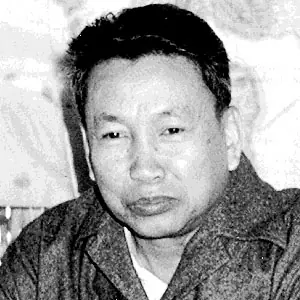
| 6 Quotes | |
| Born as | Saloth Sar |
| Known as | Comrade Pol |
| Occup. | Criminal |
| From | Cambodia |
| Born | May 19, 1925 Kampong Thom Province, French Indochina |
| Died | April 15, 1998 Anlong Veng, Kingdom of Cambodia |
| Cause | Natural |
| Aged | 72 years |
Saloth Sar, later known as Pol Pot, was born on May 19, 1925, in Prek Sbauv village in Kampong Thom province, French Protectorate of Cambodia. His family were comparatively prosperous rural Khmers, connected by marriage and patronage to local officials; this social position exposed him early to the hierarchies of village life and the prestige culture of the royal state, even as most Cambodians lived under colonial extraction and insecurity.
As a boy he moved between countryside and Phnom Penh, spending time near courtly and monastic milieus that prized discipline, status, and a moral order anchored in Buddhism and kingship. The contradiction between Cambodia's ceremonial grandeur and its subordination to France formed a quiet, enduring resentment - not yet ideological, but personal: an ambition to belong to the ruling stratum and a fear of humiliation that would later harden into suspicion of rivals, intellectuals, and any social layer seen as "impure".
Education and Formative Influences
In the late 1940s Saloth Sar traveled to Paris on a scholarship, nominally to study technical subjects, but he was more decisively schooled by politics than by classrooms. In postwar France he encountered Marxist-Leninist and anti-colonial circles, including Cambodian students who debated Viet Minh strategy, Stalinist discipline, and the idea that history could be forced to accelerate by a purified vanguard. The culture of clandestine cells, self-criticism, and ideological certainty suited his temperament: cautious, secretive, and drawn to systems that replaced messy compromise with moral absolutes.
Career, Major Works, and Turning Points
Back in Cambodia, he joined the underground communist movement, rose within the Workers Party of Kampuchea (later the Communist Party of Kampuchea), and by the early 1960s became its principal leader while maintaining an unusually hidden public profile. After years in the jungle organizing cadres and expanding guerrilla zones, the 1970 coup that removed Prince Norodom Sihanouk - and the ensuing civil war, widened by U.S. bombing and Vietnamese involvement - created the opening the Khmer Rouge needed. On April 17, 1975, they captured Phnom Penh and proclaimed Democratic Kampuchea; Pol Pot became prime minister in 1976 and oversaw a radical project of agrarian communism: evacuating cities, abolishing money and markets, collectivizing labor, and building an apparatus of surveillance and terror. The regime's signature institution, S-21 (Tuol Sleng) under Kaing Guek Eav (Duch), processed torture-induced "confessions" and fed purges that spread from alleged CIA and KGB agents to internal rivals and entire ethnic communities. Border war with Vietnam escalated; in December 1978 Vietnam invaded, and in January 1979 the Khmer Rouge were driven from Phnom Penh. Pol Pot continued guerrilla warfare from the Thai border for years, sheltered by Cold War geopolitics and factions seeking to bleed Vietnam, until factional splits, defections, and the loss of patronage left him increasingly isolated. He died on April 15, 1998, in Anlong Veng, after internal detention by his own movement, as international prosecution loomed.
Philosophy, Style, and Themes
Pol Pot's governing idea was that Cambodia could be remade instantly - purified of class, foreign influence, and "corruption" - by annihilating intermediate institutions and forcing the population into a single productive identity: the revolutionary peasant. His style was managerial and evasive: decisions flowed downward through "Angkar" (the Organization), a faceless authority that made obedience feel like fate. That facelessness was not mere propaganda but a psychological strategy - to dissolve personal accountability while intensifying fear. The revolution became a moral machine in which human beings were raw material, valued only for utility and pliability.
His justifications repeatedly framed violence as reluctant patriotism and later as personal innocence. "I want you to know that everything I did, I did for my country". The sentence reveals the inner bargain at the core of his self-concept: if the nation is sacred, then any act can be reclassified as duty rather than crime. When confronted with mass death, he leaned on the language of judgment deferred - "It's up to history to judge". That posture is less humility than insulation, a way to shift the burden from conscience to an abstract tribunal. Yet the regime's ethic was explicit about expendability - "Since he is of no use anymore, there is no gain if he lives and no loss if he dies". In that calculus, empathy is a political error; the individual exists only as a node of labor or a carrier of contamination, and killing becomes administration.
Legacy and Influence
Pol Pot's legacy is inseparable from the Cambodian genocide: roughly 1.7 million people are commonly estimated to have died from execution, starvation, forced labor, and disease between 1975 and 1979, alongside the destruction of families, religion, education, and trust itself. The trauma reshaped Cambodia's demography and moral landscape, while the Cold War afterlife of the Khmer Rouge - including years of diplomatic recognition for an anti-Vietnam coalition - hardened Cambodian cynicism about international principles. The Extraordinary Chambers in the Courts of Cambodia later prosecuted senior Khmer Rouge figures, but Pol Pot died beyond the reach of a verdict, leaving a lingering absence at the center of accountability. His enduring influence is cautionary: a case study in how utopian certainty, secrecy, and bureaucratized dehumanization can turn revolutionary rhetoric into a system where death is policy and memory becomes a battlefield.
Our collection contains 6 quotes who is written by Pol, under the main topics: Freedom - Legacy & Remembrance - Human Rights - War - Humility.
Other people realated to Pol: Jacques Verges (Lawyer)
Source / external links