
Pope Benedict XVI Biography Quotes 11 Report mistakes
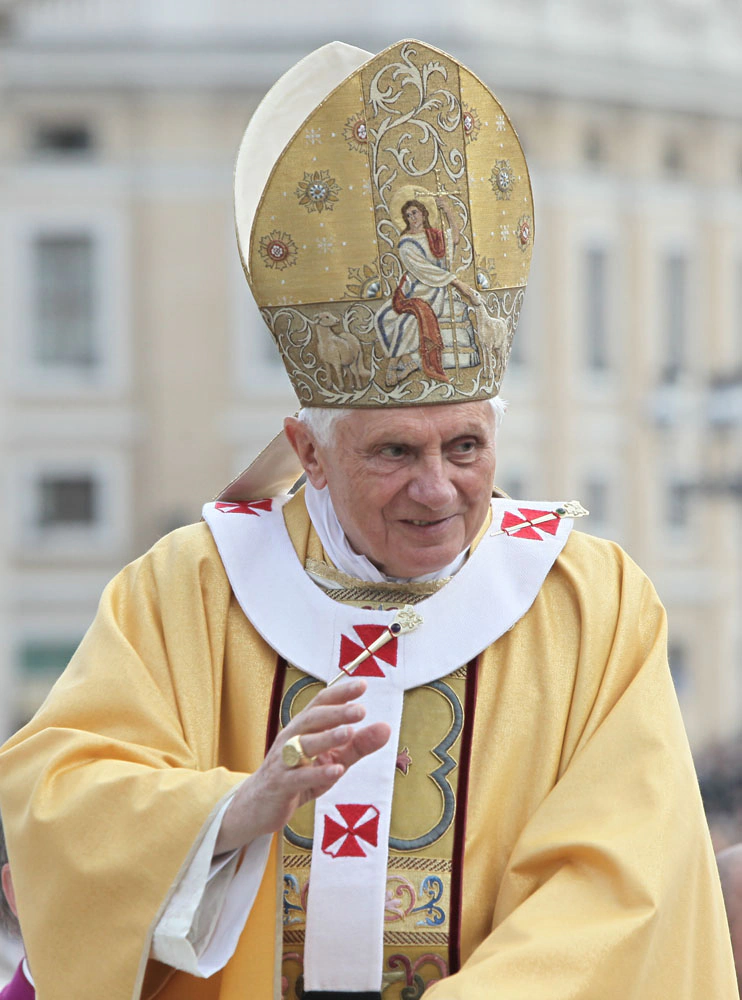
11 Quotes
Born asJoseph Aloisius Ratzinger
Occup.Pope
FromGermany
BornApril 16, 1927
Marktl am Inn, Bavaria, Germany
DiedFebruary 28, 2020
Vatican City
CauseNatural causes
Aged92 years
Early Life and Formation
Joseph Aloisius Ratzinger was born on April 16, 1927, in Marktl am Inn, Bavaria, Germany, the youngest of three children of Joseph Ratzinger, a police officer, and Maria Ratzinger (nee Peintner). He grew up in the region around Traunstein, close to the Austrian border, in a Catholic family that valued learning and faith. Like many of his generation, his adolescence unfolded under the pressures of wartime Germany. He experienced compulsory state organizations, was conscripted in the closing months of World War II, and was briefly held as a prisoner of war before returning home in 1945. These experiences left him wary of ideological coercion and contributed to his lasting defense of human dignity and religious freedom.

After the war, he entered the seminary at Freising with his older brother, Georg Ratzinger, and pursued theological studies at the Ludwig Maximilian University of Munich and the Herzogliches Georgianum. Guided by mentors such as Gottlieb Sohngen and Michael Schmaus, he developed a deep engagement with the Church Fathers, especially Augustine, and with medieval theology. On June 29, 1951, Joseph and Georg were ordained to the priesthood by Cardinal Michael von Faulhaber. The brothers remained close throughout their lives; Georg became a noted church musician and choir director, while Joseph moved toward a scholarly vocation.

Scholar and Council Theologian
Ratzinger completed a doctoral dissertation on Augustine's ecclesiology and, after revisions, a habilitation on the theology of history in St. Bonaventure, achievements that launched him into a prominent academic career. He taught at Bonn, then at the University of Munster, moved to Tubingen during a period of intense intellectual ferment, and later accepted a chair at Regensburg. His colleagues included theologians with a wide range of views; he esteemed figures like Henri de Lubac and Yves Congar, but also clashed with currents that, in his view, risked severing theology from the living faith of the Church. The campus upheavals of 1968 left a strong impression and reinforced his commitment to pairing academic freedom with fidelity to Christian doctrine.

At the Second Vatican Council (1962, 1965) he served as a peritus, or theological expert, for Cardinal Josef Frings of Cologne. In that role he contributed to debates on revelation, the Church, and religious liberty, collaborating with bishops and theologians from across the world, among them Karol Wojtyla of Krakow, the future Pope John Paul II. The experience shaped his lifelong concern for the proper interpretation of the Council, which he later described as a "hermeneutic of reform" rooted in continuity rather than rupture.

Archbishop and Cardinal
In 1977 Pope Paul VI appointed Ratzinger Archbishop of Munich and Freising. He chose the episcopal motto "Cooperators of the Truth" (Cooperatores Veritatis), reflecting a conviction that truth is both received and served. Within months he was created a cardinal, bringing him into closer contact with the universal governance of the Church. In Munich he worked to strengthen catechesis and theological formation, and he remained in close contact with his family; his sister, Maria, managed his household for many years, and Georg continued his ministry in sacred music.

Guardian of Doctrine in Rome
In 1981 Pope John Paul II called Cardinal Ratzinger to Rome to lead the Congregation for the Doctrine of the Faith. As prefect, he became the pope's principal collaborator on doctrinal matters, and their partnership lasted nearly a quarter century. He oversaw documents that clarified essential teachings on Christ, the Church, and moral life, such as Dominus Iesus (2000), which affirmed the uniqueness of Christ and the Church in dialogue with other religions. He engaged critical trends in theology, addressing issues in liberation theology (for example, cases involving Leonardo Boff) while emphasizing the Gospel's preferential love for the poor.

Ratzinger also confronted grave disciplinary issues. With John Paul II he helped establish norms in 2001 that centralized the handling of the most serious canonical crimes, including sexual abuse by clergy, at his congregation. He pushed for swifter canonical procedures and applied penalties in notable cases, including actions in 2006 that removed Marcial Maciel from public ministry. In 2002 he became dean of the College of Cardinals, presiding over the college's deliberations in the years leading to the next conclave.

Pontificate
After John Paul II's death in 2005, the conclave elected Cardinal Ratzinger as the 265th pope on April 19, 2005. He took the name Benedict XVI, evoking Benedict XV's commitment to peace and St. Benedict of Nursia's legacy in European culture. In the early months he continued working closely with Cardinal Angelo Sodano, then appointed Cardinal Tarcisio Bertone as Secretary of State. His longtime aide, Georg Gaenswein, served as personal secretary.

Pope Benedict XVI's teaching focused on the relationship between faith and reason, the centrality of Jesus Christ, and the social implications of charity. His first encyclical, Deus Caritas Est (2005), reflected on Christian love; Spe Salvi (2007) explored hope; Caritas in Veritate (2009) addressed integral human development and social ethics. He authored a widely read trilogy, Jesus of Nazareth, presenting a scholarly yet accessible portrait of Christ. A significant liturgical act of his pontificate was Summorum Pontificum (2007), which broadened the possibility of celebrating the Roman liturgy according to the 1962 Missal.

Benedict devoted energy to ecumenism and interreligious dialogue. His 2006 Regensburg lecture, which reflected on faith, reason, and violence, sparked controversy due to a historical quotation, prompting outreach to Muslim leaders and visits to sites such as Istanbul's Blue Mosque. He deepened ties with the Orthodox, working with Ecumenical Patriarch Bartholomew I, and pursued relations with Anglicans, culminating in the apostolic constitution Anglicanorum coetibus (2009), enabling personal ordinariates for groups entering full communion with Rome. He visited Auschwitz, emphasized reconciliation in Germany, the United Kingdom, and the Holy Land, and presided over World Youth Days in Cologne (2005), Sydney (2008), and Madrid (2011).

Addressing the abuse crisis, Benedict met with survivors in several countries, urged bishops to adopt rigorous safeguarding norms, and wrote a pastoral letter to Catholics in Ireland in 2010. He promoted reforms intended to make canonical processes more effective and emphasized the need for penance, justice, and healing.

Resignation and Years as Pope Emeritus
On February 11, 2013, citing diminishing strength, Benedict XVI announced his resignation, effective February 28. It was the first papal resignation in centuries and drew widespread attention. The conclave elected Pope Francis on March 13, 2013. Benedict took the title Pope Emeritus and moved to the Mater Ecclesiae monastery within the Vatican Gardens. He lived a largely quiet life of prayer and study, remaining in cordial contact with his successor. Francis visited him on significant occasions, and the two men publicly affirmed mutual esteem.

As Pope Emeritus, Benedict avoided public interventions but occasionally wrote theological reflections and correspondence. In 2019 he contributed thoughts on the roots of the abuse crisis. In early 2020, a book on priestly celibacy associated his name with that of Cardinal Robert Sarah; Benedict subsequently clarified his limited contribution and his wish to avoid confusion about authorship. Throughout these years, Archbishop Georg Gaenswein continued as his secretary, facilitating communications and visits. Benedict's brother Georg died in 2020, a loss he bore with characteristic restraint and prayer.

Death and Legacy
Benedict XVI died on December 31, 2022, at the Mater Ecclesiae monastery in Vatican City, at the age of 95. Pope Francis presided at the funeral Mass in St. Peter's Square on January 5, 2023, after which Benedict was buried in the Vatican Grottoes. His passing closed a chapter in which a premier theologian of the twentieth century became a pastor to the world.

Joseph Ratzinger's legacy rests on his sustained effort to show that faith purifies and elevates reason rather than opposing it, and that the Church's renewal must be pursued through continuity with her living tradition. He championed a Christ-centered theology, a reverent liturgical vision, and a moral teaching grounded in truth and love. The relationships that shaped him, from early mentors like Gottlieb Sohngen and Michael Schmaus, to collaborators such as John Paul II, Paul VI, and Francis, to interlocutors including Hans Kung, trace the path of a man who prized clarity without rancor. In scholarship and governance alike, he sought to serve the truth he believed ultimately has a human face.

Our collection contains 11 quotes who is written by Pope, under the main topics: Witty One-Liners - Motivational - Friendship - Faith - Peace.

Other people realated to Pope: Fidel Castro (Statesman), Francis Arinze (Clergyman), Anthony Hopkins (Actor)

Source / external links

11 Famous quotes by Pope Benedict XVI