
Pope Francis Biography Quotes 10 Report mistakes
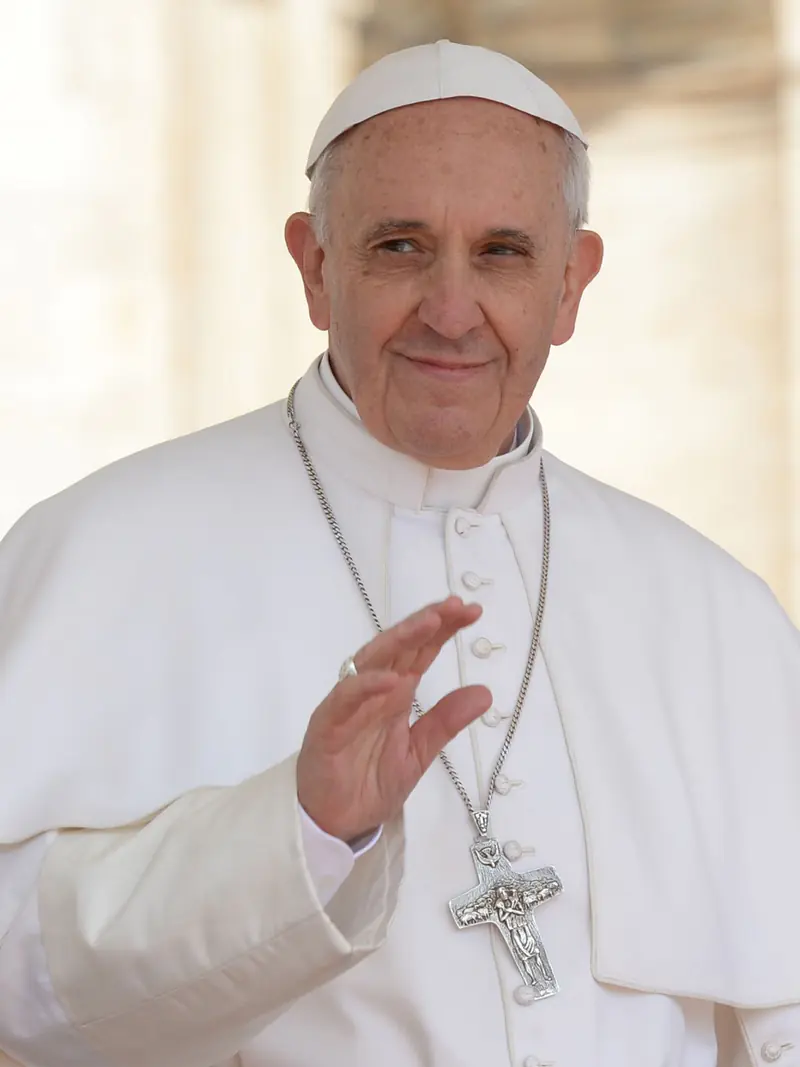
| 10 Quotes | |
| Born as | Jorge Mario Bergoglio |
| Occup. | Pope |
| From | Argentina |
| Born | December 17, 1936 Buenos Aires, Argentina |
| Age | 89 years |
Jorge Mario Bergoglio was born on December 17, 1936, in the Flores neighborhood of Buenos Aires, Argentina, to Mario Jose Bergoglio and Regina Maria Sivori, Italian immigrants who carried with them a culture of hard work, family devotion, and deep Catholic faith. The eldest of five children, he grew up in a modest household shaped by the rhythms of the city and the traditions of the Church. As a teenager he studied at a technical secondary school and earned a qualification as a chemical technician, working for a time in a laboratory. A serious illness in his youth, followed by a decisive experience of confession on the feast of Saint Matthew in 1953, stirred a sense of vocation that gradually redirected his path away from a secular profession toward the priesthood.
He entered the Society of Jesus in 1958, drawn to Ignatian spirituality, its missionary zeal, and its insistence on discernment in service to others. He studied philosophy and theology at Jesuit institutions in Argentina and was ordained a priest on December 13, 1969, by Archbishop Ramon Jose Castellano. Teaching literature and psychology in Jesuit schools, he developed a reputation as a demanding but compassionate educator with a gift for connecting the Gospel to everyday life.
Jesuit Leadership in Argentina
Bergoglio rose quickly in the Jesuit order, becoming provincial superior in Argentina from 1973 to 1979 under the wider leadership of Father Pedro Arrupe, the Jesuit Superior General. His tenure coincided with turbulent years in Argentine society. He insisted that Jesuit communities remain close to the poor and maintained a cautious and protective posture toward collaborators who faced danger. The kidnapping of the Jesuit priests Orlando Yorio and Franz Jalics during the military dictatorship later drew scrutiny to his decisions. Jalics would eventually state that he had reconciled with Bergoglio, while the episode continued to shadow discussions of the Church's role in that era. After serving as provincial, he became rector of the Colegio Maximo and continued to mentor younger Jesuits, emphasizing prayerful discernment, doctrinal fidelity, and practical charity.
A period of relative obscurity followed, including time devoted to spiritual direction and study. Those who worked with him recall a reserved man of intense prayer, marked by simplicity and a ready humor, someone who preferred listening to speaking and who sought to mediate conflicts without public drama.
Episcopal Ministry in Buenos Aires
In 1992, Pope John Paul II appointed Bergoglio auxiliary bishop of Buenos Aires, and he was consecrated by Cardinal Antonio Quarracino. Named coadjutor archbishop in 1997, he succeeded Quarracino in 1998 as archbishop of the sprawling Argentine capital. He cultivated a pastoral style of proximity: traveling by bus, cooking his own meals, and focusing the archdiocese on the "peripheries", especially the villas miserias where he supported priests ministering among the urban poor. He built close ties with leaders of other faiths, notably the rabbi and scholar Abraham Skorka, with whom he held public conversations on ethics and religion.
Created a cardinal by John Paul II in 2001, Bergoglio became known in Rome as a disciplined, understated churchman. He served on several Vatican bodies and twice led the Argentine bishops' conference, where he encouraged unity and a shared pastoral focus amid sharp political and cultural debates in the country. He was respected for plain speech and for insisting that church structures serve evangelization rather than comfort.
Election as Pope
Following the resignation of Pope Benedict XVI in 2013, Bergoglio entered the conclave as a widely respected pastor and spiritual leader. On March 13, 2013, the cardinal protodeacon Jean-Louis Tauran announced his election as the 266th pope. Choosing the name Francis in homage to Saint Francis of Assisi, he signaled a program of renewal grounded in simplicity, care for creation, and closeness to the marginalized. He asked the crowd gathered in St. Peter's Square to pray for him before he imparted his first blessing, setting a tone of humility and reciprocity.
Style and Governance
Pope Francis chose to live at the Casa Santa Marta rather than the Apostolic Palace, explaining that community life helped him pastor better. He strengthened the role of the Secretary of State, entrusting Cardinal Pietro Parolin with key diplomatic and administrative responsibilities. To guide the reform of the Roman Curia, he created a council of cardinal advisers that included figures such as Cardinal Oscar Andres Rodriguez Maradiaga, Cardinal Seán O'Malley, and Cardinal Reinhard Marx. He launched economic reforms and entrusted the Secretariat for the Economy to Cardinal George Pell, initiating audits and new budgeting procedures. Financial cleanup brought tensions and, eventually, a high-profile Vatican trial involving Cardinal Angelo Becciu and others, which Francis allowed to proceed in the Vatican tribunal to underscore accountability.
The reform of the Curia took legislative shape in the apostolic constitution Praedicate evangelium (2022), emphasizing evangelization, service, and a more mission-oriented structure. He elevated lay men and women to leadership roles and widened consultation, including the appointment of Sister Nathalie Becquart as an undersecretary of the synod office with voting rights. His preference for synodality culminated in a multi-year Synod on Synodality, which invited local churches worldwide into prayer, listening, and discernment.
Teaching and Major Texts
Francis's teaching developed a pastoral, missionary emphasis. His programmatic exhortation Evangelii gaudium (2013) called the Church to move outward in joy, to accompany people patiently, and to resist "spiritual worldliness". Lumen fidei (2013), completed at the start of his pontificate, drew on drafts by Benedict XVI. Laudato si' (2015) offered an integral ecology that linked environmental care with social justice and human dignity, and Laudate Deum (2023) urged renewed commitment in the face of climate crisis. Amoris laetitia (2016), the fruit of synods on the family, encouraged pastors to form consciences and integrate fragile family situations with mercy and truth. He later approved a revision of the Catechism describing the death penalty as inadmissible (2018), reflecting a consistent ethic of life. Fratelli tutti (2020) called for social friendship, dialogue against polarization, and a politics centered on the common good. In liturgical matters, Traditionis custodes (2021) reshaped the norms governing the preconciliar Roman liturgy to foster unity.
Diplomacy and Ecumenism
Francis's diplomatic style favors dialogue and behind-the-scenes mediation. He helped facilitate the thaw between the United States and Cuba in 2014, with Cardinal Jaime Ortega of Havana carrying messages to Barack Obama and Raul Castro. Under Cardinal Parolin, the Holy See pursued a provisional agreement with China in 2018, seeking a framework for the appointment of bishops while preserving the Church's freedom; the path remained delicate and contested. Ecumenically, he met Patriarch Kirill of Moscow in 2016, the first such encounter between a pope and a Russian patriarch, and cultivated a close friendship with Ecumenical Patriarch Bartholomew, especially on care for creation. In interreligious dialogue, he signed the Document on Human Fraternity in Abu Dhabi in 2019 with the Grand Imam of Al-Azhar, Ahmed el-Tayeb, advancing a shared vision against extremism and indifference.
Pastoral Initiatives and Global Witness
From his first trip to Lampedusa in 2013, Francis raised a strong moral voice for migrants and refugees, denouncing a "globalization of indifference". He visited many countries on the peripheries of world attention, including Myanmar and Bangladesh, where he met refugees, and Iraq in 2021, offering a message of peace and coexistence. During the COVID-19 pandemic he offered a solitary Urbi et Orbi blessing in a rain-soaked St. Peter's Square in March 2020, praying for a suffering world and commending it to mercy.
Crises and Accountability
The sexual abuse crisis remained a central challenge of his pontificate. In 2014, he established the Pontifical Commission for the Protection of Minors under Cardinal Seán O'Malley to advise on prevention and care for survivors. After initially defending Bishop Juan Barros in Chile, Francis sent Archbishop Charles Scicluna to investigate; he later apologized, met survivors including Juan Carlos Cruz, and accepted the resignation of several bishops. He issued Vos estis lux mundi (2019), setting global procedures for reporting and investigating abuse and cover-up, including accountability for bishops.
Health, Personality, and Daily Habits
Francis's personal style remains simple and informal. He prefers spontaneous encounters, makes phone calls to people in difficulty, and speaks with directness that sometimes stirs debate. As a young man he had part of a lung removed after a severe infection, and in later years he faced sciatica, knee pain, and abdominal surgeries in 2021 and 2023 that he recovered from with patience and humor. He continues to advocate for a "culture of care" rooted in prayer, discernment, and closeness to those who suffer.
Legacy and Influence
Pope Francis stands as the first Jesuit pope, the first from the Americas, and a pastor who brought the language of mercy and mission to the center of Catholic life. The people around him, from Cardinal Pietro Parolin guiding diplomacy to advisers like Cardinal Oscar Rodriguez Maradiaga and Cardinal Reinhard Marx, from reformers like Cardinal George Pell to protectors of minors like Cardinal Seán O'Malley, and from ecumenical and interfaith partners such as Patriarch Bartholomew, Patriarch Kirill, and Ahmed el-Tayeb, have helped shape an expansive, outward-looking pontificate. His engagement with world leaders including Barack Obama and Raul Castro, his collaboration with churchmen like Cardinal Antonio Quarracino and Archbishop Ramon Jose Castellano in earlier decades, his friendship with Rabbi Abraham Skorka, and his trust in investigators like Archbishop Charles Scicluna illustrate a leadership style that combines personal relationships with institutional reform.
At the heart of his biography lies a consistent thread: a man formed by Argentina's barrios and the Spiritual Exercises of St. Ignatius, determined to keep the Church close to the poor, to the young and the elderly, and to a wounded planet, and to call women and men everywhere to build a culture of encounter grounded in the Gospel.
Our collection contains 10 quotes who is written by Pope, under the main topics: Ethics & Morality - Justice - Love - Nature - Faith.
Other people realated to Pope: Pope Paul VI (Clergyman), Pope John XXIII (Clergyman), Greta Thunberg (Environmentalist), Joseph Ratzinger (Clergyman), Hans Kung (Theologian), Roger Mahony (Clergyman), Timothy Radcliffe (Clergyman), Karl Lehmann (Clergyman), John Boehner (Politician), Dionigi Tettamanzi (Clergyman)
Source / external links