
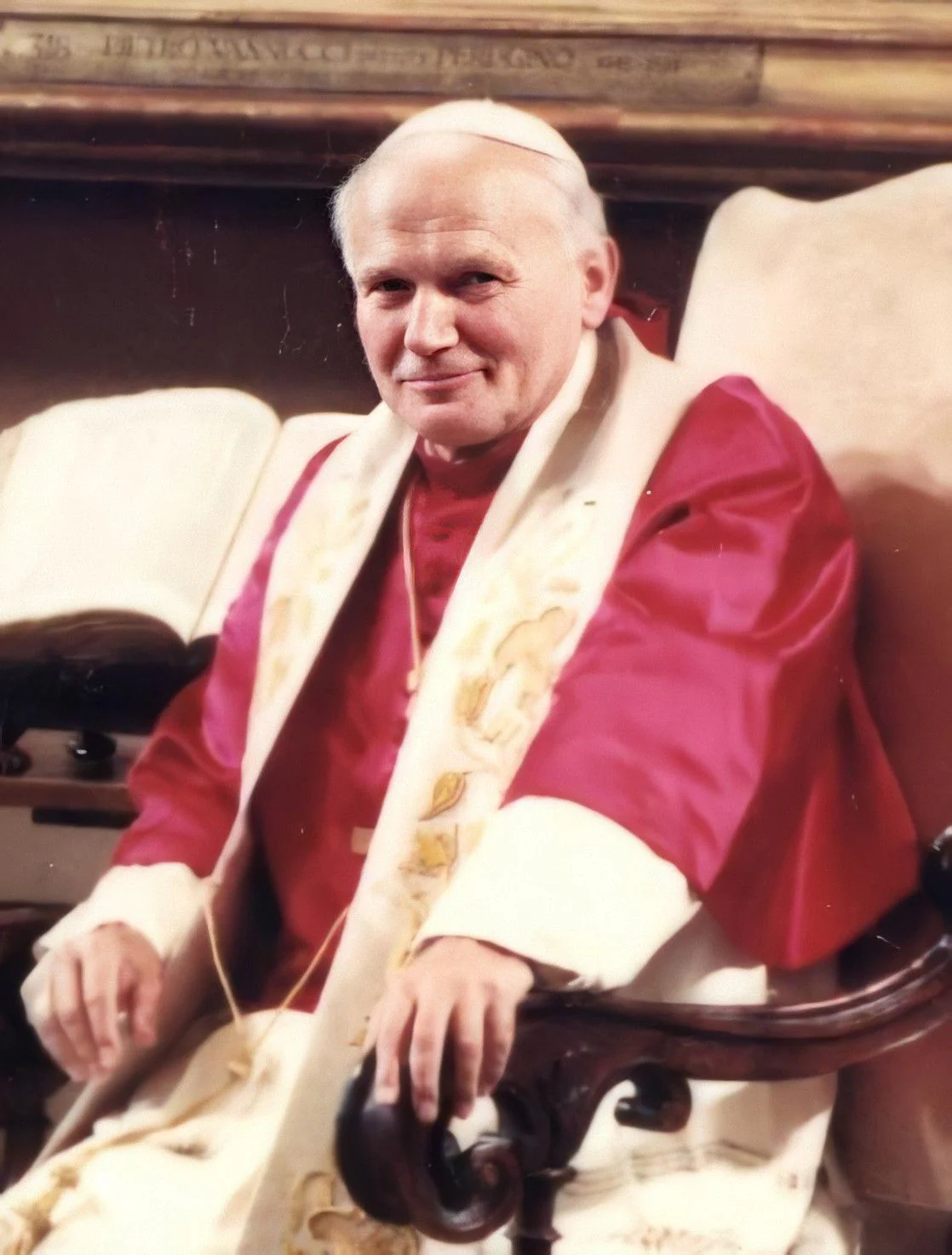
Pope John Paul II Biography Quotes 35 Report mistakes
| 35 Quotes | |
| Born as | Karol Józef Wojtyła |
| Occup. | Clergyman |
| From | Poland |
| Born | May 18, 1920 Wadowice, Poland |
| Died | April 2, 2005 Vatican City |
| Cause | Septic shock due to urinary tract infection |
| Aged | 84 years |
| Cite | |
Citation Formats
APA Style (7th ed.)
Pope john paul ii biography, facts and quotes. (2026, February 2). FixQuotes. https://fixquotes.com/authors/pope-john-paul-ii/
Chicago Style
"Pope John Paul II biography, facts and quotes." FixQuotes. February 2, 2026. https://fixquotes.com/authors/pope-john-paul-ii/.
MLA Style (9th ed.)
"Pope John Paul II biography, facts and quotes." FixQuotes, 2 Feb. 2026, https://fixquotes.com/authors/pope-john-paul-ii/. Accessed 25 Mar. 2026.
Early Life and Background
Karol Jozef Wojtyla was born on 18 May 1920 in Wadowice, a small town near Krakow in the newly reborn Polish Republic. His family life was marked early by loss: his mother, Emilia Kaczorowska Wojtyla, died in 1929; his only sibling, Edmund, a physician, died in 1932; and his father, Karol Wojtyla Sr., a former Austro-Hungarian army officer turned civil servant, became the central moral presence of his adolescence. The cadence of prayer, Polish patriotism, and ordinary working-class discipline formed the atmosphere in which the boy learned that love could be steady even when history was not.The Poland of Wojtyla's youth was a borderland of cultures and anxieties, with Catholic piety existing alongside Jewish neighbors and the ever-present memory of partition and war. In 1939, Nazi Germany invaded and Poland collapsed into occupation and terror; Krakow became a city of curfews, roundups, and the slow disappearance of public life. Wojtyla worked in a quarry and then at the Solvay chemical plant, experiences that later gave his theology a laborer's concreteness: the body had dignity, and suffering was not an abstraction. When his father died in 1941, he was left with a solitude that pressed him inward, turning grief into vocation rather than bitterness.
Education and Formative Influences
Before the war, Wojtyla studied Polish philology at Jagiellonian University and acted with the Rhapsodic Theatre, where clandestine performances defended language and memory against Nazi cultural annihilation. Under occupation he entered the underground seminary in Krakow (1942) under Archbishop Adam Stefan Sapieha, was ordained a priest on 1 November 1946, and pursued advanced study in Rome at the Pontifical University of St. Thomas Aquinas (Angelicum), writing on St. John of the Cross. Back in Poland, he ministered to students and young workers, later completing a habilitation that matured into his philosophical synthesis of Thomism and phenomenology, culminating in the influential work "The Acting Person" (1969).Career, Major Works, and Turning Points
Appointed auxiliary bishop of Krakow in 1958 and archbishop in 1964, Wojtyla became a significant voice at the Second Vatican Council (1962-1965), contributing notably to "Gaudium et Spes" and to the defense of religious liberty amid Cold War pressures. Made a cardinal in 1967, he navigated communist surveillance while building parishes, supporting intellectual life, and defending the Church's public space. On 16 October 1978 he was elected pope - the first non-Italian in centuries - taking the name John Paul II; his pontificate became one of the longest and most traveled, shaped by a 1981 assassination attempt in St. Peter's Square, his role in sustaining Poland's Solidarity movement, landmark encyclicals ("Redemptor Hominis", "Laborem Exercens", "Sollicitudo Rei Socialis", "Centesimus Annus"), a global evangelizing program, and a persistent effort to interpret modernity without surrendering doctrine. In later years Parkinson's disease and physical decline turned his body into a public testament; he died in Rome on 2 April 2005.Philosophy, Style, and Themes
John Paul II's inner life fused mysticism with an actor's sense of the human person as drama - freedom tested by love, truth, and suffering. He insisted that freedom was not self-invention but moral vocation: “Freedom consists not in doing what we like, but in having the right to do what we ought”. This was not a slogan but a diagnosis drawn from totalitarianism and consumerism alike, both of which promised liberation while training desire to obey. His political imagination was personalist rather than partisan: the state exists for the person, and the person is intelligible only in relation - to God, to others, and to conscience.His style was pastoral and philosophically muscular, often moving from anthropology to social ethics: family, work, and culture were not private hobbies but civilizational foundations - “As the family goes, so goes the nation and so goes the whole world in which we live”. The same logic shaped his warnings about nationalism and ideological captivity: “Pervading nationalism imposes its dominion on man today in many different forms and with an aggressiveness that spares no one. The challenge that is already with us is the temptation to accept as true freedom what in reality is only a new form of slavery”. Even his optimism was disciplined, born from Easter theology and from surviving the century's massacres; he preached hope as a choice against despair, not a temperament.
Legacy and Influence
John Paul II left a Church more globally visible, intellectually assertive, and publicly engaged, with a reenergized papacy that spoke directly to youth, workers, dissidents, and believers behind the Iron Curtain. He helped accelerate communism's moral unraveling in Eastern Europe while also challenging Western societies on abortion, consumerism, and the reduction of the person to economics or pleasure; his "Theology of the Body" reshaped Catholic discourse on sex and marriage, and his interreligious gestures - including outreach to Jews and visits to synagogues and the Holy Land - recalibrated Catholic-Jewish relations after the Holocaust. Canonized in 2014, he remains a polarizing figure to some and a model of courageous pastoral leadership to many, but even critics concede the scale of his influence: a philosopher-pope who made human dignity the central battlefield of late-20th-century history.Our collection contains 35 quotes written by Pope, under the main topics: Witty One-Liners - Justice - Music - Love - Freedom.
Other people related to Pope: Roger Mahony (Clergyman), Francis Arinze (Clergyman), Rocco Buttiglione (Politician), Lindy Boggs (Politician), Basil C. Hume (English), Carl Bernstein (Journalist), Helen Prejean (Writer), Basil Hume (Clergyman), Bronislaw Geremek (Historian), Wojciech Jaruzelski (Leader)