
Pope Paul VI Biography Quotes 25 Report mistakes
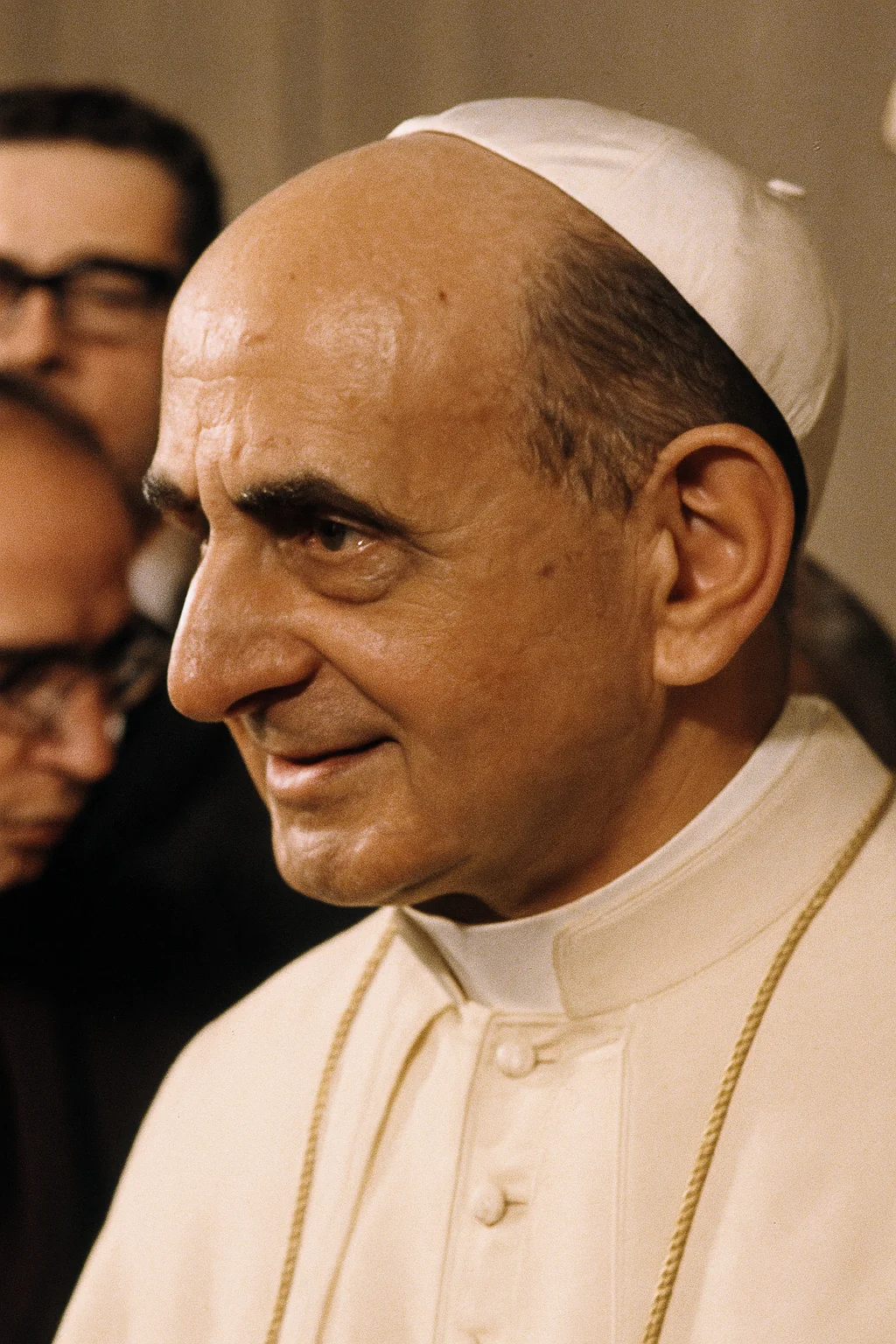
Attr: Yoichi Okamoto
| 25 Quotes | |
| Born as | Giovanni Battista Enrico Antonio Maria Montini |
| Known as | Giovanni Battista Montini |
| Occup. | Clergyman |
| From | Italy |
| Born | September 26, 1897 Concesio, Italy |
| Died | August 6, 1978 Castel Gandolfo, Italy |
| Cause | heart attack |
| Aged | 80 years |
| Cite | |
Citation Formats
APA Style (7th ed.)
Pope paul vi biography, facts and quotes. (2026, February 11). FixQuotes. https://fixquotes.com/authors/pope-paul-vi/
Chicago Style
"Pope Paul VI biography, facts and quotes." FixQuotes. February 11, 2026. https://fixquotes.com/authors/pope-paul-vi/.
MLA Style (9th ed.)
"Pope Paul VI biography, facts and quotes." FixQuotes, 11 Feb. 2026, https://fixquotes.com/authors/pope-paul-vi/. Accessed 25 Mar. 2026.
Early Life and Background
Giovanni Battista Enrico Antonio Maria Montini was born on September 26, 1897, in Concesio, near Brescia, in Lombardy, a region where Catholic social activism met the tensions of a newly unified Italy. His family was prominent and civic-minded: his father, Giorgio Montini, was a lawyer, journalist, and Catholic politician associated with the Popular Party milieu; his mother, Giuditta Alghisi, anchored a piety that was practical rather than theatrical. The household blended parish devotion with newspapers, debate, and a sense that faith had public responsibilities, a mix that would later shape Montini's insistence that the Church speak to modern life without surrendering its core.He grew up physically fragile and introspective, a temperament that pushed him toward disciplined study and an interior spirituality rather than easy sociability. The First World War and the social upheavals that followed did not make him a firebrand; they made him a careful reader of history, suspicious of mass enthusiasms and ideological shortcuts. From early on, he learned to interpret the Church as a long memory in a volatile century - a posture that would define his papacy: patient, analytical, often lonely, and determined to keep lines of communication open even when the culture seemed to reward rupture.
Education and Formative Influences
Montini entered the seminary in Brescia and was ordained a priest on May 29, 1920; he soon studied in Rome at the Gregorian University and the Pontifical Ecclesiastical Academy, preparing for diplomatic and curial service. Early assignments in the Secretariat of State placed him close to the machinery of global Catholicism and the emerging challenges of totalitarian politics, modern media, and mass movements. Equally formative was his long involvement with FUCI, the Italian Catholic university students, where he learned to take intellectuals seriously, to argue rather than condemn, and to frame conscience and culture as arenas of evangelization.Career, Major Works, and Turning Points
He rose within the Vatican under Pius XI and Pius XII, becoming Substitute in the Secretariat of State in 1937 and absorbing the burdens of wartime diplomacy and postwar reconstruction; in 1954 he was sent to Milan as archbishop, a seeming exile that became his pastoral proving ground amid factory labor, migration, and secularization. Created cardinal in 1958, he was elected pope on June 21, 1963, taking the name Paul VI and immediately making the Second Vatican Council his defining task: he guided it to conclusion in 1965, then carried the heavier work of implementation, reforming the Roman Curia and pressing a global, dialogical Catholicism. His key texts mark the era's fault lines: Ecclesiam suam (1964) on dialogue, Populorum progressio (1967) on integral human development, and Humanae vitae (1968) on the moral limits of contraception, a decision that drew fierce dissent and exposed the strain between pastoral adaptation and doctrinal continuity. He also became the first pope in the modern age to travel widely, stepping onto the world stage at the United Nations in 1965 and visiting the Holy Land in 1964, where his meeting with Patriarch Athenagoras signaled a new ecumenical seriousness.Philosophy, Style, and Themes
Paul VI's interior life was marked by a constant effort to hold together contemplation and governance. He believed the Church could not retreat into sacral self-protection, yet he feared a Church that mistook novelty for renewal. His writing returns to conscience, dialogue, and the discipline of worship as the engine of charity. Liturgy, for him, was not aesthetic preference but spiritual anthropology: “The Eucharistic mystery stands at the heart and center of the liturgy since it is the fount of life by which we are cleansed and strengthened to live not for ourselves but for God and to be united in love among ourselves”. That conviction explains both his support for postconciliar liturgical reform and his anxiety that activism without adoration would hollow the Church from within.His social teaching was similarly synthetic: he read technology, economics, and sexuality as tests of whether modernity could produce meaning, not merely options. “Technological society has succeeded in multiplying the opportunities for pleasure, but it has great difficulty in generating joy”. The line captures his psychological posture - a man alert to seductions that numb the soul, and to the loneliness that follows when transcendence is traded for consumption. Even in the storm around Humanae vitae, his reasoning aimed less at control than at a human ecology of love and responsibility, summed up in his insistence: “You must strive to multiply bread so that it suffices for the tables of mankind, and not rather favor an artificial control of birth, which would be irrational, in order to diminish the number of guests at the banquet of life”. His style was cautious, sometimes anguished, but rarely cynical; he governed like someone who believed history could be redeemed, yet knew redemption would not be cheap.
Legacy and Influence
Paul VI died at Castel Gandolfo on August 6, 1978, having carried the heaviest transitional papacy of the twentieth century: closing Vatican II, translating its decrees into institutions, and enduring the backlash from both traditionalists and progressives. His legacy is the architecture of the postconciliar Church - the Synod of Bishops, a global pastoral presence, ecumenical and diplomatic openings, and a social doctrine that linked development to human dignity. Canonized in 2018, he remains a reference point for popes who navigate continuity and change: a modern successor of Peter who wagered that dialogue and doctrine could coexist, and that the Church's credibility would depend not on winning the century, but on serving it without becoming it.Our collection contains 25 quotes written by Pope, under the main topics: Witty One-Liners - Motivational - Ethics & Morality - Wisdom - Art.
Other people related to Pope: Athenagoras I (Clergyman), Robert McAfee Brown (Theologian), Dionigi Tettamanzi (Clergyman), Jean Guitton (Philosopher)
Frequently Asked Questions
- Pope Paul VI miracles: Two approved miracles: healings of unborn children after prayers for his intercession (one in California, one in Italy).
- What is Pope Paul VI the patron saint of: No officially designated patronage.
- Pope Paul VI funeral: 12 August 1978, simple rites in St. Peter's Square; buried in St. Peter's Basilica.
- Pope Paul VI successor: Pope John Paul I.
- Pope Paul VI (born): 26 September 1897, Concesio, Brescia, Italy.
- Why was Pope Paul VI important: He guided and implemented Vatican II reforms, advanced ecumenism, modernized the liturgy, expanded global outreach, and authored Humanae Vitae.
- What did Pope Paul VI died from: A heart attack (myocardial infarction).
- Pope Paul VI died: 6 August 1978, at Castel Gandolfo, Italy.
- How old was Pope Paul VI? He became 80 years old
Source / external links