
Pythagoras Biography Quotes 24 Report mistakes
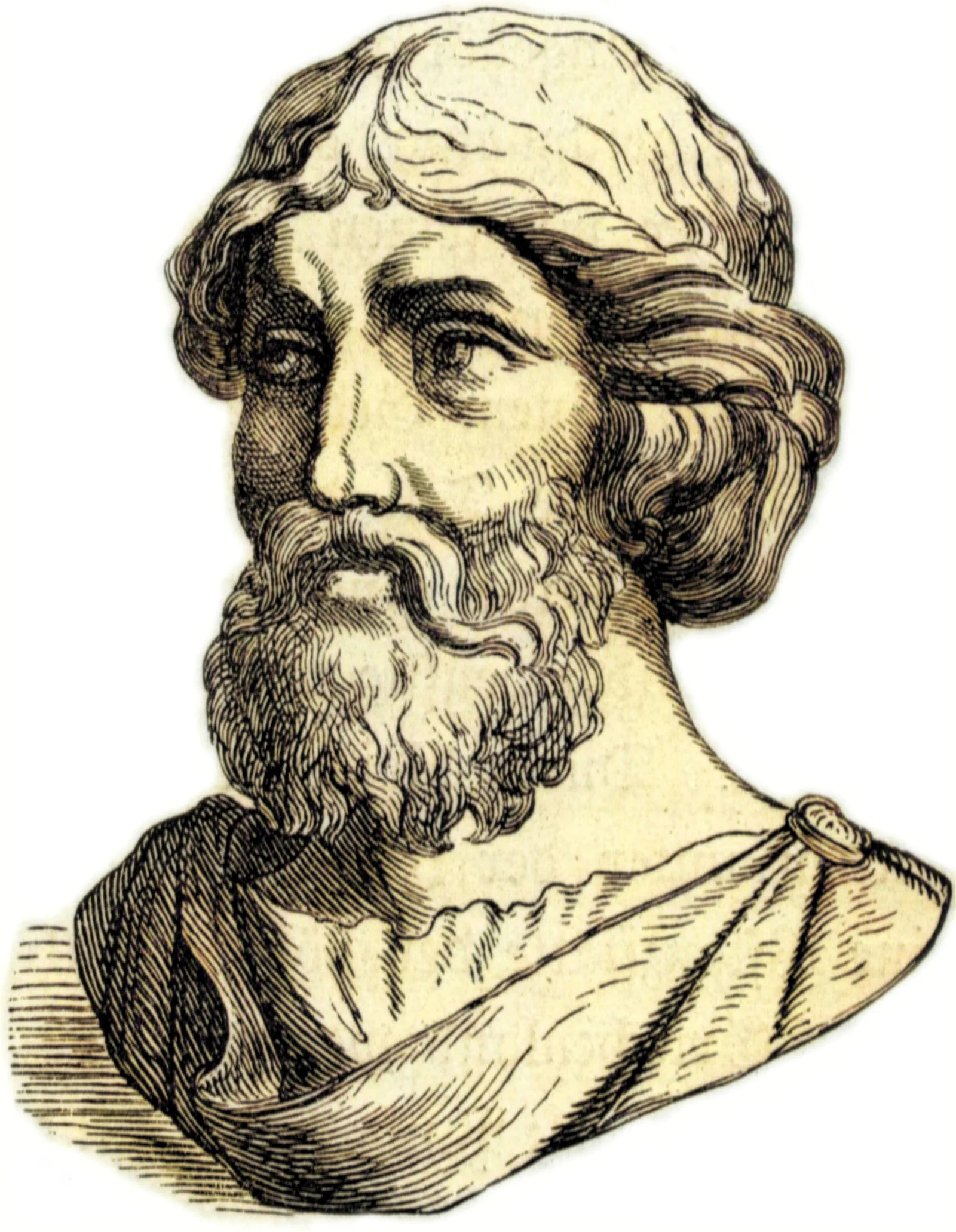
| 24 Quotes | |
| Known as | Pythagoras of Samos |
| Occup. | Mathematician |
| From | Greece |
| Born | 570 BC Samos |
| Died | 495 BC Metapontum |
| Cite | |
Citation Formats
APA Style (7th ed.)
Pythagoras biography, facts and quotes. (2026, February 2). FixQuotes. https://fixquotes.com/authors/pythagoras/
Chicago Style
"Pythagoras biography, facts and quotes." FixQuotes. February 2, 2026. https://fixquotes.com/authors/pythagoras/.
MLA Style (9th ed.)
"Pythagoras biography, facts and quotes." FixQuotes, 2 Feb. 2026, https://fixquotes.com/authors/pythagoras/. Accessed 4 Mar. 2026.
Early Life and Background
Pythagoras was born around 570 BCE on Samos, an Aegean island caught between Greek civic ambition and the expanding power of Lydia and Persia. Later writers cast him as the son of Mnesarchus and Pythais, but even these basics arrive through layers of legend, a sign of how quickly his life became a template for the philosophic holy man. Samos in his youth was commercially connected and culturally mixed, with seafaring wealth, new technical knowledge, and the pressure of tyranny - conditions that made questions of order, measure, and self-rule more than abstractions.Ancient tradition places his departure from Samos under Polycrates tyranny, a move that reads less like exile than self-invention: the mathematician as moral legislator. The world he entered was the early classical Mediterranean, where Ionian natural philosophy, mystery cults, and practical mathematics traveled the same routes as grain and silver. Pythagoras absorbed that cosmopolitan atmosphere and then reacted against it by building a counter-world: a disciplined community in which number, ritual, and ethics were fused into a single way of life.
Education and Formative Influences
No contemporary biography survives, so his education must be reconstructed from plausible contacts and later testimony: he was linked to Ionian thinkers such as Thales and Anaximander, and to travels in Egypt and perhaps Babylonia, where geometry, calendrics, and priestly discipline were mature arts. Whether every journey happened as told matters less than what the tradition preserves about his formation - a conviction that mathematical structures are not merely tools but revelations, and that the soul can be trained, purified, and even relocated across lives (metempsychosis). In that milieu, mathematics, music, and religion were not separate departments; they were different doors into the same hidden architecture of the cosmos.Career, Major Works, and Turning Points
By about mid-life Pythagoras settled in Croton in Magna Graecia (southern Italy), founding a brotherhood that functioned as school, ethical order, and political faction. The Pythagoreans practiced secrecy, communal property, graded initiation, and rules governing diet and conduct; they studied arithmetic, geometry, harmonics, and astronomy, and treated these as spiritual exercises as much as intellectual pursuits. The theorem later named for him was known in Babylonian contexts earlier, but in the Greek world his circle helped turn such results into demonstrative knowledge - proofs, definitions, and the idea that reasoned structure could ground certainty. The movement became influential enough to provoke backlash: factional violence in several cities, traditionally including an attack on a meeting house at Croton, scattered the group; Pythagoras himself is usually said to have died around 495 BCE at Metapontum, where his memory was preserved as that of a founder-sage rather than a mere technician.Philosophy, Style, and Themes
At the center of Pythagorean thought lies an audacious psychological wager: mastery of the self is the precondition for understanding the world. The discipline of silence, the regulation of appetite, and the submission to communal rule were meant to produce inner clarity, not social conformity. His ethic is captured by the maxim “No one is free who has not obtained the empire of himself”. Freedom, for Pythagoras, was not the absence of constraint but the presence of an inner governor strong enough to keep desire from breaking the soul into factions.That inward government served a cosmology in which number is both explanatory and devotional. Harmonics - the discovery that musical intervals correspond to simple numerical ratios - became a model for the intelligibility of nature and the hope that human life could be tuned to it. “There is geometry in the humming of the strings, there is music in the spacing of the spheres”. In this view, mathematics is not cold but consoling: it promises that behind noise and conflict there is proportion. His preference for concise, aphoristic instruction also reflects a belief that speech should sharpen, not intoxicate: “Do not say a little in many words but a great deal in a few”. The secrecy of the school, often criticized, can be read as an extension of this psychology - ideas were not entertainment but commitments that could reshape a life.
Legacy and Influence
Pythagoras left no undisputed writings, yet his influence is among the most durable in intellectual history because his community made ideas into practices and practices into identities. Plato and later Platonists absorbed the Pythagorean marriage of mathematics and metaphysics; Greek mathematics inherited the ideal of proof; musicians and astronomers inherited a dream of lawful harmony; moralists inherited an image of philosophy as an askesis, a training of the whole person. Even where particular doctrines were rejected, the Pythagorean provocation endured: that reality is structured, that the mind can mirror that structure, and that a life ordered by measure may be the most radical form of freedom.Our collection contains 24 quotes written by Pythagoras, under the main topics: Ethics & Morality - Wisdom - Friendship - Freedom - Reason & Logic.
Other people related to Pythagoras: Marsilio Ficino (Philosopher)
Frequently Asked Questions
- Pythagoras education: Pythagoras received education in philosophy, mathematics, and religious teachings, influenced by his travels in Egypt and other regions.
- What was Pythagoras famous for: Pythagoras was primarily famous for the Pythagorean theorem and his influence on mathematics and philosophical teachings.
- Pythagoras meaning: Pythagoras is a name from Greek origin meaning 'Pythian Apollo' and 'assembly of the people'.
- Pythagoras born and died: Pythagoras was born around 570 BCE and died around 495 BCE.
- Pythagoras' philosophy: Pythagoras' philosophy included the belief in the immortality of the soul and the idea that the universe is governed by numbers.
- Pythagoras theorem: The Pythagorean theorem states that in a right triangle, the square of the hypotenuse is equal to the sum of the squares of the other two sides.
- Pythagoras contribution to mathematics: Pythagoras contributed by developing the Pythagorean theorem in geometry, which relates the sides of a right triangle.
Source / external links