
R. Buckminster Fuller Biography Quotes 41 Report mistakes
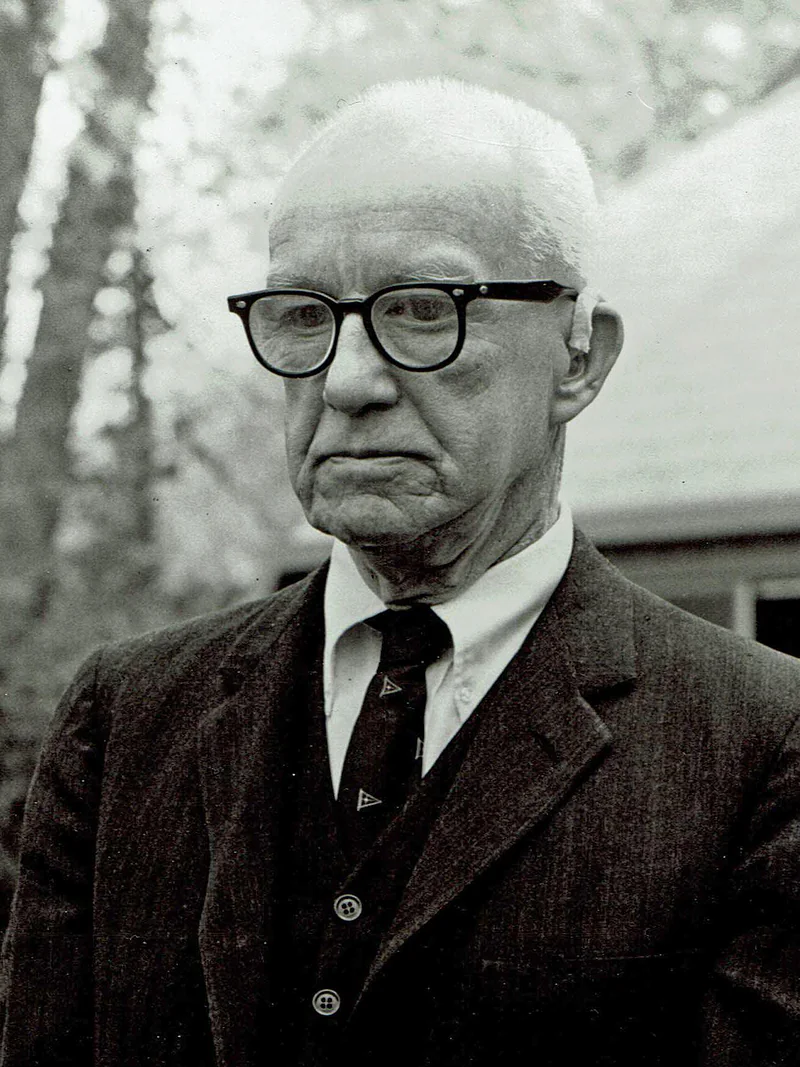
| 41 Quotes | |
| Born as | Richard Buckminster Fuller |
| Known as | Buckminster Fuller |
| Occup. | Inventor |
| From | USA |
| Born | July 12, 1895 Milton, Massachusetts, USA |
| Died | July 1, 1983 Los Angeles, California, USA |
| Cause | heart attack |
| Aged | 87 years |
| Cite | |
Citation Formats
APA Style (7th ed.)
R. buckminster fuller biography, facts and quotes. (2026, February 11). FixQuotes. https://fixquotes.com/authors/r-buckminster-fuller/
Chicago Style
"R. Buckminster Fuller biography, facts and quotes." FixQuotes. February 11, 2026. https://fixquotes.com/authors/r-buckminster-fuller/.
MLA Style (9th ed.)
"R. Buckminster Fuller biography, facts and quotes." FixQuotes, 11 Feb. 2026, https://fixquotes.com/authors/r-buckminster-fuller/. Accessed 26 Mar. 2026.
Early Life and Background
Richard Buckminster Fuller was born on 1895-07-12 in Milton, Massachusetts, into a New England family that mixed privilege with insecurity. Summers on Bear Island off the coast of Maine gave him a laboratory of tides, wind, and improvised tools; he learned by making, failing, and making again. His father died when Fuller was young, and the household centered on his mother, Caroline Wolcott Andrews, who both protected him and expected him to amount to something - a tension that later surfaced in his obsession with proving usefulness rather than chasing status.He grew up with strong eyesight problems and a restless temperament that made conventional schooling feel like confinement. That mismatch between his quick pattern recognition and institutional pace fostered a lifelong suspicion of credentialed authority. Early on he absorbed two equal and opposite truths: the world could be engineered, and the individual could be abruptly knocked off course by forces larger than intention. That duality later shaped his conviction that design had to serve the whole human system, not just personal success.
Education and Formative Influences
Fuller entered Harvard College in 1913 but was dismissed, readmitted, and ultimately left without a degree, an early rupture that hardened his independence while leaving a bruise he never quite stopped pressing. During World War I he served in the U.S. Navy, where logistics, navigation, and standardization sharpened his sense that complex outcomes hinge on simple rules. After the war he worked in the building trades and eventually in his father-in-law's company, Stockade Building System, trying to industrialize housing components; the venture faltered, and by the mid-1920s his finances and reputation were in crisis.Career, Major Works, and Turning Points
In 1927, after business failure and the death of his young daughter Alexandra, Fuller experienced what he later described as a near-suicidal turning point on a Chicago lakeshore and resolved to treat his life as an experiment in what one ordinary person could do for all humanity. From that self-imposed mission came the Dymaxion program - "dynamic maximum tension" - a suite of prototypes and arguments: the Dymaxion House (lightweight, mass-producible shelter), the Dymaxion Car (streamlined, efficiency-driven transport), and the Dymaxion Map (an icosahedral projection intended to reduce geopolitical distortion). His geodesic dome research, developed through the 1940s and publicized after the postwar years, culminated in wide attention and institutional roles, including teaching and lecturing at places such as Black Mountain College and later as a public intellectual whose books - notably "Operating Manual for Spaceship Earth" (1969) - framed the planet as a closed system requiring design-level stewardship.Philosophy, Style, and Themes
Fuller read the 20th century as an engineering problem inside a moral emergency: industrial power had outrun ethical coordination, and scarcity politics were becoming a choice rather than a fate. His method was to think in systems and to speak in neologisms, diagrams, and geometric proofs, insisting that the smallest structural insight could scale to planetary consequence. He warned that technologies are not neutral in human hands, and the line between playful experimentation and organized harm can thin quickly: “Those who play with the devil's toys will be brought by degrees to wield his sword”. The warning is psychological as much as political - a self-portrait of a mind that feared seduction by cleverness and tried to bind invention to accountability.Yet his tone was rarely despairing. He believed design could convert brute forces into allies, and that the future was something to be drafted rather than endured: “We are called to be architects of the future, not its victims”. That sentence distills his inner posture - a man using optimism as discipline, not as mood. Even his aesthetic claims were diagnostic: for Fuller, elegance was evidence of truth and economy, a check against ego-driven complication. “When I am working on a problem, I never think about beauty but when I have finished, if the solution is not beautiful, I know it is wrong”. Beauty, in his psychology, was the conscience of engineering.
Legacy and Influence
Fuller died on 1983-07-01 in Los Angeles, days after the death of his wife, Anne Hewlett Fuller, closing a partnership that anchored his itinerant public life. His enduring influence is less a single invention than a vocabulary for planetary responsibility: "Spaceship Earth", comprehensive design, doing "more with less", and the dome as a symbol of lightweight strength. Architects, sustainability thinkers, systems engineers, and technology idealists still argue with him - about technocracy, about naivete, about the limits of design - but they often do so in concepts he helped popularize. In an era defined by world war, Cold War scale, and ecological awakening, Fuller made the case that the human future is a design problem, and that the designer is not a specialist but a citizen who refuses to accept tragedy as the default setting.Our collection contains 41 quotes written by Buckminster Fuller, under the main topics: Ethics & Morality - Truth - Wisdom - Love - Mortality.
Other people related to Buckminster Fuller: James Dyson (Designer), Isamu Noguchi (Sculptor)