
Rainer Maria Rilke Biography Quotes 33 Report mistakes
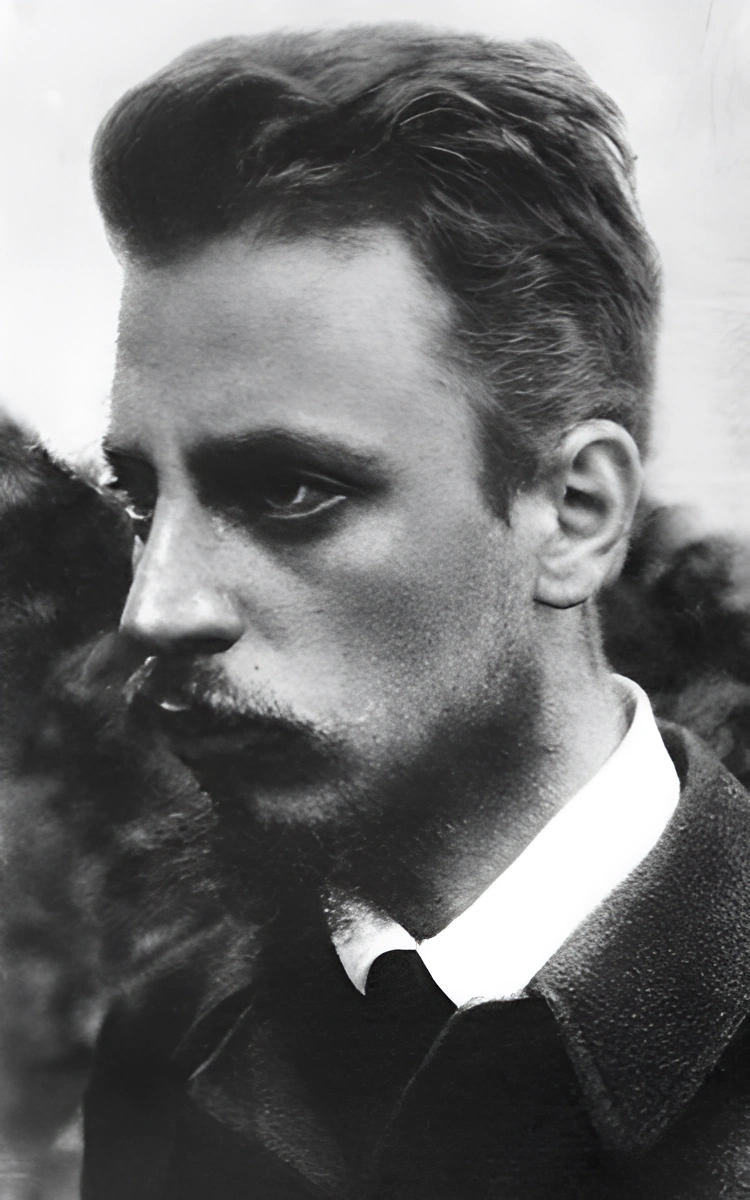
Attr: Wikimedia
| 33 Quotes | |
| Born as | René Karl Wilhelm Johann Josef Maria Rilke |
| Occup. | Poet |
| From | Germany |
| Born | December 4, 1875 Prague, Austria-Hungary |
| Died | December 29, 1926 Val-Mont, Montreux, Switzerland |
| Cause | leukemia |
| Aged | 51 years |
| Cite | |
Citation Formats
APA Style (7th ed.)
Rainer maria rilke biography, facts and quotes. (2026, February 11). FixQuotes. https://fixquotes.com/authors/rainer-maria-rilke/
Chicago Style
"Rainer Maria Rilke biography, facts and quotes." FixQuotes. February 11, 2026. https://fixquotes.com/authors/rainer-maria-rilke/.
MLA Style (9th ed.)
"Rainer Maria Rilke biography, facts and quotes." FixQuotes, 11 Feb. 2026, https://fixquotes.com/authors/rainer-maria-rilke/. Accessed 21 Mar. 2026.
Early Life and Background
Rainer Maria Rilke was born Rene Karl Wilhelm Johann Josef Maria Rilke on 1875-12-04 in Prague, then in the Austro-Hungarian Empire, into a German-speaking Catholic family whose ambitions and disappointments pressed hard on an only child. His father, Josef Rilke, had left a hoped-for military career and worked in the railways; his mother, Sophie "Phia" Entz, came from a more comfortable merchant background and poured into her son an intense, sometimes possessive attention. Their marriage fractured early, and the boy grew up amid alternating tenderness and instability, learning to read the weather of adult moods with the sensitivity that later made his poems feel like instruments calibrated to tremor and silence.The era he entered was one of accelerating modernity - urban growth, new psychology, the decay of old empires - but his inner climate was formed first by loneliness and by the strictures of gendered expectation. Family stories of a dead infant daughter and his mothers longing for a lost ideal have often been linked to the childs early experiences of confusion, performance, and self-invention, though the record is partial. What is clear is that the young Rilke developed an instinct to survive by inwardness: the habit of turning pressure into language, and of treating private feeling as a place where fate could be studied and, perhaps, transfigured.
Education and Formative Influences
Against his temperament, Rilke was sent to military preparatory schools, first at Sankt Polten (1886) and then at Mahrisch-Weisskirchen, experiences he later remembered as physically damaging and psychologically coercive; he left in 1891. He drifted through civilian schooling and began writing early poems while studying intermittently at the German University in Prague and later in Munich (1896-97), absorbing art history, philosophy, and the aesthetic debates of fin-de-siecle Europe. The decisive formative relationship came in 1897 when he met the writer Lou Andreas-Salome, who encouraged him to revise his name to "Rainer", sharpened his discipline, and introduced him to Russian culture; journeys to Russia in 1899 and 1900, including meetings with Leo Tolstoy and encounters with Orthodox spirituality, widened his sense of the sacred as something severe, earthy, and unsentimental.Career, Major Works, and Turning Points
Rilkes career unfolded as a nomadic apprenticeship to places and patrons: Worpswede and its artists colony, the marriage to sculptor Clara Westhoff (1901) and the birth of their daughter Ruth (1901), and then long periods of separation that made family life more ideal than daily. In Paris (1902-10) he worked as Auguste Rodins secretary, learned a craftsmanlike attention to the visible, and turned it into a new poetic objectivity in Neue Gedichte (1907) and Der neuen Gedichte anderer Teil (1908), alongside the novel Die Aufzeichnungen des Malte Laurids Brigge (1910), whose fractured notebooks register modern cities as systems of fear and revelation. The First World War shattered his rhythms; after wartime constraints and depression, he reassembled his life in Switzerland, finally finding the concentration he had sought at the chateau of Muzot in Valais. There, in the "furious week" of February 1922, he completed the long-delayed Duineser Elegien and wrote the first full burst of Sonette an Orpheus, securing his stature as one of the defining poets of European modernism.Philosophy, Style, and Themes
Rilkes inner life was a workshop of transformation: he treated anxiety not as an obstacle but as raw material. “The only journey is the one within”. That maxim is less self-help than method - a refusal to let outward success, romance, or travel substitute for the harder task of changing ones capacity to perceive. His letters, especially those later gathered as Briefe an einen jungen Dichter, insist that art begins where impatience ends. Even love, for him, was not primarily consolation but training - a way of learning to stand beside another person without collapsing the mystery that makes them real.His style moved from early Symbolist music toward a mature precision that could make an object - a panther behind bars, a torso, a rose - become an index of the soul. The Elegies and Orpheus sonnets push further: they stage consciousness as a threshold between worlds, where loss is not negation but a condition of praise. “The future enters into us, in order to transform itself in us, long before it happens”. In this light, dread becomes a messenger, and the terrible becomes educative rather than merely traumatic: “Perhaps everything terrible is in its deepest being something helpless that wants help from us”. Psychologically, this is Rilkes wager that the self is not a fixed identity but an organ for metamorphosis - that fear, desire, and grief can be metabolized into a more spacious attention.
Legacy and Influence
Rilke died on 1926-12-29 in Valmont near Montreux, Switzerland, after illness often associated with leukemia, leaving a body of work that shaped 20th-century lyric inwardness without shrinking from historys abrasions. He became a touchstone for poets and readers seeking a language for solitude, devotion, and the ethics of seeing, influencing figures as different as W. H. Auden, Robert Bly, Paul Celan, and countless letter-writers who discovered in him a model of seriousness without dogma. His enduring power lies in the way he turned private vulnerability into a disciplined art of perception, teaching generations to treat the inner life not as retreat, but as the place where reality is most demanding - and most capable of being praised.Our collection contains 33 quotes written by Rainer, under the main topics: Motivational - Wisdom - Art - Love - Deep.
Other people related to Rainer: Balthus (Artist), Marina Tsvetaeva (Poet)
Rainer Maria Rilke Famous Works
- 1929 Letters to a Young Poet (Non-fiction)
- 1923 Sonnets to Orpheus (Poetry)
- 1923 Duino Elegies (Poetry)
- 1910 The Notebooks of Malte Laurids Brigge (Novel)
- 1907 New Poems (Poetry)
- 1905 The Book of Hours (Poetry)
- 1903 Rodin (Essay)
- 1902 The Book of Images (Poetry)
- 1899 The Lay of the Love and Death of Cornet Christopher Rilke (Novella)
Source / external links