
Ralph Nader Biography Quotes 29 Report mistakes
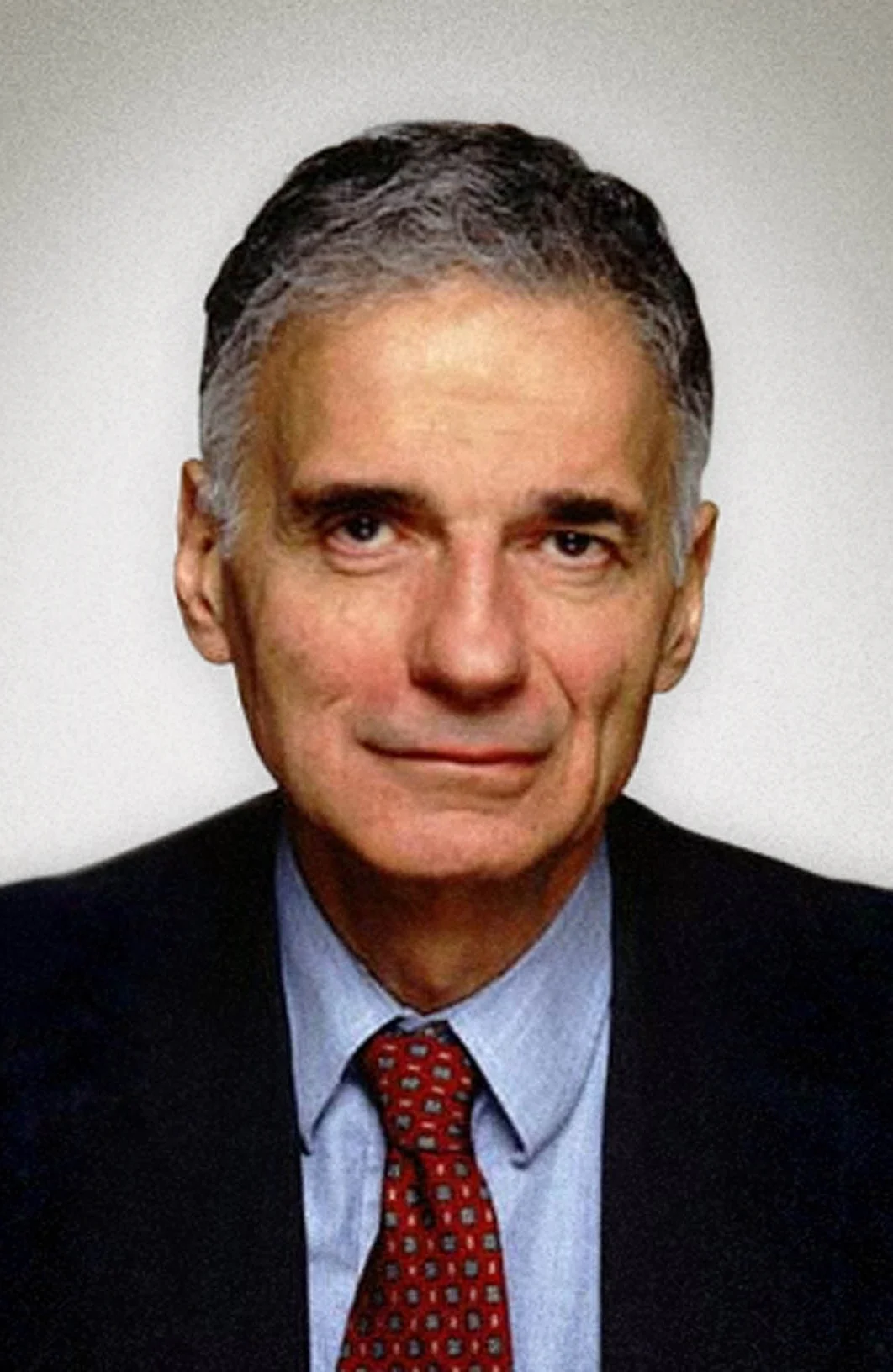
| 29 Quotes | |
| Occup. | Lawyer |
| From | USA |
| Born | February 27, 1934 Winsted, Connecticut, U.S. |
| Age | 92 years |
| Cite | |
Citation Formats
APA Style (7th ed.)
Ralph nader biography, facts and quotes. (2026, February 11). FixQuotes. https://fixquotes.com/authors/ralph-nader/
Chicago Style
"Ralph Nader biography, facts and quotes." FixQuotes. February 11, 2026. https://fixquotes.com/authors/ralph-nader/.
MLA Style (9th ed.)
"Ralph Nader biography, facts and quotes." FixQuotes, 11 Feb. 2026, https://fixquotes.com/authors/ralph-nader/. Accessed 25 Mar. 2026.
Early Life and Background
Ralph Nader was born on February 27, 1934, in Winsted, Connecticut, the youngest of four children of Lebanese immigrant parents, Rose and Nathra Nader. His father ran the Nader family restaurant and taught his children to treat commerce as a public trust - a place where arguments about wages, war, and elected officials belonged at the dinner table. In that small-town setting, Nader absorbed an ethic of disciplined independence: customers were fed, but also debated; the point was not to please power, but to test it.The Great Depression's aftershocks and World War II's mobilization framed his earliest sense of the state as something that could either protect ordinary people or leave them exposed. Nader grew up watching industrial abundance widen the gap between what corporations could do and what citizens could demand. That imbalance - between private decision-making and public risk - became the emotional engine of his life's work: a persistent suspicion that modern injuries were not accidents of fate but products of design, incentives, and weak oversight.
Education and Formative Influences
Nader attended Princeton University, graduating in 1955, and then Harvard Law School, earning his LL.B. in 1958. He served briefly in the U.S. Army, and traveled widely, including to Europe and the Middle East, studying how different systems treated consumer protection and administrative power. At Harvard he gravitated less to courtroom drama than to regulatory law, torts, and the machinery of government - the unglamorous levers that determine whether safety standards exist, whether agencies enforce them, and whether citizens can see what is being done in their name.Career, Major Works, and Turning Points
Nader's defining public breakthrough came with Unsafe at Any Speed (1965), a meticulously argued indictment of automobile safety failures, centered on the Chevrolet Corvair but aimed at a culture that treated preventable deaths as acceptable costs. When General Motors responded by hiring private investigators to discredit him, the backlash amplified Nader's credibility and helped catalyze the 1966 National Traffic and Motor Vehicle Safety Act and the creation of modern federal auto-safety standards. He then built a new kind of advocacy infrastructure: "Nader's Raiders", young investigators who produced reports on agencies like the Federal Trade Commission and the Interstate Commerce Commission, pushing transparency, enforcement, and public participation. Over subsequent decades he helped spur or shape institutions and laws tied to consumer, environmental, and workplace safeguards, and later carried his critique of corporate influence into electoral politics through repeated presidential campaigns (notably 1996, 2000, 2004, and 2008), as well as initiatives that seeded citizen groups and watchdog organizations nationwide.Philosophy, Style, and Themes
Nader's inner life reads as a long discipline of attention - to the fine print, to casualty statistics, to the quiet ways institutions normalize harm. His writing and testimony rarely chase charisma; they pursue accumulation: documents, memos, engineering choices, regulatory loopholes. That method is psychological as much as legal. He treats power as a system of routines, and reform as the patient conversion of private knowledge into public record. In that sense, his work is animated by a civic moralism that mistrusts sentimentality: justice is not a mood but an architecture. “A society that has more justice is a society that needs less charity”. The line captures his impatience with after-the-fact benevolence and his focus on upstream rules that prevent injury and exploitation.His themes converge on citizenship as a daily practice and on corporate dominance as the central modern political problem. He urges participation not as self-expression but as self-defense: “Turn on to politics, or politics will turn on you”. That warning doubles as autobiography - a man who watched regulators defer, then devoted himself to making deference harder. Nader's criticism of the two-party system follows the same logic, less tribal than structural, arguing that both parties routinely bend toward concentrated capital: “The only difference between the Republican and Democratic parties is the velocities with which their knees hit the floor when corporations knock on their door. That's the only difference”. Even when critics found his electoral bids disruptive, the underlying motif stayed consistent: without organized citizens, elected officials and agencies default to organized money.
Legacy and Influence
Nader's lasting influence is visible in seat belts and recalls, but also in the expectation that consumers deserve data, that agencies must answer to the public, and that corporate claims can be litigated, audited, and regulated. He helped professionalize public-interest investigation, modeled a pipeline for young reformers, and expanded the vocabulary of "regulatory capture" and consumer rights in mainstream politics. Admired as a conscience and criticized as an uncompromising scold, he nonetheless changed the baseline: in modern American life, safety is no longer merely a private choice - it is a public standard, and citizens are entitled to demand it.Our collection contains 29 quotes written by Ralph, under the main topics: Witty One-Liners - Ethics & Morality - Justice - Leadership - Freedom.
Other people related to Ralph: Peter Camejo (Businessman)
Source / external links