
Ray Bradbury Biography Quotes 30 Report mistakes
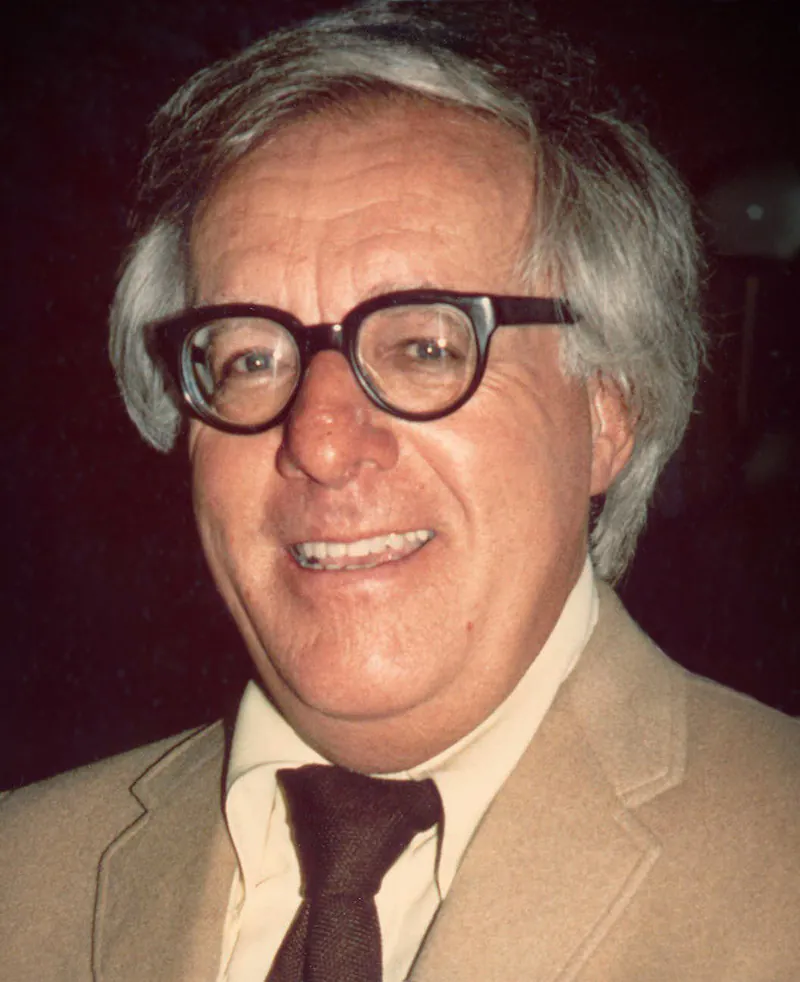
Attr: photo by Alan Light, CC BY 2.0
| 30 Quotes | |
| Born as | Ray Douglas Bradbury |
| Occup. | Writer |
| From | USA |
| Spouse | Marguerite McClure (m. 1947–2003) |
| Born | August 22, 1920 Waukegan, Illinois, USA |
| Died | June 5, 2012 Los Angeles, California, USA |
| Cause | Natural Causes |
| Aged | 91 years |
Ray Douglas Bradbury was born on August 22, 1920, in Waukegan, Illinois, to Leonard Spaulding Bradbury, a telephone lineman, and Esther Marie Moberg Bradbury, who had emigrated from Sweden. His Midwestern childhood, filled with carnivals, lakefront summers, and the rituals of small-town life, became the imaginative bedrock of his fiction. He later transmuted Waukegan into the mythic Green Town of stories like Dandelion Wine, celebrating memory, innocence, and the sharpened sensory world of youth. The family moved between Illinois and Arizona during the Depression before settling in Los Angeles in 1934, where Bradbury discovered that libraries could be a university for the self-taught. He read omnivorously, absorbing Edgar Allan Poe, H. G. Wells, Jules Verne, and the pulps, and began to write daily, teaching himself by imitating his heroes until his own voice took over.
Formative Years and First Publications
In Los Angeles he found a community of kindred spirits. The science fiction fan Forrest J Ackerman encouraged the high-school-aged Bradbury, introducing him to the local fan scene and to collectors, writers, and editors. Bradbury met Ray Harryhausen, the stop-motion animator who became a lifelong friend; their shared love of dinosaurs, fantasy, and wonder nourished both careers for decades. In 1939 Bradbury launched the fanzine Futuria Fantasia and learned the rhythms of deadlines and editorial work. His first professional sale, co-written with Henry Hasse, was "Pendulum" in 1941. He quickly placed stories in Weird Tales and other magazines, honing a lyrical, human-centered mode of science fiction and fantasy that leaned more on metaphors and moral concerns than on engineering.
Breakthrough and Major Works
Bradbury's first major book, The Martian Chronicles (1950), wove linked tales into a meditation on colonization, grief, ecological ignorance, and the fragile illusions of progress. The Illustrated Man (1951) followed, binding cautionary tales to a storyteller's skin. Fahrenheit 451 (1953), his most famous novel, examined censorship and the self-erasure of a distracted society; he drafted it on coin-operated typewriters in the basement of UCLA's library, a fitting birthplace for a manifesto about reading. He returned to his Green Town memories in Dandelion Wine (1957), mapping childhood to seasons and rituals, and explored darkness and temptation in Something Wicked This Way Comes (1962). His voice, by turns rhapsodic and razor-edged, made speculative fiction feel like prose poetry without sacrificing plot or urgency.
Hollywood and Collaborative Work
Bradbury's gift for imagery and structure drew him to film and television. John Huston hired him to write the screenplay for Moby Dick (1956), a demanding collaboration in Ireland that Bradbury later reimagined in his book Green Shadows, White Whale. He wrote for Alfred Hitchcock Presents and contributed "I Sing the Body Electric!" to The Twilight Zone. His story "The Fog Horn" inspired the film The Beast from 20, 000 Fathoms, a key early work in creature cinema, and he provided the story for It Came from Outer Space. In comics, a courteous but pointed letter to William M. Gaines and Al Feldstein at EC Comics, after they adapted a story without permission, led to proper credit and an ongoing series of authorized adaptations. Bradbury also collaborated with artists like Charles Addams, whose macabre wit paired naturally with Bradbury's Elliott family tales. Later, The Ray Bradbury Theater (1985-1992) brought dozens of his stories to television, with Bradbury himself introducing episodes.
Advocacy, Ideas, and Public Life
Across essays, interviews, and talks, Bradbury championed libraries, curiosity, and the discipline of daily work. He often said he never attended college; libraries were his classrooms and librarians his professors. He loved cities and argued for humane urban design, writing civic-minded pieces that favored walkability and imaginative public spaces. A passionate supporter of space exploration, he visited NASA and the Jet Propulsion Laboratory, urging that voyages to other worlds would renew a sense of destiny at home. His enthusiasm helped bridge artists and engineers, reminding scientists that metaphor can be a tool for vision.
Style and Themes
Bradbury's work often centers on memory, the ethics of technology, and the costs of conformity. He distrusted nihilism and preferred wonder to cynicism, yet he warned that comfort and distraction can erode freedom as surely as overt repression. His prose, saturated with sensory detail, embraced metaphor in long, musical sentences that made rockets feel like dandelion seeds and small-town nights feel cosmic. Even when he wrote of Mars, he was writing about Earth; even when he staged carnivals, he was weighing the bargains people make with fear and desire.
Publishing Allies and Mentors
Key figures helped move Bradbury from pulp magazines to the mainstream. His longtime literary agent, Don Congdon, advocated for him across publishers, while editor Walter I. Bradbury at Doubleday (no relation) shepherded early landmark books into print. Friends from fandom, especially Forrest J Ackerman and Ray Harryhausen, formed an early circle of encouragement and collaboration. In Hollywood, John Huston provided a crucible that expanded Bradbury's range as a dramatist. These relationships, along with artists like Charles Addams and the EC Comics team, widened the channels through which his stories reached new audiences.
Work for Museums, Theme Parks, and Education
Beyond books, Bradbury consulted on exhibits and themed environments, most notably contributing to the narrative concept and script elements for Spaceship Earth at EPCOT. He saw such projects as public storytelling, where the history of communication and imagination could be experienced rather than merely read. In lectures and essays such as those collected in Zen in the Art of Writing, he urged young writers to write daily, read deeply, and protect their sense of play.
Personal Life
Bradbury married Marguerite "Maggie" McClure in 1947. Maggie, who worked at a bookstore when they met, became an anchor for his domestic and professional life, managing practical matters so he could keep to his rigorous schedule at the typewriter. They had four daughters: Susan, Ramona, Bettina, and Alexandra. Bradbury never learned to drive and spent his adult life in Los Angeles neighborhoods within reach of libraries and theaters. He delighted in public readings, local stage productions of his plays, and mentoring younger writers who sought him out after events.
Later Career, Honors, and Legacy
Bradbury remained productive into his later years, returning to earlier myths in The Halloween Tree, gathering reminiscences and craft advice in Zen in the Art of Writing, revisiting his Irish sojourn in Green Shadows, White Whale, and extending the Green Town cycle with Farewell Summer. Recognition accumulated: the National Book Foundation's Medal for Distinguished Contribution to American Letters (2000), the National Medal of Arts (2004), and a special citation from the Pulitzer Prize Board (2007) acknowledged a lifetime of work that reshaped American popular and literary culture. After his death on June 5, 2012, NASA named the Curiosity rover landing site on Mars "Bradbury Landing", a tribute that folded his ardent hopes for space exploration back into the red planet he had imagined so vividly. His wife, Maggie, had died in 2003, and tributes from filmmakers, writers, scientists, and readers emphasized how his stories taught them to see the ordinary as luminous.
Enduring Influence
Bradbury's books remain perennial in classrooms and libraries, not only as cornerstones of speculative fiction but as touchstones for conversations about literacy, censorship, childhood, and the moral uses of technology. He showed that a writer could be at once a poet of nostalgia and a prophet of warning, that science fiction could be as intimate as a summer night and as expansive as interplanetary travel. In the community that nurtured him, from Forrest J Ackerman and Ray Harryhausen to Don Congdon and John Huston, and in the communities he, in turn, nurtured through teaching and advocacy, Bradbury helped build a culture where imagination is a civic virtue.
Our collection contains 30 quotes who is written by Ray, under the main topics: Motivational - Wisdom - Love - Meaning of Life - Leadership.
Other people realated to Ray: Kim Stanley Robinson (Writer), Theodore Sturgeon (Writer), Hugh Hefner (Publisher), Julius Schwartz (Editor), Clifford D. Simak (Writer), Norman Corwin (Writer), Rock Hudson (Actor)
Ray Bradbury Famous Works
- 1962 Something Wicked This Way Comes (Novel)
- 1957 Dandelion Wine (Novel)
- 1953 Fahrenheit 451 (Novel)
- 1951 The Illustrated Man (Short Story Collection)
- 1950 The Martian Chronicles (Short Story Collection)
Source / external links