
Red Auerbach Biography Quotes 8 Report mistakes
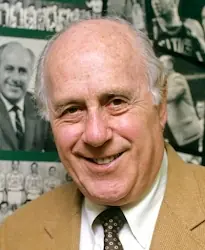
| 8 Quotes | |
| Occup. | Coach |
| From | USA |
| Born | September 20, 1917 |
| Died | October 28, 2006 |
| Aged | 89 years |
Arnold "Red" Auerbach was born in 1917 in Brooklyn, New York, the son of Russian-Jewish immigrants who emphasized discipline, education, and hard work. He grew up in a neighborhood where street games and school gyms provided a natural outlet for an intense competitive streak. At Eastern District High School he discovered coaching as well as playing, drawn to the strategy and teaching that would define his life. He attended George Washington University in Washington, D.C., where he played guard and studied education, a combination that sharpened his understanding of how to organize people and communicate under pressure. After college he coached at the high school level in the Washington area, including St. Albans and Roosevelt, earning a reputation for detail, conditioning, and demanding practices that yielded results.
Entry into Professional Coaching
Auerbach broke into the professional ranks with the Washington Capitols in the Basketball Association of America in 1946. He guided the Capitols to immediate success with an up-tempo style and rigorous defense, demonstrating an instinct for matchups and a willingness to challenge players to exceed their perceived limits. After a short, turbulent stop with the Tri-Cities Blackhawks, he was hired by Boston Celtics owner Walter A. Brown in 1950. That partnership transformed a struggling franchise into a model of excellence and stability in American sports.
Building the Celtics
In Boston, Auerbach sought skilled ballhandlers and shooters who could run, pass, and defend as a unit. He surrounded himself with players who embraced team play and pressure defense. The backcourt of Bob Cousy and Bill Sharman became the engine of a fast break that forced opponents into mistakes. Auerbach also believed in teaching and trusting young players; he welcomed Tom Heinsohn as a dynamic scorer and relentless competitor and later molded K.C. Jones and Sam Jones into a fearsome defensive and clutch backcourt pairing. He drafted Chuck Cooper in 1950, making the Celtics the first NBA team to draft an African-American player, a landmark of integration that reflected his conviction that talent and character mattered more than anything else.
The Russell Revolution and a Dynasty
Auerbach's most consequential move came in 1956 when he maneuvered to acquire Bill Russell, a defensive savant whose timing, rebounding, and shot-blocking redefined the sport. With Russell anchoring the backline, Auerbach had the freedom to push pace relentlessly, knowing the paint was secured. He built around Russell with versatile forwards and smart guards: Tom Heinsohn's scoring, Sam Jones's bank shots in the clutch, K.C. Jones's defense, and later John Havlicek's tireless two-way play created a group that overwhelmed opponents mentally as much as physically. The result was a historic run: nine championships in ten seasons, including eight straight from 1959 through 1966. Along the way the Celtics battled the St. Louis Hawks of Bob Pettit and the Los Angeles Lakers led by Elgin Baylor and Jerry West, rivalries that raised the league's profile. Boston fans came to anticipate Auerbach's famous victory cigar, which he lit near the end of decided games, a ritual that became both a celebration for his team and a provocation for opponents.
Leadership, Integration, and Influence
Auerbach's impact extended beyond tactics. He stood at the forefront of racial progress in professional basketball. In addition to drafting Chuck Cooper, he later started the first all-Black lineup in NBA history, a decision rooted in his straightforward standard: the best five play. His support of Bill Russell as a leader was unwavering. When Auerbach retired from coaching after the 1965-66 season, he named Russell as his successor, making Russell the first Black head coach in major American professional sports. The trust, respect, and candor between Auerbach and Russell became a template for player-coach relationships built on accountability and shared purpose.
From Bench to Front Office
Stepping upstairs to the general manager's office in 1966, Auerbach continued to shape the Celtics. He entrusted former players and colleagues with key roles: Tom Heinsohn coached Boston to titles in 1974 and 1976 with a core featuring Dave Cowens, John Havlicek, and Jo Jo White, while Satch Sanders contributed as a teacher of defense and professionalism. Auerbach's eye for value and fit kept the franchise competitive during transitions.
In 1978 he made a franchise-altering decision by drafting the rights to Larry Bird a year before Bird turned professional, then negotiating a landmark rookie deal. Auerbach doubled down in 1980, trading for Robert Parish and the draft pick that became Kevin McHale, forming a frontcourt that defined an era. Under coach Bill Fitch the Celtics won the 1981 championship; under K.C. Jones they added titles in 1984 and 1986, with Bird, McHale, and Parish complemented by Dennis Johnson, Cedric Maxwell, Danny Ainge, and a deep bench. Auerbach's chessboard comprised not only players and coaches but also the patience to develop continuity and the nerve to make unpopular moves when he believed they would pay off.
Rivalries, Standards, and the Culture He Built
Auerbach cultivated a culture of trust within the Celtics and conflict without, a mental edge he believed to be decisive. He discouraged fraternization with opponents, demanded elite conditioning, and insisted that every player commit to team defense and unselfish offense. Announcer Johnny Most gave voice to that ethos, narrating moments like the famous "Havlicek stole the ball!" turnover that sealed the 1965 Eastern Conference title, an example of the pressure defense Auerbach prized. He maintained the franchise's identity through multiple ownership changes and eras, guiding the team through cycles while preserving its standards.
Public Persona and Methods
Fierce on the sideline and in negotiations, Auerbach was also a teacher who simplified complex ideas. He favored short practices that emphasized fundamentals, quick outlet passes, and spacing. He used timeouts and even the occasional technical foul as tools of motivation. The victory cigar signaled more than bravado; it reflected his belief in closing the deal with decisiveness. Off the court he wrote and spoke extensively about leadership, and late in life he collaborated with author John Feinstein on a reflective volume that distilled decades of lessons about people, pressure, and winning.
People Around Him
Auerbach's professional life intertwined with a constellation of figures who defined the sport: Walter A. Brown, the owner who hired and trusted him; Bill Russell, the cornerstone whose partnership with Auerbach underpinned the dynasty; Bob Cousy and Bill Sharman, who gave early Celtics teams their identity; Tom Heinsohn, K.C. Jones, and Sam Jones, who carried the torch; John Havlicek, whose stamina and versatility epitomized Celtics basketball; Dave Cowens and Jo Jo White, who bridged eras; Larry Bird, Robert Parish, and Kevin McHale, who restored the Celtics' dominance in the 1980s; coaches Bill Fitch and K.C. Jones, whom Auerbach empowered to lead; and broadcaster Johnny Most, who captured the franchise's spirit. In the organization he also drew energy from family; his brother Zang Auerbach, a noted artist, designed the team's leprechaun logo, an enduring symbol of the brand Red built.
Later Years and Ongoing Legacy
In the 1990s Auerbach's role shifted amid league-wide changes and new leadership philosophies, but he remained the franchise's conscience and, in practical terms, its most trusted adviser. He offered counsel to coaches and executives through winning and losing seasons alike. When new ownership led by Wyc Grousbeck arrived in the early 2000s, Auerbach's presence remained central as president and later as president emeritus; his standards continued to frame decisions about scouting, player development, and culture. The Celtics' return to contention after his death carried clear echoes of his priorities: defense, passing, and accountability.
Honors and Recognition
Auerbach was inducted into the Naismith Memorial Basketball Hall of Fame as a coach in 1969. He won the NBA Coach of the Year award in 1965, and the league later named the Coach of the Year trophy in his honor. As an executive he was recognized for roster-building excellence, including being named NBA Executive of the Year in 1980. The ultimate measure of his career remained the banners: nine championships as a head coach and additional titles as an executive, contributing to a total of sixteen the Celtics raised by the mid-1980s. His insistence on merit, his aptitude for developing leaders, and his willingness to confront injustice left a mark that extended beyond basketball.
Personal Life and Character
Auerbach married Dorothy "Dottie" Lewis and together they raised a family that anchored him through decades of public life. Friends and players described him as fiercely loyal, blunt in conversation, and deeply protective of his teams. He was proud of his heritage and of the opportunities basketball opened for him and for those he mentored. He could be combative, but he was also generous with time and advice, especially to players making the transition to life after the game.
Passing and Enduring Impact
Red Auerbach died in 2006 in Washington, D.C., prompting tributes from across the sport. Bill Russell, Larry Bird, and generations of Celtics spoke of a coach and executive who saw what they could become and demanded that they get there. His example endures in the league's competitive fabric, in the Celtics' organizational DNA, and in the understanding that a coach's real power lies not only in schemes but in the ability to forge a culture where unselfishness and excellence reinforce each other. He left behind a franchise and a sport remade in his image: fast, smart, tough, and united by trust.
Our collection contains 8 quotes who is written by Red, under the main topics: Motivational - Ethics & Morality - Live in the Moment - Sports - Honesty & Integrity.
Source / external links