
Reiner Knizia Biography Quotes 2 Report mistakes
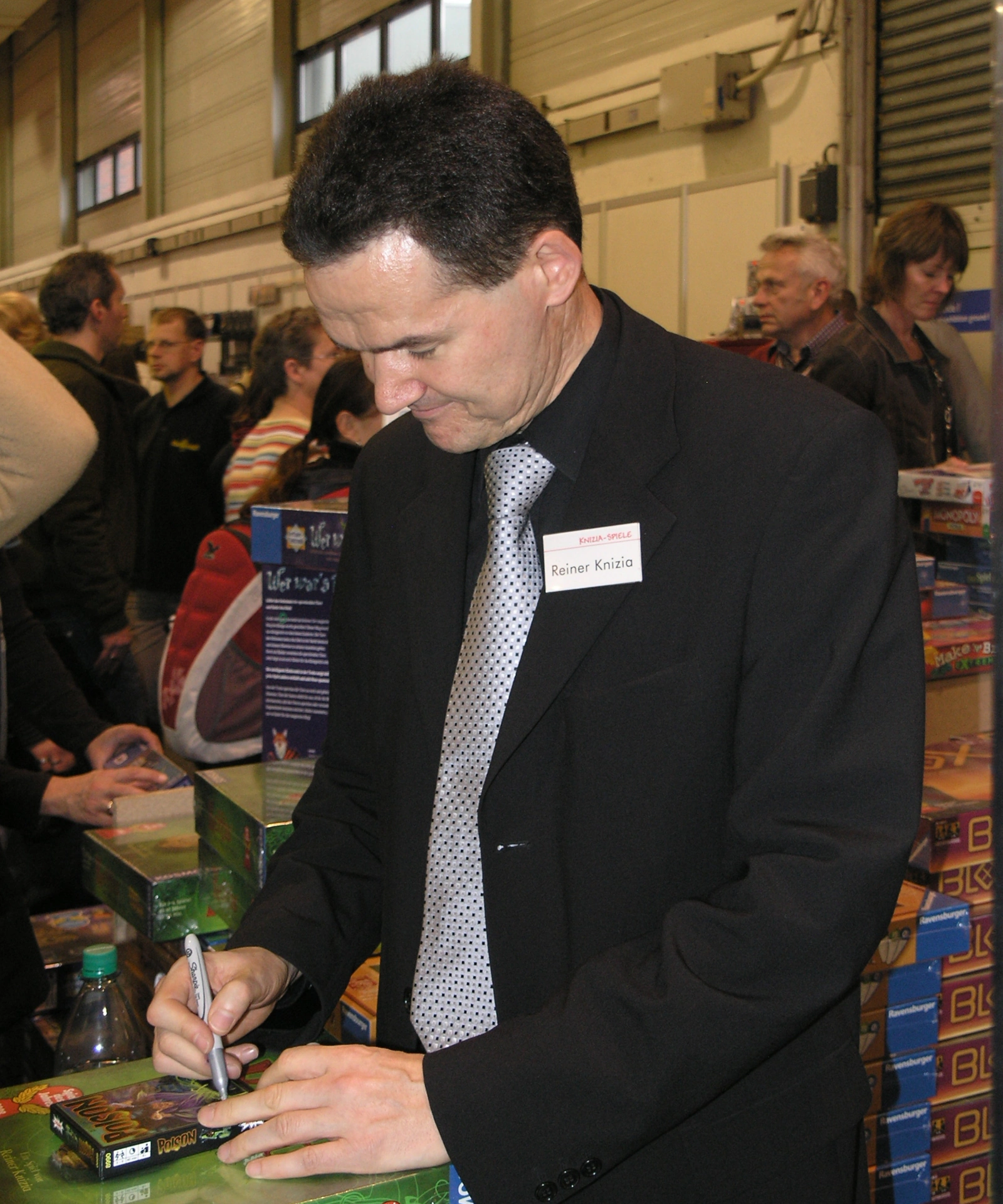
Attr: Matej Batha
| 2 Quotes | |
| Born as | Reiner Werner Knizia |
| Occup. | Designer |
| From | Germany |
| Born | November 16, 1957 Illertissen, Bavaria, West Germany |
| Age | 68 years |
| Cite | |
Citation Formats
APA Style (7th ed.)
Reiner knizia biography, facts and quotes. (2026, February 11). FixQuotes. https://fixquotes.com/authors/reiner-knizia/
Chicago Style
"Reiner Knizia biography, facts and quotes." FixQuotes. February 11, 2026. https://fixquotes.com/authors/reiner-knizia/.
MLA Style (9th ed.)
"Reiner Knizia biography, facts and quotes." FixQuotes, 11 Feb. 2026, https://fixquotes.com/authors/reiner-knizia/. Accessed 4 Apr. 2026.
Early Life and Background
Reiner Werner Knizia was born in 1957 in Germany, in a postwar society that prized engineering, rebuilding, and measurable progress. That atmosphere mattered: his later work would repeatedly fuse rigorous structure with accessible play, as if translating the precision of a technical culture into the language of family tables and hobby clubs. Germanys long tradition of kartenspiel and boardgaming - from Skat to strategy abstracts - also provided a living backdrop in which rules were not merely entertainment but a kind of social craft.From early on, Knizia gravitated to puzzles, numbers, and the small satisfactions of optimization. Friends and later collaborators often described his thinking as simultaneously analytical and playful - an inner habit of testing systems, searching for the cleanest mechanism that still produced surprise. That temperament, formed amid the economic confidence of West Germany and the widening consumer culture of late-20th-century Europe, positioned him well for the rise of modern designer board games that would later be called Eurogames.
Education and Formative Influences
Knizia pursued higher education in mathematics and related technical fields, culminating in doctoral-level work, and he built a parallel life in business and finance, including senior roles in banking and management. Those formative years trained him to treat uncertainty as something to model rather than fear, and to value elegant abstraction over ornament - instincts that would become signatures of his design voice. At the same time, he kept designing games privately, absorbing the emerging German design movement that emphasized clear rules, limited luck, and meaningful tradeoffs.Career, Major Works, and Turning Points
By the 1990s Knizia began publishing at a prolific pace, and over the following decades he became one of the most published and influential designers in tabletop history, with hundreds of titles and editions. Landmark designs such as Modern Art (1992), Tigris and Euphrates (1997), Lost Cities (1999), Through the Desert (1998), Ra (1999), Samurai (1998), and later cooperative and thematic works like Lord of the Rings (2000) demonstrated a rare range: auctions, area control, set collection, push-your-luck, and narrative cooperation, often expressed through minimal components and rules that scaled from families to expert circles. A key turning point was his move from designing alongside a corporate career to embracing design as a central vocation, enabling sustained experimentation and close partnerships with publishers, illustrators, and developers across Germany, the UK, and beyond.Philosophy, Style, and Themes
Knizias games repeatedly revolve around tension created by simple choices that compound over time: when to commit, when to wait, and what to sacrifice. His best systems feel like clean mathematical models of desire - scarcity, timing, and opportunity cost - yet they aim for emotional clarity rather than calculation for its own sake. The designs often invite players to take responsibility for risk, making luck a texture to manage rather than a verdict to accept; the resulting psychology is one of ownership, where triumph and regret both feel earned.This is why his design ethos is frequently summarized in the idea that process matters more than outcome. “The goal is to win, but it is the goal that is important, not the winning”. Read psychologically, the line suggests a creator more interested in sustained engagement than domination - a preference for striving, learning, and replayable tension over a single decisive moment. In practice, he builds games that reward attention and courage, then ends them before they sprawl: the arc is tight, the pressure constant, and the final score reveals a story of decisions rather than a story of fate.
Legacy and Influence
Knizia helped define what modern board games could be: strategically deep yet approachable, interactive without being punitive, and elegant without being sterile. His mechanisms - especially auctions, constrained scoring, and spatial conflict resolved through simple rules - became reference points for later designers, while specific titles like Tigris and Euphrates, Ra, and Lost Cities remain staples in both hobby circles and critical canons. More broadly, his work demonstrated that a designer could be both prolific and exacting, and that mathematical discipline could coexist with human drama at the table, shaping the global spread of Eurogame design from the late 20th century into the present.Our collection contains 2 quotes written by Reiner, under the main topics: Games.
Frequently Asked Questions
- Reiner Knizia Iliad: Reiner Knizia designed a board game titled Iliad (based on Homer’s epic), originally released in the early 2000s and later reprinted in some markets.
- Reiner Knizia games list: Notable titles include Ra, Tigris & Euphrates, Modern Art, Samurai, Through the Desert, Lost Cities, Battle Line, and The Quest for El Dorado (see BGG for full list).
- Reiner Knizia how many games: He has designed hundreds of games; commonly cited estimates are 700+ published designs and expansions.
- Reiner Knizia best games: Many consider Ra, Tigris & Euphrates, Modern Art, Samurai, Through the Desert, and The Quest for El Dorado among his best.
- Reiner Knizia games ranked: Often-ranked favorites include Tigris & Euphrates, Ra, Modern Art, Through the Desert, Samurai, and The Quest for El Dorado.
- How old is Reiner Knizia? He is 68 years old
Source / external links