
Richard Branson Biography Quotes 30 Report mistakes
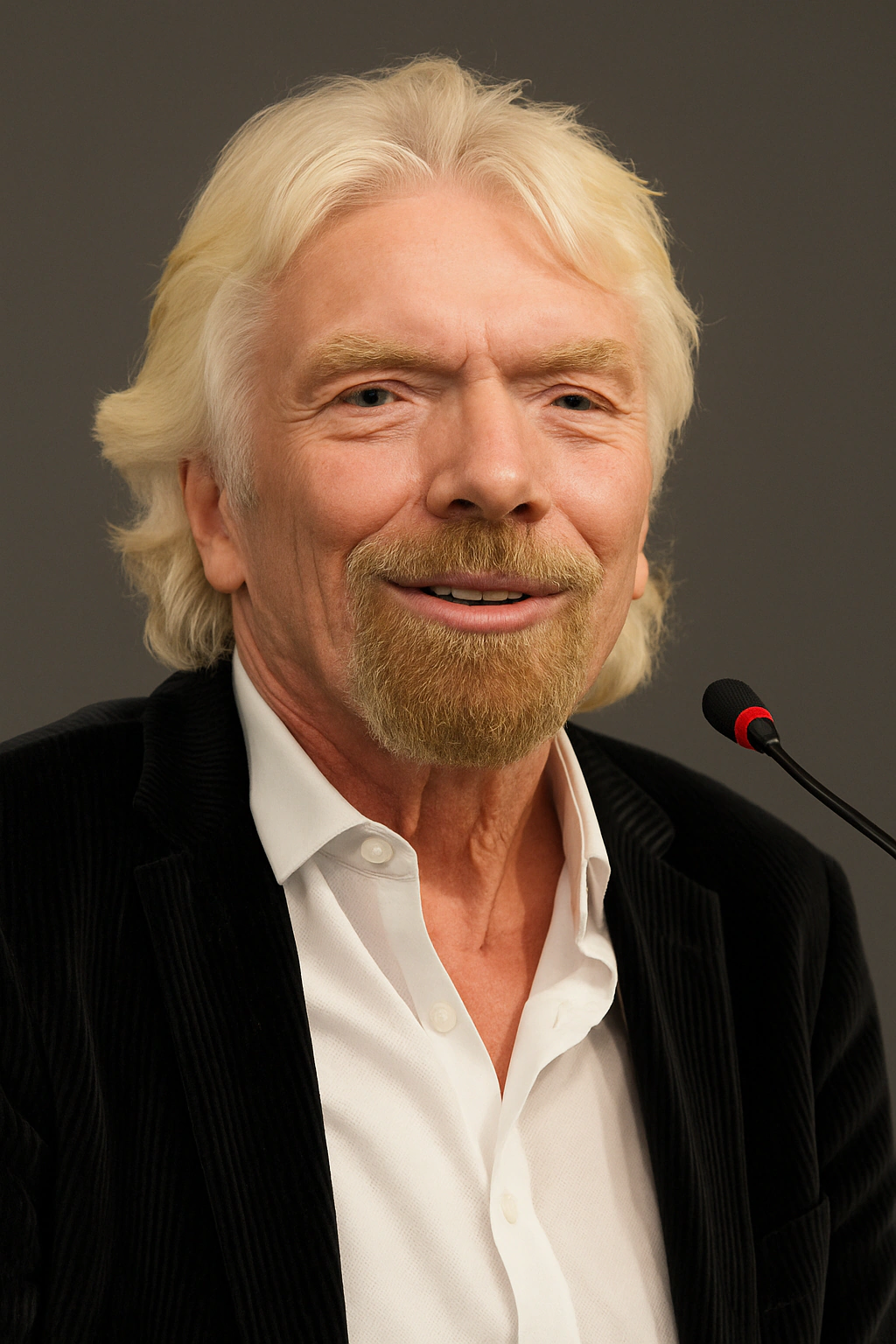
Attr: Ocean Conference 2015 in Valparaíso
| 30 Quotes | |
| Born as | Richard Charles Nicholas Branson |
| Known as | Sir Richard Charles Nicholas Branson |
| Occup. | Businessman |
| From | United Kingdom |
| Spouses | Kristen Tomassi (1972-1979) Joan Templeman (1989) |
| Born | July 18, 1950 London, England, United Kingdom |
| Age | 75 years |
| Cite | |
Citation Formats
APA Style (7th ed.)
Richard branson biography, facts and quotes. (2026, February 11). FixQuotes. https://fixquotes.com/authors/richard-branson/
Chicago Style
"Richard Branson biography, facts and quotes." FixQuotes. February 11, 2026. https://fixquotes.com/authors/richard-branson/.
MLA Style (9th ed.)
"Richard Branson biography, facts and quotes." FixQuotes, 11 Feb. 2026, https://fixquotes.com/authors/richard-branson/. Accessed 26 Mar. 2026.
Early Life and Background
Richard Charles Nicholas Branson was born on July 18, 1950, in Blackheath, London, and grew up in postwar Britain as the welfare state expanded and a new youth culture began to define markets as much as music. His father, Edward Branson, was a barrister; his mother, Eve, was a former ballet dancer turned airline hostess whose practical toughness became family lore. In a household that prized independence, Branson learned early that social class opened doors but did not guarantee direction.
That independence was sharpened by frustration. Branson struggled with dyslexia and conventional schooling, but he also developed a taste for risk and public attention, traits that would later become business tools. Britain in the 1960s offered both constraint and opportunity: the old industries were creaking, but the cultural industries - records, youth fashion, magazines - were booming. Branson absorbed the era's lesson that branding, not factory ownership, could be the lever that moved markets.
Education and Formative Influences
Branson attended Scaitcliffe School and then Stowe School in Buckinghamshire, where he felt out of place academically yet found his lane in persuasion and organizing. He started Student magazine in 1966, selling ads and courting countercultural credibility while learning how to turn attention into revenue. Leaving school at 16, he tried a mail-order record venture that evolved into Virgin, a name that signaled both beginner status and a willingness to offend established taste - a generational instinct that commerce could be insurgent.
Career, Major Works, and Turning Points
Virgin Records emerged from a 1970 record shop on Oxford Street and a 1972 studio at The Manor in Oxfordshire; the label's early turning point was Mike Oldfield's Tubular Bells (1973), followed by signings that mixed provocation and pop scale, including the Sex Pistols and Culture Club. Branson then used the Virgin brand as a passport into deregulating sectors: Virgin Atlantic launched in 1984, challenging British Airways through price, service design, and publicity. The 1992 sale of Virgin Records to Thorn EMI - driven partly by the need to fund the airline during recession and fare wars - marked his most painful trade-off: cashing out an identity-defining asset to preserve the broader group. From the 1990s onward, Virgin became a constellation: mobile telephony (Virgin Mobile), rail (Virgin Trains), finance, health clubs, and hospitality, alongside high-profile adventure attempts like transatlantic speed records and around-the-world ballooning that doubled as marketing and personal compulsion.
Philosophy, Style, and Themes
Branson's inner life reads as a negotiation between vulnerability and performance. Dyslexia pushed him toward delegation, simplicity, and story; he built companies that could be explained in a sentence and sold with a grin. His optimism is not naive so much as iterative: “Business opportunities are like buses, there's always another one coming”. That attitude allowed him to recover from misfires and to frame risk as a renewable resource, yet it also reveals a fear of stasis - the sense that he must keep moving to stay ahead of self-doubt.
His leadership style prizes disruption, consumer empathy, and conspicuous fun, but it is anchored in a moral argument about wealth and example. He has repeatedly insisted that status consumption is spiritually deadening and socially corrosive: “Ridiculous yachts and private planes and big limousines won't make people enjoy life more, and it sends out terrible messages to the people who work for them. It would be so much better if that money was spent in Africa - and it's about getting a balance”. This theme - profit with a public face - runs through Virgin's service innovations and his later philanthropy, and it coexists with a futurist instinct for infrastructure shifts, as when he predicted mass connectivity: “We believe that within five years, 96 percent of British consumers will have access to the Internet, whether it be through a personal computer, a set-top box or a mobile phone”. Branson's psychology is clearest where adventure, brand, and conviction meet: risk becomes both self-test and recruitment poster for a culture that wants employees to feel part of a mission.
Legacy and Influence
Branson helped popularize the modern archetype of the celebrity-entrepreneur: a founder who markets through personal narrative, treats branding as strategy, and uses a portfolio model to enter ossified industries. He influenced how challengers approach aviation, telecoms, and consumer finance - not by inventing new technologies, but by reframing service, pricing, and trust as the product. Through Virgin Unite and projects tied to climate and global health, he also normalized the expectation that business leaders speak the language of social outcomes, even as critics debate the limits of such capitalism. His enduring imprint is the idea that entrepreneurship can be both spectacle and system: a story that sells, and a set of organizations built to keep that story plausible.
Our collection contains 30 quotes written by Richard, under the main topics: Witty One-Liners - Music - Nature - Overcoming Obstacles - Mother.
Other people related to Richard: Mike Melville (Aviator)
Frequently Asked Questions
- Richard Branson movies: Cameos: Casino Royale (2006), Superman Returns (2006), Around the World in 80 Days (2004)
- Richard Branson books: Losing My Virginity; Finding My Virginity; Screw It, Let’s Do It; Business Stripped Bare
- Richard Branson Island: Necker Island (British Virgin Islands)
- Richard Branson companies: Virgin Group (e.g., Virgin Atlantic, Virgin Galactic, Virgin Voyages, Virgin Money, Virgin Hotels)
- Richard Branson wife: Joan Templeman
- Richard Branson airline: Virgin Atlantic
- What is Richard Branson net worth? About $3 billion (varies)
- How old is Richard Branson? He is 75 years old
Richard Branson Famous Works
- 2017 Finding My Virginity: The New Autobiography (Autobiography)
- 2014 The Virgin Way: Everything I Know About Leadership (Non-fiction)
- 2011 Screw Business as Usual (Non-fiction)
- 2008 Business Stripped Bare: Adventures of a Global Entrepreneur (Non-fiction)
- 2006 Screw It, Let's Do It: Lessons in Life (Non-fiction)
- 1999 Like a Virgin: Secrets They Won't Teach You at Business School (Non-fiction)
- 1998 Losing My Virginity: How I Survived, Had Fun, and Made a Fortune Doing Business My Way (Autobiography)
Source / external links