
Richard P. Feynman Biography Quotes 14 Report mistakes
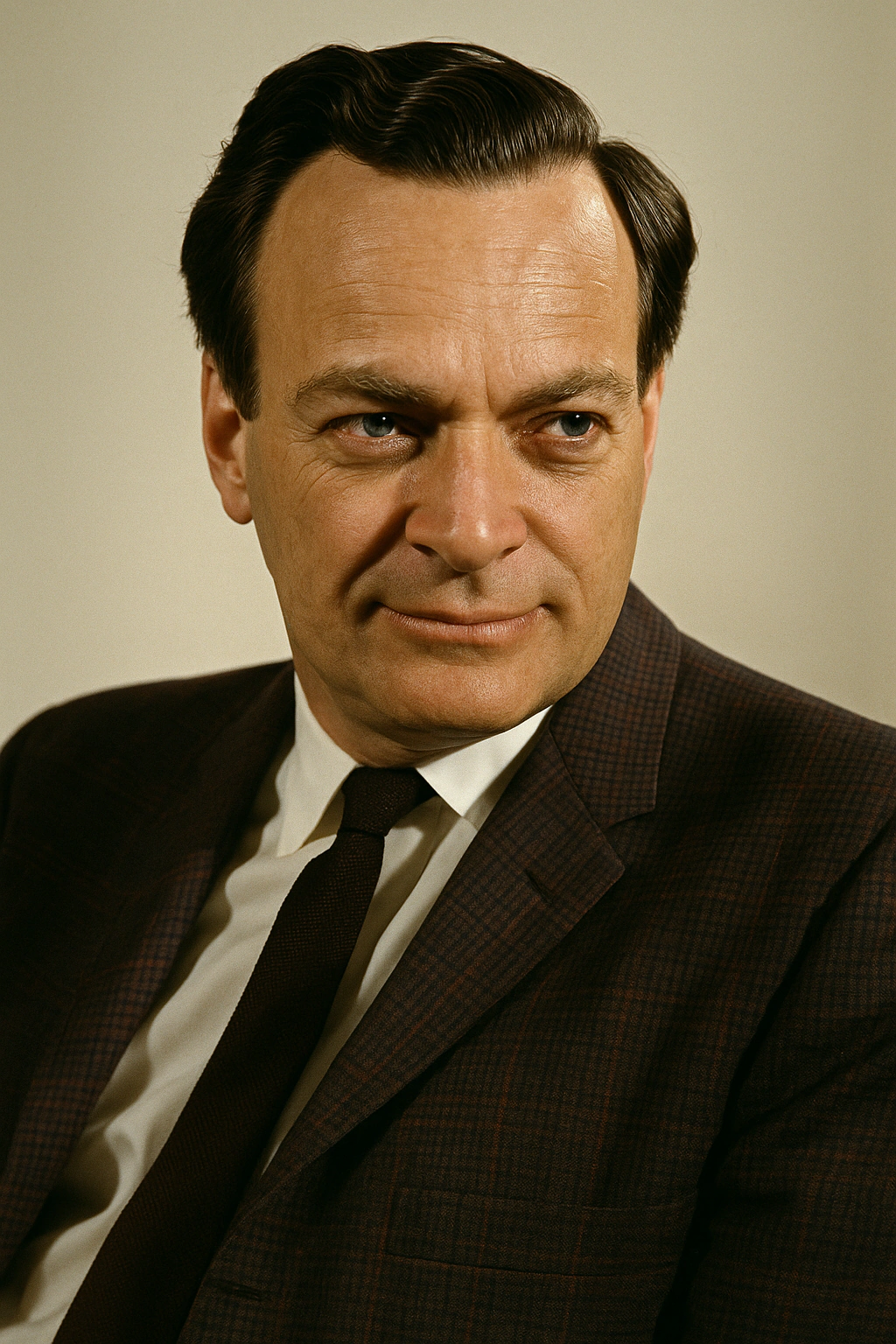
| 14 Quotes | |
| Born as | Richard Phillips Feynman |
| Known as | Richard Feynman |
| Occup. | Physicist |
| From | USA |
| Spouses | Arline Greenbaum (1942-1945) Mary Louise Bell (1952-1958) Gweneth Howarth (1960) |
| Born | May 11, 1918 Queens, New York City, United States |
| Died | February 15, 1988 Los Angeles, California, United States |
| Aged | 69 years |
| Cite | |
Citation Formats
APA Style (7th ed.)
Richard p. feynman biography, facts and quotes. (2026, February 11). FixQuotes. https://fixquotes.com/authors/richard-p-feynman/
Chicago Style
"Richard P. Feynman biography, facts and quotes." FixQuotes. February 11, 2026. https://fixquotes.com/authors/richard-p-feynman/.
MLA Style (9th ed.)
"Richard P. Feynman biography, facts and quotes." FixQuotes, 11 Feb. 2026, https://fixquotes.com/authors/richard-p-feynman/. Accessed 6 Mar. 2026.
Early Life and Background
Richard Phillips Feynman was born on May 11, 1918, in Far Rockaway, Queens, New York, to Melville Feynman, a uniform salesman with a storyteller's flair for science, and Lucille Phillips Feynman, whose quick humor shaped her son's lifelong taste for performance and provocation. The household was secular, Jewish in background, and saturated with the idea that understanding mattered more than reciting names. His father taught him to distrust labels and to chase mechanisms - why a bird's feathers work, how a radio pulls a voice from the air - a habit that became Feynman's signature: an almost physical impatience with pretended knowledge.The America of his boyhood was the Depression-era city of tinkering and aspiration, where practical skills and self-invention were virtues. Feynman built gadgets, repaired radios, and invented codes with friends; he also developed the brash confidence that would later charm and irritate colleagues in equal measure. That confidence hid a private intensity: he wanted not merely to be clever but to be right, and he took rightness personally, as if nature were a strict but fair judge.
Education and Formative Influences
Feynman attended Far Rockaway High School and then the Massachusetts Institute of Technology, graduating in 1939, first drawn to mathematics and electrical engineering before committing to physics when he discovered the thrill of deriving results from simple principles. He moved on to Princeton for doctoral work under John Archibald Wheeler, producing a thesis that recast quantum mechanics through a least-action approach and hinted at the diagrammatic thinking he would later perfect. At Princeton he met Arline Greenbaum, his sharp-witted partner through a period of looming war; her long illness and death in 1945 carved into him a mixture of grief and disbelief that he carried as a hidden undertow beneath his public playfulness.Career, Major Works, and Turning Points
Recruited to the Manhattan Project, Feynman worked at Los Alamos from 1943, organizing computation, diagnosing technical bottlenecks, and learning how institutions behave under secrecy and pressure - lessons that later fueled his intolerance for bureaucratic self-deception. After the war he held positions at Cornell and, from 1950, at the California Institute of Technology, where he became a legendary teacher and a central figure in postwar theoretical physics. In 1948-49 he introduced the path-integral formulation and Feynman diagrams, turning the messy bookkeeping of quantum electrodynamics into a toolset usable by working physicists; for this work he shared the 1965 Nobel Prize in Physics with Julian Schwinger and Sin-Itiro Tomonaga. Later milestones included his parton model insights in high-energy physics, contributions to superfluidity and quantum computing ideas, and his public service on the 1986 Challenger disaster investigation, where a simple demonstration about O-rings cut through layers of official reassurance.Philosophy, Style, and Themes
Feynman's inner life was a paradox: he performed certainty while cultivating doubt. He prized the moment when a problem yields to an almost childlike directness - draw the picture, find the symmetry, estimate the size - and he distrusted virtuosity that could not touch reality. His style fused streetwise pragmatism with aesthetic appetite: he wanted theories that were not only correct but that snapped into place with minimal waste, like a clean piece of engineering.His ethics of thought were as central as his equations. “It doesn't matter how beautiful your theory is, it doesn't matter how smart you are. If it doesn't agree with experiment, it's wrong”. That sentence is not just methodology but temperament: a refusal to let prestige protect an idea from the tribunal of measurement. He aimed the same scrutiny inward, warning that “The first principle is that you must not fool yourself and you are the easiest person to fool”. The psychological core is exposure - of nature, of institutions, of the self - because he believed error thrives where people confuse explanation with authority. Even his humor served that mission: it punctured piety, restored proportion, and made it socially acceptable to say, out loud, that one does not know.
Legacy and Influence
Feynman's influence persists in the daily working language of physics: diagrams on blackboards, integrals over histories, and a culture that prizes calculational honesty over rhetorical elegance. Through The Feynman Lectures on Physics, Surely You're Joking, Mr. Feynman!, and his Los Alamos and Challenger stories, he became a rare scientific celebrity whose myth sometimes obscures the discipline behind the charisma - endless calculation, ruthless self-critique, and a drive to simplify without lying. He left a model of scientific adulthood for a media age: curiosity without credentialism, skepticism without cynicism, and the insistence that in science - and in public life when science matters - reality has the last word.Our collection contains 14 quotes written by Richard, under the main topics: Witty One-Liners - Truth - Nature - Science - Knowledge.
Other people related to Richard: Enrico Fermi (Physicist), David Deutsch (Scientist), Philip Morrison (Scientist), Martin Gardner (Mathematician), Jerome Isaac Friedman (Physicist), Stephen Wolfram (Scientist), Hans Bethe (Scientist)
Frequently Asked Questions
- Richard Feynman books: Surely You're Joking, Mr. Feynman!; What Do You Care What Other People Think?; The Feynman Lectures on Physics; QED: The Strange Theory of Light and Matter; Six Easy Pieces.
- Richard Feynman Nobel Prize: 1965 Nobel Prize in Physics for QED, shared with Julian Schwinger and Sin-Itiro Tomonaga.
- Richard Feynman children: Two: Carl and Michelle (adopted).
- Surely You're Joking, Mr Feynman: His 1985 memoir of autobiographical anecdotes (Adventures of a Curious Character).
- Richard Feynman love letter: The famous 1946 letter to Arline written after her death, professing undying love.
- Richard p Feynman letter to wife: A 1946 letter to his late wife Arline, expressing enduring love; found unopened after his death.
- Richard Feynman cause of death: Abdominal cancer.
- How old was Richard P. Feynman? He became 69 years old
Richard P. Feynman Famous Works
- 1999 The Pleasure of Finding Things Out (Collection)
- 1998 The Meaning of It All: Thoughts of a Citizen-Scientist (Book)
- 1988 What Do You Care What Other People Think?: Further Adventures of a Curious Character (Memoir)
- 1985 Surely You're Joking, Mr. Feynman!: Adventures of a Curious Character (Memoir)
- 1985 QED: The Strange Theory of Light and Matter (Book)
- 1982 Simulating Physics with Computers (Essay)
- 1965 The Character of Physical Law (Book)
- 1964 The Feynman Lectures on Physics (Book)
- 1959 There's Plenty of Room at the Bottom (Essay)
- 1949 Space–Time Approach to Quantum Electrodynamics (Essay)
- 1949 The Theory of Positrons (Essay)
Source / external links