
Robert A. Heinlein Biography Quotes 36 Report mistakes
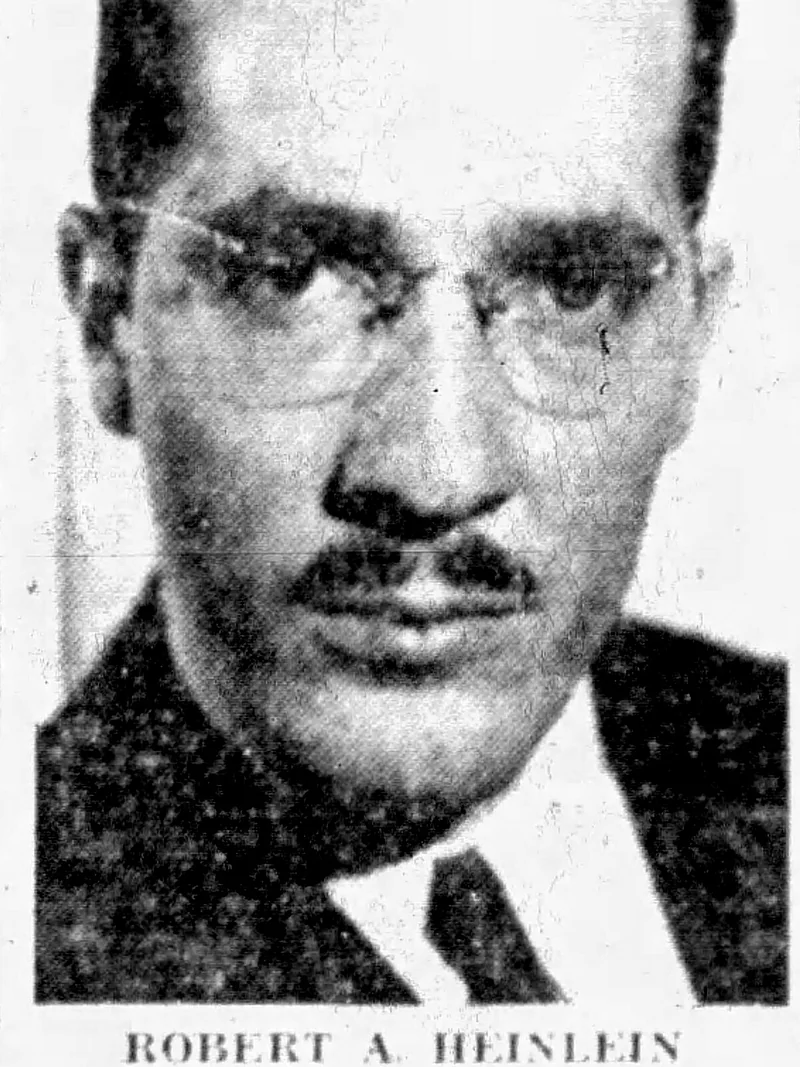
| 36 Quotes | |
| Born as | Robert Anson Heinlein |
| Occup. | Writer |
| From | USA |
| Born | July 7, 1907 Butler, Missouri, USA |
| Died | May 8, 1988 Carmel, California, USA |
| Aged | 80 years |
| Cite | |
Citation Formats
APA Style (7th ed.)
Robert a. heinlein biography, facts and quotes. (2026, February 2). FixQuotes. https://fixquotes.com/authors/robert-a-heinlein/
Chicago Style
"Robert A. Heinlein biography, facts and quotes." FixQuotes. February 2, 2026. https://fixquotes.com/authors/robert-a-heinlein/.
MLA Style (9th ed.)
"Robert A. Heinlein biography, facts and quotes." FixQuotes, 2 Feb. 2026, https://fixquotes.com/authors/robert-a-heinlein/. Accessed 27 Mar. 2026.
Early Life and Background
Robert Anson Heinlein was born on July 7, 1907, in Butler, Missouri, the third of seven children in a respectable Midwestern household shaped by Protestant discipline, small-town hierarchy, and the long aftershocks of the Gilded Age. His childhood moved to Kansas City, where the modern city - streetcars, newspapers, movie houses, and public libraries - pressed against older rural values. That tension between tradition and technological acceleration would become a lifelong engine of his fiction.Heinlein came of age as the United States lurched from Progressive optimism into World War I nationalism and then the lean moral arithmetic of the 1920s. Even as a boy he read widely, including popular science and adventure, and grew alert to how communities police belonging. The outsider who watches social rules being enforced - and wonders who benefits - is already present in his earliest imaginative posture, later sharpened into his signature blend of civic seriousness and contrarian provocation.
Education and Formative Influences
In 1925 he entered the U.S. Naval Academy at Annapolis, graduating in 1929 into a Navy that prized engineering competence, chain of command, and a pragmatic skepticism toward wishful thinking. Sea duty and technical training strengthened his belief that systems matter - machines, institutions, constitutions - and that failure is often less a moral flaw than a design error. Forced retirement in 1934 after recurring illness (tuberculosis was long suspected) cut short the identity he had built around service, leaving him to reconstruct purpose in civilian life during the Great Depression, when political ideologies competed to explain scarcity and social fracture.Career, Major Works, and Turning Points
After varied work in California and political activism that flirted with left-liberal causes, Heinlein turned to science fiction as a paying craft, selling "Life-Line" to Astounding Science-Fiction in 1939 and quickly becoming a central architect of the field's "Golden Age" realism. During World War II he worked in aeronautics-related research and at the Philadelphia Navy Yard, and the war's bureaucratic scale and technological urgency pushed him toward stories where competence and responsibility are survival traits. From 1947 through the late 1950s his juvenile novels (including Rocket Ship Galileo, Space Cadet, and Have Space Suit - Will Travel) educated a generation in scientific curiosity and civic duty, while his adult breakthroughs - The Puppet Masters (1951), Double Star (1956), and Starship Troopers (1959) - made him famous and divisive for tying adventure to arguments about citizenship. The 1961-1966 period, with Stranger in a Strange Land and The Moon Is a Harsh Mistress, marked a second turning point: he expanded into sexual ethics, counterculture notoriety, and radical political thought experiments, later culminating in time-bending metafiction like The Number of the Beast and the self-referential late-world of Job and To Sail Beyond the Sunset.Philosophy, Style, and Themes
Heinlein wrote with an engineer's impatience for vagueness: scenes are built from procedures, testable claims, and the consequences of decisions. Yet beneath the crisp exposition sits a novelist fascinated by how people justify power - and how quickly crowds trade judgment for comfort. His warning, “Never underestimate the power of human stupidity”. , is not merely cynical; it is a psychological diagnosis of mass behavior, a fear that intelligence is fragile while slogans are contagious. Many of his villains are not monsters but normal citizens who prefer easy answers, and many of his heroes are stubbornly lucid, willing to be disliked in exchange for being accurate.That stance made him a magnet for controversy. Heinlein believed societies survive by aligning rights with duties, and he dramatized the argument that freedom is not a mood but a disciplined practice. His aphorism “Being right too soon is socially unacceptable”. captures a recurring inner-life pattern: the lonely satisfaction of foreseeing outcomes, followed by the bruising experience of watching others punish the messenger. At his most provocative, he insisted that civility and safety are negotiated through credible self-defense - “An armed society is a polite society. Manners are good when one may have to back up his acts with his life”. - a line that reveals both his distrust of institutional protection and his hope that responsibility can restrain violence. Across libertarian lunar revolutions, militarized civics lessons, and utopian household experiments, he kept returning to the question he could never drop: what kind of adult does a free civilization require?
Legacy and Influence
Heinlein died on May 8, 1988, in Carmel, California, leaving behind not just a shelf of classics but an argumentative template for modern science fiction - the idea that a story can be a laboratory for political philosophy without surrendering plot velocity. He helped professionalize the genre's attitude toward science and logistics, mentored peers through example and correspondence, and influenced everyone from space-advocacy engineers to novelists who either embraced his competence ethic or wrote in revolt against it. Terms like "grok" entered popular language, and debates over Starship Troopers and Stranger in a Strange Land continue to rehearse his central provocation: that the future is not a backdrop but a referendum on how we live now.Our collection contains 36 quotes written by Robert, under the main topics: Witty One-Liners - Motivational - Ethics & Morality - Wisdom - Love.
Other people related to Robert: Daniel Keys Moran (Writer), Jerry Pournelle (Journalist), Spider Robinson (Writer), Larry Niven (Writer), James Gunn (Writer), John W. Campbell (Writer), Clifford D. Simak (Writer)
Robert A. Heinlein Famous Works
- 1985 The Cat Who Walks Through Walls (Novel)
- 1984 Job: A Comedy of Justice (Novel)
- 1973 Time Enough for Love (Novel)
- 1970 I Will Fear No Evil (Novel)
- 1966 The Moon Is a Harsh Mistress (Novel)
- 1963 Glory Road (Novel)
- 1961 Stranger in a Strange Land (Novel)
- 1959 All You Zombies— (Short Story)
- 1959 Starship Troopers (Novel)
- 1958 Have Space Suit, Will Travel (Children's book)
- 1957 The Door into Summer (Novel)
- 1957 Citizen of the Galaxy (Novel)
- 1956 Double Star (Novel)
- 1951 The Puppet Masters (Novel)
- 1942 Beyond This Horizon (Novel)
- 1942 Waldo (Short Story)
- 1941 Methuselah's Children (Novel)
- 1940 The Man Who Sold the Moon (Short Story)
- 1940 The Roads Must Roll (Short Story)
- 1939 Life-Line (Short Story)