
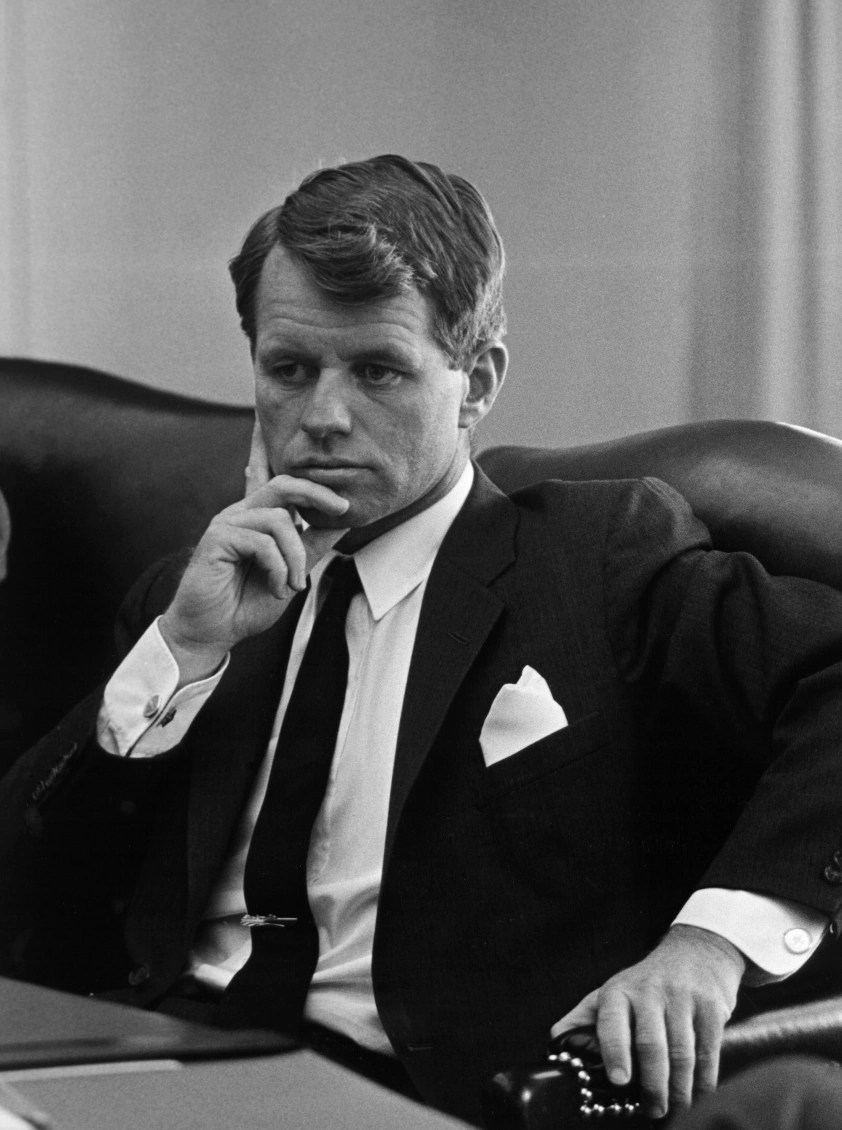
Robert F. Kennedy Biography Quotes 1 Report mistakes
| 1 Quotes | |
| Occup. | Politician |
| From | USA |
| Born | November 20, 1925 |
| Died | June 6, 1968 |
| Aged | 42 years |
| Cite | |
Citation Formats
APA Style (7th ed.)
Robert f. kennedy biography, facts and quotes. (2026, February 11). FixQuotes. https://fixquotes.com/authors/robert-f-kennedy/
Chicago Style
"Robert F. Kennedy biography, facts and quotes." FixQuotes. February 11, 2026. https://fixquotes.com/authors/robert-f-kennedy/.
MLA Style (9th ed.)
"Robert F. Kennedy biography, facts and quotes." FixQuotes, 11 Feb. 2026, https://fixquotes.com/authors/robert-f-kennedy/. Accessed 12 Feb. 2026.
Early Life and Background
Robert Francis Kennedy was born on November 20, 1925, in Brookline, Massachusetts, into a Catholic Irish American family whose wealth and ambition made public life feel less like an option than an expectation. The seventh of nine children of Joseph P. Kennedy Sr. and Rose Fitzgerald Kennedy, he grew up in a household where achievement was audited daily and where politics, sports, and moral talk competed for attention. The Great Depression and the family patriarch's rise in finance and diplomacy formed the background music of his childhood, but it was the Kennedy code - loyalty, discipline, and the belief that power carried obligations - that shaped his temperament.Within that crowded constellation of siblings, Robert (often "Bobby") was neither the charismatic front man nor the carefree ornament. He was more private, sharp-eyed, and attuned to undercurrents. Early losses and family pressures pushed him inward, while the Second World War pulled him toward service; he briefly joined the U.S. Naval Reserve near war's end and traveled on a training cruise in the Pacific in 1946. The Kennedy family moved between Massachusetts, New York, and Hyannis Port, but Robert's inner geography was defined less by place than by the constant measurement of character - who was brave, who was useful, who could be trusted.
Education and Formative Influences
After time at Harvard College (BA, 1948), where he completed his studies amid his family's growing political investments, Kennedy earned an LLB at the University of Virginia School of Law in 1951. The law trained his appetite for evidence and cross-examination, but his strongest education came from proximity to power: he learned how institutions protect themselves, how public narratives are manufactured, and how moral certainty can be used either as cover or as a lever for reform. His Catholic faith and the example of his mother reinforced a language of duty; his father's ruthlessness, and the costs it imposed, taught him that ends-and-means calculations always leave a residue.Career, Major Works, and Turning Points
Kennedy became his brother John F. Kennedy's most trusted political operator, serving as campaign manager for the 1960 presidential run and then as U.S. attorney general (1961-1964). In the Justice Department he confronted organized crime and corruption, while also becoming a central strategist in Cold War crises such as the 1962 Cuban Missile Crisis. His tenure coincided with the civil rights movement's most dangerous years: he sent federal marshals to protect the Freedom Riders, pressed for enforcement of desegregation orders, and helped lay the groundwork for the Civil Rights Act of 1964. After John Kennedy's assassination in 1963, grief reordered his life; he entered the U.S. Senate from New York (1965-1968), traveled to anti-poverty programs at home and to troubled regions abroad, and emerged as a leading critic of the Vietnam War. His 1968 presidential campaign fused policy with moral urgency, and it ended when he was shot in Los Angeles after winning the California primary; he died on June 6, 1968.Philosophy, Style, and Themes
Kennedy's public arc often looks like a conversion narrative - from hard-edged political enforcer to empathic tribune - but the deeper continuity was a fierce, almost prosecutorial conscience. He loved clarity: a problem named precisely could be attacked. Yet personal catastrophe made him suspicious of triumphalism, and the 1960s forced him to reconcile order with justice. His encounters with poverty in Appalachia, with Black organizers facing terror, and with young people sent to fight in Southeast Asia tightened his belief that the state is judged by the lives it permits its weakest citizens to live.His best lines were less ornamental than diagnostic, revealing a mind that measured happiness by usefulness and authority by accountability. "You're happiest while you're making the greatest contribution". That sentiment was not a motivational slogan in his mouth; it was a standard he used to interrogate himself after his brother's death, when ambition could have hardened into mere inheritance. It also explained his attraction to unpopular causes - migrant workers, inner-city youth, political prisoners - because contribution, for him, meant proximity to suffering and a willingness to spend political capital. His style, both as attorney general and as candidate, combined moral heat with tactical discipline: he could be abrupt, even intimidating, yet increasingly he sought coalition rather than conquest, believing that national healing required truth spoken without humiliation.
Legacy and Influence
Kennedy remains a symbol of the unfinished possibilities of the 1960s: a politician who fused law-and-order credentials with an expanding commitment to civil rights, anti-poverty action, and a more restrained foreign policy. His life and death helped define modern liberal idealism in America - urgent, skeptical of complacency, and willing to treat empathy as a political instrument rather than a private virtue. Institutions, activists, and later candidates have borrowed his vocabulary of moral responsibility and his insistence that politics be measured by human outcomes, even as the circumstances of his assassination made him a permanent emblem of a nation that seemed, in 1968, to lose its most persuasive voices for reconciliation.Our collection contains 1 quotes written by Robert, under the main topics: Happiness.
Other people related to Robert: Jerry Springer (Celebrity), David Talbot (Journalist), Dean Rusk (Diplomat), Pierre Salinger (Public Servant), Byron White (Judge), George McGovern (Politician), Sargent Shriver (Politician), Cesar Chavez (Activist), Arthur M. Schlesinger, Jr. (Historian), Ramsey Clark (Public Servant)