
Robert Frost Biography Quotes 81 Report mistakes
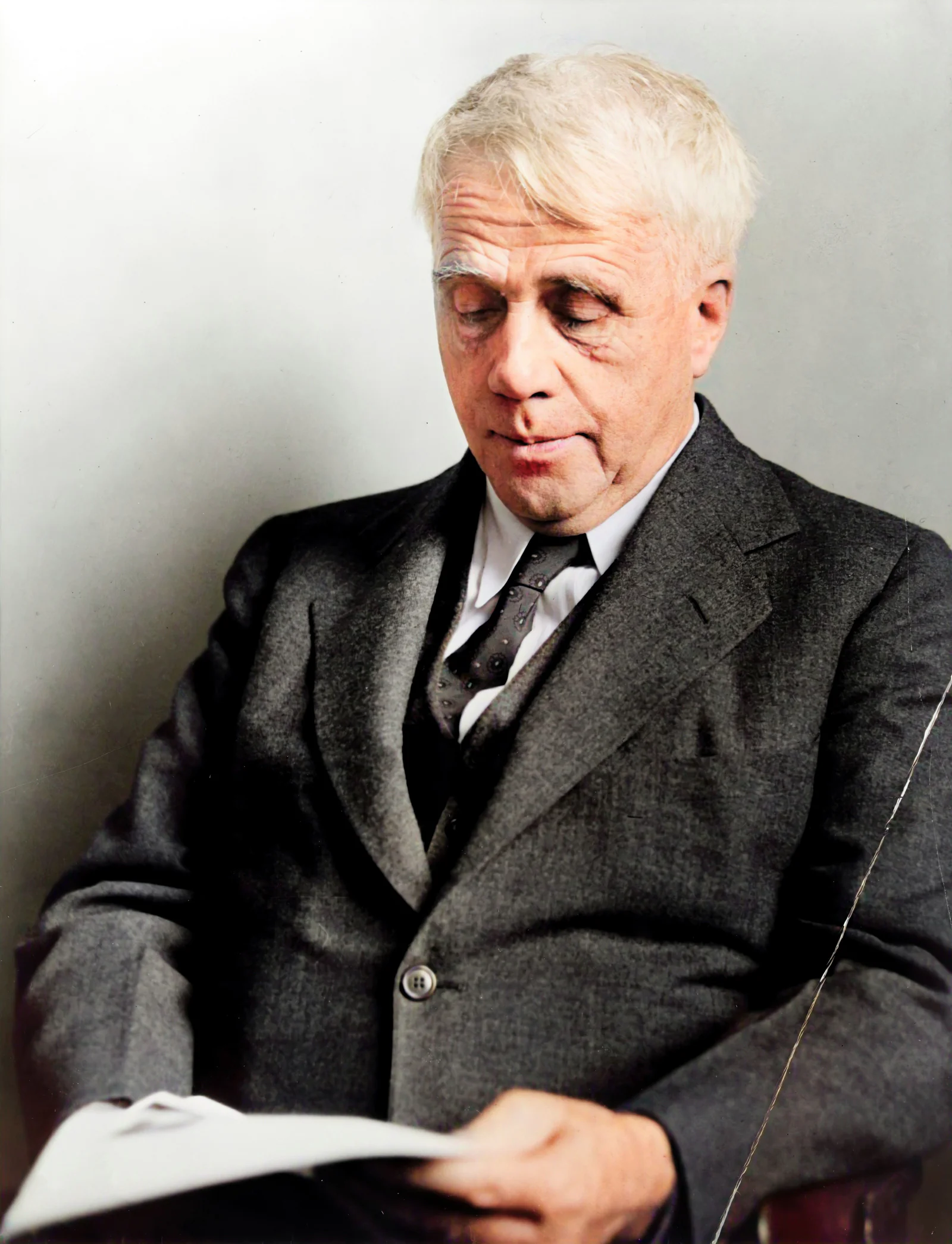
| 81 Quotes | |
| Born as | Robert Lee Frost |
| Occup. | Poet |
| From | USA |
| Born | March 26, 1874 San Francisco, California, USA |
| Died | January 29, 1963 Boston, Massachusetts, USA |
| Cause | Heart attack |
| Aged | 88 years |
| Cite | |
Citation Formats
APA Style (7th ed.)
Robert frost biography, facts and quotes. (2026, February 2). FixQuotes. https://fixquotes.com/authors/robert-frost/
Chicago Style
"Robert Frost biography, facts and quotes." FixQuotes. February 2, 2026. https://fixquotes.com/authors/robert-frost/.
MLA Style (9th ed.)
"Robert Frost biography, facts and quotes." FixQuotes, 2 Feb. 2026, https://fixquotes.com/authors/robert-frost/. Accessed 26 Mar. 2026.
Early Life and Background
Robert Lee Frost was born on March 26, 1874, in San Francisco, California, into a household shaped by volatility and aspiration. His father, William Prescott Frost Jr., worked as a journalist and was drawn to politics and drink; his mother, Isabelle Moodie, a Scottish immigrant and former schoolteacher, carried a stern moral intelligence that later echoed in Frost's sense of duty to language. The early West Coast years gave him the outsider's vantage point - close to city life and argument, but not rooted in inherited stability.When his father died of tuberculosis in 1885, Frost's life was abruptly re-mapped. Isabelle moved Robert and his sister Jeanie across the continent to Lawrence, Massachusetts, to live near paternal relatives. The shift from San Francisco to New England - from a loose frontier city to a culture of villages, farms, and tight social codes - became the defining geography of his imagination. Frost learned early that security could vanish without warning; the emotional compression of grief, class strain, and regional displacement seeded the later tension in his poems between pastoral surfaces and hard psychological weather.
Education and Formative Influences
At Lawrence High School Frost excelled, co-valedictorian with Elinor White, who became his intellectual equal and lifelong center; they married in 1895 after a prolonged courtship. He attended Dartmouth briefly in 1892 and later Harvard (1897-1899) without taking a degree, pulled away by money problems, ill health, and impatience with institutional routine. Those years mattered less for credentials than for habit: wide reading, an ear trained on speech, and the conviction that a poet could be both formally exact and locally grounded. He published his first poem, "My Butterfly", in 1894, then worked as teacher, mill hand, and farmer, carrying the sense that art had to be earned against ordinary labor.Career, Major Works, and Turning Points
In 1912 Frost took a decisive risk, moving his family to England, where the literary world proved more receptive than the American market. A Boy's Will (1913) and North of Boston (1914) introduced the voice that made him famous: rural New England rendered in supple blank verse and conversational pitch, with poems like "Mending Wall", "Home Burial", and "After Apple-Picking". He returned to the United States in 1915 as his reputation arrived ahead of him, and over the next decades built a dual career as writer and public lecturer, teaching at Amherst and summering at Bread Loaf. He won four Pulitzer Prizes (beginning with New Hampshire in 1924) and published landmark volumes including West-Running Brook (1928), A Further Range (1936), and A Witness Tree (1942). The public saw the craggy sage; privately, Frost navigated repeated family tragedies, including the death of children and the long, later-life crisis of his daughter Irma, pressures that darkened the undertow beneath his celebrated "country" poems.Philosophy, Style, and Themes
Frost's art depends on a paradox: he sounded plain while building intricate structures. He wanted the "sound of sense" - speech rhythms caught and disciplined by meter - and he distrusted poetry that floated free of human talk. His landscapes are rarely mere scenery; they are testing grounds where choice, resentment, loyalty, and loneliness take form in fences, roads, storms, and chores. Even when a poem seems to offer a proverb, he keeps it unsettled, turning moral certainty into drama. The famous wall in "Mending Wall" is not only a boundary but also a confession about the need for boundaries; the diverging roads of "The Road Not Taken" are less an anthem of individualism than a study in how the self narrates its own decisions.Psychologically, Frost wrote as a man who believed endurance was the only honest comfort. “The best way out is always through”. That sentence captures his refusal of escape hatches - in life and in art - and helps explain why his poems so often force a speaker to stay with the uncomfortable truth of a situation rather than transcend it. He also treated education as a moral stance, not a credential: “Education is the ability to listen to almost anything without losing your temper or your self-confidence”. The line clarifies his public persona - combative yet controlled - and his poetic method, which listens closely to opposing voices inside a single scene. And he demanded emotional stakes: “No tears in the writer, no tears in the reader. No surprise in the writer, no surprise in the reader”. For Frost, technique without vulnerability was empty, but vulnerability without technique was merely confession; the poem had to convert private strain into shared experience, precise enough to carry feeling without sentimentality.
Legacy and Influence
Frost died on January 29, 1963, in Boston, having become an emblem of American poetry and, for many, of America itself - the first poet to read at a presidential inauguration (John F. Kennedy, 1961), yet never reducible to civic uplift. His influence runs through 20th-century verse as a model of how traditional meter can hold modern doubt, how local speech can carry philosophical weight, and how pastoral settings can expose rather than conceal violence of mind. Read closely, his work endures not because it flatters the national myth, but because it records the cost of making a life - the hard bargain between freedom and belonging, solitude and community - in lines that keep their edge long after the speaker has gone quiet.Our collection contains 81 quotes written by Robert, under the main topics: Witty One-Liners - Ethics & Morality - Truth - Wisdom - Art.
Other people related to Robert: Seamus Heaney (Poet), Randall Jarrell (Poet), John Drinkwater (Poet), Richard Eberhart (Poet)
Frequently Asked Questions
- Robert Frost writing style: He is known for his use of traditional verse forms and conversational language, often exploring themes of nature and rural life.
- Robert Frost family: He had six children: Elliot, Lesley, Carol, Irma, Marjorie, and Elinor Bettina. His wife was Elinor Miriam White.
- Robert Frost nationality: He was American.
- Robert Frost parents: His parents were William Prescott Frost Jr. and Isabelle Moodie.
- Robert Frost famous works: His famous works include 'The Road Not Taken', 'Stopping by Woods on a Snowy Evening', 'Mending Wall', and 'Birches'.
- Robert Frost wife: His wife was Elinor Miriam White.
- How old was Robert Frost? He became 88 years old
Robert Frost Famous Works
- 1962 In the Clearing (Book)
- 1947 Steeple Bush (Book)
- 1942 A Witness Tree (Book)
- 1936 A Further Range (Book)
- 1928 West-Running Brook (Book)
- 1923 New Hampshire (Book)
- 1916 Mountain Interval (Book)
- 1914 North of Boston (Book)
- 1913 A Boy's Will (Book)
Source / external links