
Robert Mugabe Biography Quotes 22 Report mistakes
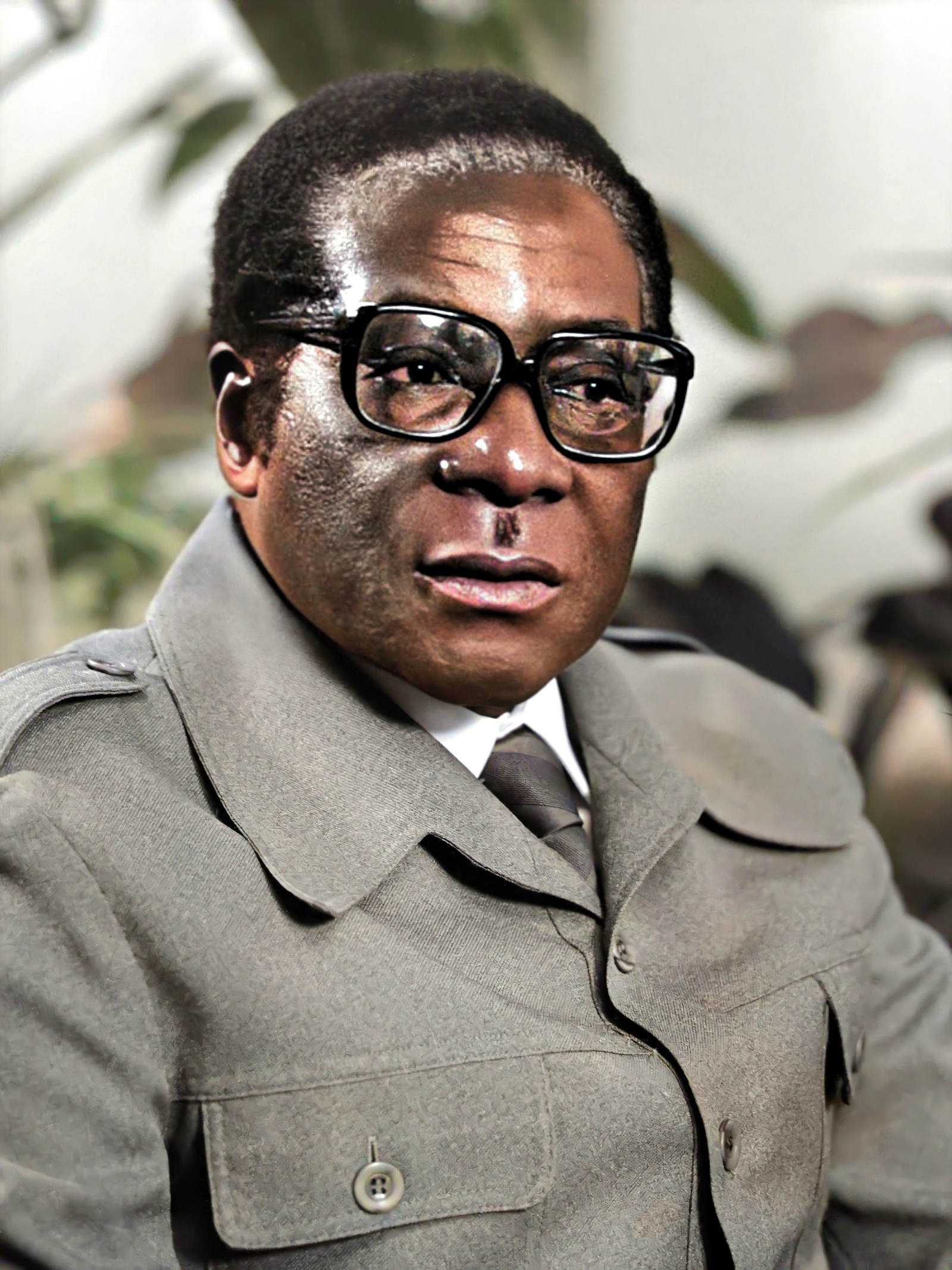
Attr: Koen Suyk / Anefo, CC BY-SA 3.0 NL
| 22 Quotes | |
| Born as | Robert Gabriel Mugabe |
| Occup. | Statesman |
| From | Zimbabwe |
| Spouse | Grace Mugabe |
| Born | February 21, 1924 Kutama, Southern Rhodesia (now Zimbabwe) |
| Died | September 6, 2019 Singapore |
| Aged | 95 years |
| Cite | |
Citation Formats
APA Style (7th ed.)
Robert mugabe biography, facts and quotes. (2026, February 11). FixQuotes. https://fixquotes.com/authors/robert-mugabe/
Chicago Style
"Robert Mugabe biography, facts and quotes." FixQuotes. February 11, 2026. https://fixquotes.com/authors/robert-mugabe/.
MLA Style (9th ed.)
"Robert Mugabe biography, facts and quotes." FixQuotes, 11 Feb. 2026, https://fixquotes.com/authors/robert-mugabe/. Accessed 26 Mar. 2026.
Early Life and Background
Robert Gabriel Mugabe was born on 1924-02-21 at Kutama, a rural mission settlement in what was then Southern Rhodesia. He grew up in a Shona Catholic world shaped by Jesuit discipline, poverty, and the racial hierarchies of a settler colony where land, wages, and law were calibrated to protect a white minority. His father left the family when Mugabe was young, an absence that contemporaries often read into his later self-containment and hunger for control.The era offered few legitimate ladders for an ambitious Black Rhodesian. Mission education could produce clerks and teachers, but politics was policed and African nationalism criminalized. Mugabe entered adulthood as colonial rule hardened into the Federation of Rhodesia and Nyasaland (1953-1963), and then into Ian Smith's white-minority regime, which declared a Unilateral Declaration of Independence in 1965. His early life thus fused personal striving with a public lesson: advancement without power could be revoked at any moment.
Education and Formative Influences
Mugabe trained as a teacher at Kutama and worked in Southern Rhodesia before leaving for Ghana in 1958, teaching there while Kwame Nkrumah's independence experiment provided a living template of postcolonial statecraft. He pursued further study by correspondence through the University of London and later earned degrees while imprisoned, cultivating a reputation for intellectual discipline, legalistic argument, and a belief that politics was, at base, a contest over institutions and narratives as much as guns.Career, Major Works, and Turning Points
Returning home in 1960, Mugabe joined the nationalist movement, was imprisoned by the Rhodesian authorities from 1964 to 1974, and emerged as a central figure in the Zimbabwe African National Union (ZANU), later leading its armed wing during the liberation war. Negotiations at Lancaster House in 1979 produced elections and internationally recognized independence in 1980, with Mugabe becoming prime minister and, after constitutional change, executive president in 1987. The early 1980s brought both rapid expansion of education and health services and the brutal Gukurahundi campaign in Matabeleland, carried out by the North Korean-trained Fifth Brigade, leaving deep, unresolved trauma. His long rule then pivoted again: the 1990s delivered structural adjustment and mounting discontent; the 2000s were defined by fast-track land seizures, violent elections, hyperinflation, and international isolation; after a tense power-sharing period with Morgan Tsvangirai (2009-2013), Mugabe consolidated again until a military intervention in November 2017 ended his presidency and installed Emmerson Mnangagwa.Philosophy, Style, and Themes
Mugabe's inner politics mixed messianic certainty with a grievance memory that never cooled. He spoke as custodian of a liberation covenant in which sovereignty was not merely constitutional but existential, won through suffering and therefore beyond external arbitration. This psychology appears in his readiness to trade prestige for autonomy: “If the choice were made, one for us to lose our sovereignty and become a member of the Commonwealth or remain with our sovereignty and lose the membership of the Commonwealth, I would say let the Commonwealth go”. The sentence is not only policy; it is self-portrait - a leader who equated compromise with humiliation, and who treated international forums as arenas of moral theater rather than mutual constraint.His rhetoric also organized the world into moral camps - liberator versus settler, patriot versus sellout - a style that could mobilize but also licensed cruelty. His most incendiary lines compressed decades of racialized dispossession into a politics of permanent emergency: “The white man is not indigenous to Africa. Africa is for Africans. Zimbabwe is for Zimbabweans”. Land, for Mugabe, was the symbolic heart of independence and the lever for rebuilding a loyal rural base; yet the same project became entangled with patronage and coercion. He defended redistribution as historical rectification while insisting on a sovereign right to define its terms: “We are no longer going to ask for the land, but we are going to take it without negotiating”. The cadence of inevitability reveals a governing instinct that preferred command to consensus, and a fear that delay meant defeat.
Legacy and Influence
Mugabe died on 2019-09-06, leaving a legacy split between emancipator and autocrat, nation-builder and nation-breaker. He presided over real early gains in literacy, public health, and Black professional advancement, while also normalizing political violence, securitized governance, and a patronage economy that hollowed institutions and collapsed livelihoods. Internationally he became a cautionary emblem of liberation movements that, once in office, convert revolutionary legitimacy into indefinite rule; domestically his imprint endures in land ownership patterns, in the unresolved wounds of Matabeleland, and in a political culture where sovereignty is invoked both as shield against domination and as excuse against accountability.Our collection contains 22 quotes written by Robert, under the main topics: Justice - Freedom - Equality - War - Peace.
Other people related to Robert: Joshua Nkomo (Politician), Gerald Clarke (Politician), Kirsty Coventry (Athlete)
Source / external links