
Robert T. Bakker Biography Quotes 19 Report mistakes
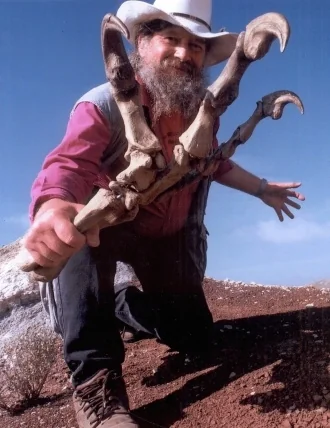
| 19 Quotes | |
| Occup. | Scientist |
| From | USA |
| Born | March 24, 1945 Bergen County, New Jersey |
| Age | 80 years |
| Cite | |
Citation Formats
APA Style (7th ed.)
Robert t. bakker biography, facts and quotes. (2026, February 11). FixQuotes. https://fixquotes.com/authors/robert-t-bakker/
Chicago Style
"Robert T. Bakker biography, facts and quotes." FixQuotes. February 11, 2026. https://fixquotes.com/authors/robert-t-bakker/.
MLA Style (9th ed.)
"Robert T. Bakker biography, facts and quotes." FixQuotes, 11 Feb. 2026, https://fixquotes.com/authors/robert-t-bakker/. Accessed 5 Mar. 2026.
Early Life and Background
Robert T. Bakker was born on March 24, 1945, in the United States, into a postwar culture that was rapidly professionalizing science even as popular media still pictured dinosaurs as sluggish reptiles. He came of age during the Cold War boom in museums, field programs, and college science, when the fossil record was becoming a public spectacle and a technical battleground at once. That combination - mass fascination and contested interpretation - formed the emotional backdrop for a boy whose imagination was seized by deep time but who would later insist on arguing it with measurable anatomy.From early on, Bakker gravitated toward the places where evidence lived: museum halls, specimen drawers, and the visual grammar of reconstruction. He was drawn not only to the drama of ancient predators but to the act of persuasion - how bone, posture, and environment could be arranged into a coherent story. Long before he became a public spokesman for "active" dinosaurs, he was already a kind of courtroom advocate for the dead, alert to how a single image could freeze an interpretation for decades.
Education and Formative Influences
Bakker trained within the elite northeastern pipeline that shaped much American paleontology in the mid-20th century, moving through museum-centered learning into graduate work and teaching. He spent time at Yale and the Peabody Museum, where he worked directly with the public and learned how to translate technical debates into memorable explanations, noting that “Also, while I was at Yale, I had a job teaching kids at the museum”. He later studied at Harvard, where he took on heavy instructional responsibilities - “At Harvard I was in charge of the comparative anatomy labs”. - a role that sharpened his comparative eye across birds, mammals, and reptiles, and trained him to see locomotion, breathing, and metabolism as anatomical problems rather than assumptions inherited from tradition.Career, Major Works, and Turning Points
Bakker became one of the central catalysts of the late-20th-century "dinosaur renaissance", arguing that many dinosaurs were dynamic, behaviorally complex animals with elevated metabolisms, and that the old image of torpid, swamp-bound giants was an artifact of Victorian categories rather than fossil evidence. As a working paleontologist he pursued fieldwork in the American West, including Wyoming, and developed a reputation for forceful synthesis - combining biomechanics, predator-prey ratios, bone histology, and ecological inference into sweeping reinterpretations. His popular book The Dinosaur Heresies (1986) brought these debates to a mass audience with an evangelist's confidence and a showman's clarity, while his scientific papers and public lectures pushed ideas about dinosaur physiology, parental behavior, and the evolutionary continuity linking theropods and birds. Over time, some of his specific arguments were refined or disputed, but his broader turning point was durable: he helped make "how did dinosaurs live?" a mainstream scientific question, not a speculative afterthought.Philosophy, Style, and Themes
Bakker's inner life as a scientist is best read as a tension between reverence for the tradition of anatomy and impatience with inherited storylines. He constantly searched the history of his discipline for overlooked cracks where new physiology could enter, and he treated earlier authorities as prompts rather than verdicts: “In 1941 Richard Owen said that the dinosaurs were almost hot blooded”. Quoting a 19th-century founder in this way was not mere name-dropping - it was a psychological move, a way of legitimizing rebellion by showing that the seeds of doubt were always present, even inside orthodoxy. His style was to compress decades of argument into vivid, directional claims, inviting readers to feel that science advances not only by data but by audacity disciplined through anatomy.Three recurring themes organize his work: metabolism, ecology, and lineage. On metabolism, Bakker framed warm-bloodedness not as a binary label but as a competitive advantage shaping entire faunas, insisting, “To me it seems that the warm blooded dinosaurs replaced advanced mammal ancestors that were warm blooded, also”. The sentence reveals a mind drawn to replacement and rivalry - evolution as an arms race - and also a willingness to unsettle comforting separations between "reptile" and "mammal". On ecology, he pushed paleontology toward habitat specificity and testable constraints, as in “Stegosaurus was common only on well drained, dry soil”. That kind of claim shows his deeper impulse: to relocate dinosaurs from timeless myth into particular landscapes with rules, seasons, and limits. On lineage, his advocacy for theropod-bird continuity aligned with, and helped popularize, a view that later became broadly supported, making flight and feathers the culmination of dinosaur biology rather than its exception.
Legacy and Influence
Bakker's lasting influence lies less in any single conclusion than in the methodological permission he gave: to treat dinosaurs as animals with high-performance physiology, complex behavior, and ecological specificity, and to argue those traits from form and context. He helped shift museum art, textbooks, and public imagination toward active postures and dynamic scenes, while also pushing professional paleontology to debate metabolism, growth rates, and bird origins with new seriousness. In the culture of science communication, he became a model of the scientist as storyteller-advocate - sometimes polarizing, often electrifying - and his central legacy endures in a simple expectation now taken for granted: that dinosaur bones are evidence not just of what creatures looked like, but of how they lived.Our collection contains 19 quotes written by Robert, under the main topics: Witty One-Liners - Nature - Learning - Science - Student.
Robert T. Bakker Famous Works
- 1995 Raptor Red (Novel)
- 1986 The Dinosaur Heresies (Book)
Source / external links