
Rosa Luxemburg Biography Quotes 14 Report mistakes
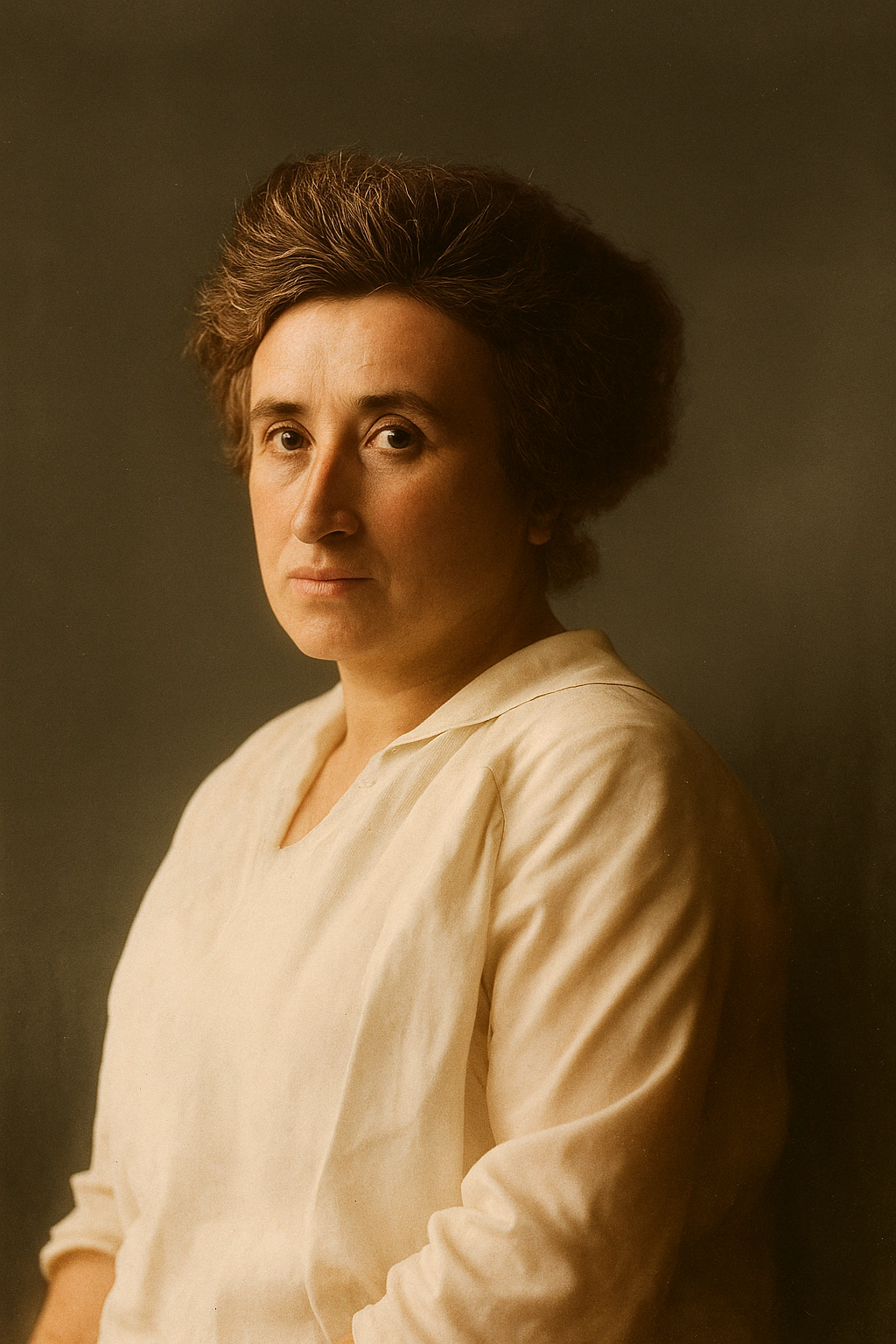
| 14 Quotes | |
| Occup. | Activist |
| From | Russia |
| Born | March 5, 1870 Zamosc, Congress Poland, Russian Empire |
| Died | January 15, 1919 Berlin, Germany |
| Cause | murder (shot by Freikorps) |
| Aged | 48 years |
| Cite | |
Citation Formats
APA Style (7th ed.)
Rosa luxemburg biography, facts and quotes. (2026, February 11). FixQuotes. https://fixquotes.com/authors/rosa-luxemburg/
Chicago Style
"Rosa Luxemburg biography, facts and quotes." FixQuotes. February 11, 2026. https://fixquotes.com/authors/rosa-luxemburg/.
MLA Style (9th ed.)
"Rosa Luxemburg biography, facts and quotes." FixQuotes, 11 Feb. 2026, https://fixquotes.com/authors/rosa-luxemburg/. Accessed 6 Mar. 2026.
Early Life and Background
Rosa Luxemburg was born on 1870-03-05 in Zamosc, in the Russian Empire's Polish lands, into an acculturated Jewish family shaped by the pressures of partitioned Poland. The political atmosphere of her childhood was defined by Russification, censorship, and the surveillance of dissident networks; in such a setting, patriotism, socialism, and the question of Jewish civic belonging were not abstractions but daily realities. From early adolescence she gravitated toward the clandestine world of left-wing study circles, absorbing both the romance and the danger of opposition.A childhood hip ailment left her with a lifelong limp, an outward marker that sharpened her inward discipline and refusal to be pitied. Friends later recalled a mind that moved with quick precision and a temperament that mixed tenderness with an iron capacity for polemic. The sense of living under an empire that demanded obedience helped form her lifelong suspicion of authority - including authority that called itself revolutionary.
Education and Formative Influences
After attending a girls' gymnasium in Warsaw and joining underground socialist circles, she fled police attention in 1889 and settled in Zurich, a hub for exiles from the Russian Empire. At the University of Zurich she studied philosophy, history, economics, and law, completing a doctorate in 1897 with a dissertation on Poland's industrial development. Zurich exposed her to European Marxist debates at their source and to the hard problem that would define her: how to marry rigorous economic analysis to mass action without turning socialism into either moral sermonizing or party-state command.Career, Major Works, and Turning Points
In 1898 Luxemburg moved to Germany, joined the Social Democratic Party (SPD), and quickly became one of its most formidable public intellectuals - a lecturer, editor, and organizer who fought Eduard Bernstein's reformism in Social Reform or Revolution? (1899). Her theoretical breakthrough, The Accumulation of Capital (1913), argued that capitalism sought non-capitalist spaces to sustain expansion, linking imperialism to the system's inner logic. She embraced the mass strike as a living weapon after the 1905 Russian Revolution, analyzed in The Mass Strike (1906), and opposed German militarism and World War I with relentless clarity. For antiwar agitation she endured repeated imprisonment, writing essays and letters that combined strategic urgency with lyrical attention to nature. In 1918 she co-founded the Spartacus League's successor, the Communist Party of Germany (KPD), yet warned against substituting party decrees for workers' self-emancipation. On 1919-01-15, amid the chaos after the failed Spartacist uprising, she was seized by Freikorps officers, beaten, shot, and thrown into Berlin's Landwehr Canal - a political murder that crystallized the counterrevolutionary violence of the age.Philosophy, Style, and Themes
Luxemburg's Marxism was neither academic system nor bureaucratic catechism; it was a theory of motion, crisis, and human creativity under pressure. Her enduring subject was the relationship between spontaneity and organization: she argued that parties could clarify and coordinate, but they could not manufacture a revolution as if it were an administrative plan. “The masses are in reality their own leaders, dialectically creating their own development process”. The sentence is not flattery but psychological self-description: she trusted collective intelligence because she distrusted the seductions of command, having watched how easily certainty hardens into coercion.Her prose fused courtroom logic with moral heat, and even in polemic she listened for the living contradictions inside events. The same sensibility drove her critique of Bolshevik emergency measures after 1917: she feared that revolutionary necessity, if made permanent, would train a new ruling caste. “Freedom is always and exclusively freedom for the one who thinks differently”. The insistence is personal as well as political - a confession that her own mind needed dissent as oxygen, and that socialism without plural struggle would become a prison that merely changed the guards. Against fatalism she set pedagogy-by-conflict, believing consciousness is forged in action, not bestowed from above: “History is the only true teacher, the revolution the best school for the proletariat”. In prison, where the state tried to reduce her to silence, she refined this faith into a stubborn serenity: history teaches, but only if people keep moving.
Legacy and Influence
Luxemburg became a martyr to the German left and a permanent test case for the ethics of revolution: how to fight ruthlessly against exploitation without reproducing domination. In Weimar and after 1945, her memory split along ideological lines - canonized selectively in East Germany, reclaimed by democratic socialists, feminists, and anti-imperialist movements who found in her both analytical force and a humane suspicion of party authoritarianism. Her letters, essays, and economic writings continue to animate debates on imperialism, mass strikes, and the limits of vanguardism, while her death remains a warning about how quickly reaction can mobilize when social order feels threatened.Our collection contains 14 quotes written by Rosa, under the main topics: Justice - Leadership - Freedom - Equality.
Other people related to Rosa: Karl Liebknecht (Politician), Ernest Mandel (Author), Rudolf Hilferding (Economist)
Frequently Asked Questions
- Rosa Luxemburg height: Not reliably recorded; described as petite (about 150–155 cm).
- What is Rosa Luxemburg famous for: Marxist theorist and revolutionary; co-founded the Spartacus League and the German Communist Party; advocate of mass strikes and socialist democracy.
- Rosa Luxemburg disability: A childhood hip ailment left her with a limp and one leg shorter.
- Rosa Luxemburg books: Reform or Revolution; The Accumulation of Capital; The Mass Strike; The Junius Pamphlet; Introduction to Political Economy.
- Rosa Luxemburg assassination: Killed by Freikorps in Berlin on 15 Jan 1919; her body was thrown into the Landwehr Canal.
- Rosa Luxemburg husband: Gustav Lübeck (marriage of convenience; later divorced).
- How old was Rosa Luxemburg? She became 48 years old
Source / external links