
Rudolf Steiner Biography Quotes 3 Report mistakes
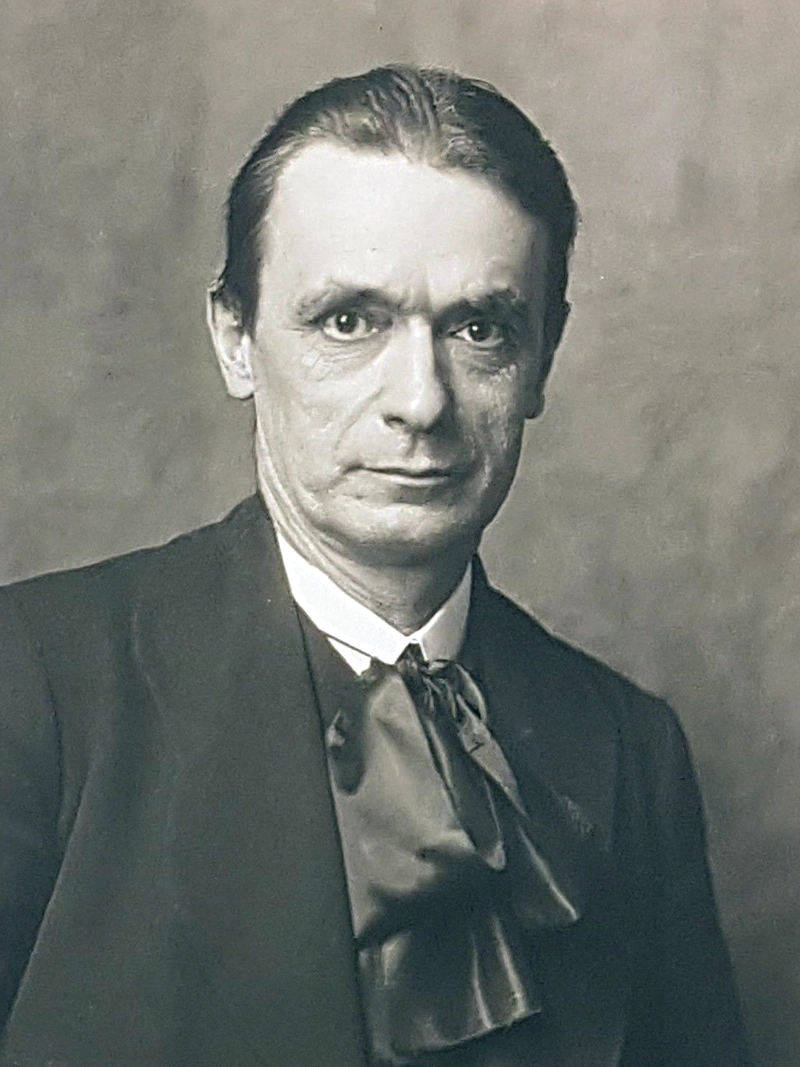
| 3 Quotes | |
| Occup. | Philosopher |
| From | Austria |
| Born | February 5, 1861 Donji Kraljevec |
| Died | March 30, 1925 Dornach, Switzerland |
| Aged | 64 years |
| Cite | |
Citation Formats
APA Style (7th ed.)
Rudolf steiner biography, facts and quotes. (2026, February 11). FixQuotes. https://fixquotes.com/authors/rudolf-steiner/
Chicago Style
"Rudolf Steiner biography, facts and quotes." FixQuotes. February 11, 2026. https://fixquotes.com/authors/rudolf-steiner/.
MLA Style (9th ed.)
"Rudolf Steiner biography, facts and quotes." FixQuotes, 11 Feb. 2026, https://fixquotes.com/authors/rudolf-steiner/. Accessed 25 Mar. 2026.
Early Life and Background
Rudolf Steiner was born on 1861-02-05 in Kraljevec, then in the Austrian Empire (now in Croatia), to a railway telegraphist father whose postings moved the family along the southern rail lines. The borderland setting mattered: German-speaking officialdom, Slavic countryside, and the accelerating tempo of industrial modernity met in everyday life. Steiner later framed his childhood as an early encounter with two worlds at once - the measurable world of signals, schedules, and machinery, and an inward world of heightened perception that he insisted was not mere fantasy but a different mode of cognition.He grew up largely in small towns in what is now Austria, including Neudorfl and later the Wiener Neustadt area. The late Habsburg decades were marked by nationalism, positivist science, and the aftershocks of 1848 liberalism; for an intellectually ambitious provincial youth, Vienna loomed as both magnet and proving ground. Steiner developed a self-conception as a mediator: someone who could take the rigor of modern science without surrendering the soul to materialism, and who could take spirituality without dissolving it into superstition.
Education and Formative Influences
From 1879 he studied at the Vienna Institute of Technology, focusing on mathematics, physics, chemistry, and philosophy, while devouring German idealism and contemporary debates on epistemology. A decisive early influence was Johann Wolfgang von Goethe, especially Goethe's scientific writings on morphology and color, which offered Steiner a model of disciplined, participatory observation rather than reductionism. In the 1880s and 1890s he edited Goethe's scientific works for the Weimar edition, sharpening his belief that thinking itself could be an organ of perception; this conviction culminated in The Philosophy of Freedom (1894), his bid to ground ethics and individuality in a phenomenology of thinking rather than in authority, instinct, or social conformity.Career, Major Works, and Turning Points
Steiner worked first as editor and writer in the German-speaking cultural world, including a period in Weimar and later Berlin, where he moved in literary and reformist circles; he also published early epistemological studies such as Truth and Knowledge (1892) and pursued a distinctive reading of Goethean science. Around the turn of the century he turned increasingly to esoteric questions, teaching within the Theosophical Society before breaking away amid doctrinal conflicts and his emphasis on a Western, Christ-centered path; in 1913 he founded the Anthroposophical Society. A catastrophe and rebirth shaped his public role: after the first Goetheanum at Dornach, Switzerland, burned in 1922-23, he drove himself to design and rebuild while lecturing relentlessly across Europe. His influence widened into practical initiatives: Waldorf education (begun 1919 in Stuttgart for the children of the Waldorf-Astoria cigarette factory workers), biodynamic agriculture (1924), and an alternative medical and therapeutic movement. He died on 1925-03-30 in Dornach, exhausted after years of punishing travel, organizational conflict, and creative overextension.Philosophy, Style, and Themes
Steiner's inner drama was the attempt to reconcile modern selfhood with cosmic meaning without sacrificing intellectual honesty. He held that the human being could train attention and imagination so that cognition deepened into "spiritual science" - not as a flight from facts but as a disciplined expansion of experience. His language often moved between analytic argument and visionary description, because he wanted to show continuity between clear thinking and reverent listening to the world. “All of nature begins to whisper its secrets to us through its sounds. Sounds that were previously incomprehensible to our soul now become the meaningful language of nature”. The sentence reveals his psychology: a yearning for intimacy with reality, coupled with a conviction that meaning is not manufactured by the mind but can be heard when the mind is tuned.Ethically and socially, Steiner rejected both collectivist absorption and isolated egoism, proposing a threefold social order that differentiated cultural life, rights, and economics so that freedom, equality, and fraternity could each find an appropriate sphere. His ideal of community was not sentimental harmony but a moral ecology of reciprocal recognition. “A healthy social life is found only, when in the mirror of each soul the whole community finds its reflection, and when in the whole community the virtue of each one is living”. Here he projects an almost architectural image of society as mutual reflection - a clue to his lifelong drive to build institutions (schools, farms, buildings, artistic practices) that would incarnate inner development in outer form. Underneath lay a devotional temperament, evident in his recurring insistence that knowledge without love becomes domination: “May my soul bloom in love for all existence”.
Legacy and Influence
Steiner remains one of the most consequential - and contested - European spiritual thinkers of the early 20th century, a period when mechanized war and mass politics made many search for new foundations of meaning. His legacy is concrete: thousands of Waldorf schools and kindergartens worldwide, biodynamic farming and its certification systems, anthroposophical medicine and therapies, and the distinctive architecture of Dornach. Intellectually, he is remembered for an ambitious synthesis of German idealism, Goethean science, Christian esotericism, and cultural reform, as well as for a vast lecture corpus that continues to shape alternative education, ecology, and the arts. Admirers see in him a rare attempt to make inner life socially productive; critics question his empirical claims and the authority structures that can form around charismatic teachings. Yet his enduring influence lies in the same wager that animated his life: that modern freedom need not end in disenchantment, and that disciplined attention can turn experience into responsibility.Our collection contains 3 quotes written by Rudolf, under the main topics: Ethics & Morality - Nature - Kindness.
Other people related to Rudolf: Joseph Beuys (Artist), H. P. Blavatsky (Philosopher), Christian Morgenstern (Poet)
Rudolf Steiner Famous Works
- 1919 The Threefold Social Order (On the Social Question) (Essay)
- 1910 Occult Science: An Outline (Non-fiction)
- 1907 The Education of the Child in the Light of Anthroposophy (Non-fiction)
- 1904 How to Know Higher Worlds (Non-fiction)
- 1904 Knowledge of the Higher Worlds and Its Attainment (Non-fiction)
- 1904 Theosophy: An Introduction to the Supersensible Knowledge of the World and of Man (Non-fiction)
- 1894 The Philosophy of Freedom (Book)