
Rudyard Kipling Biography Quotes 33 Report mistakes
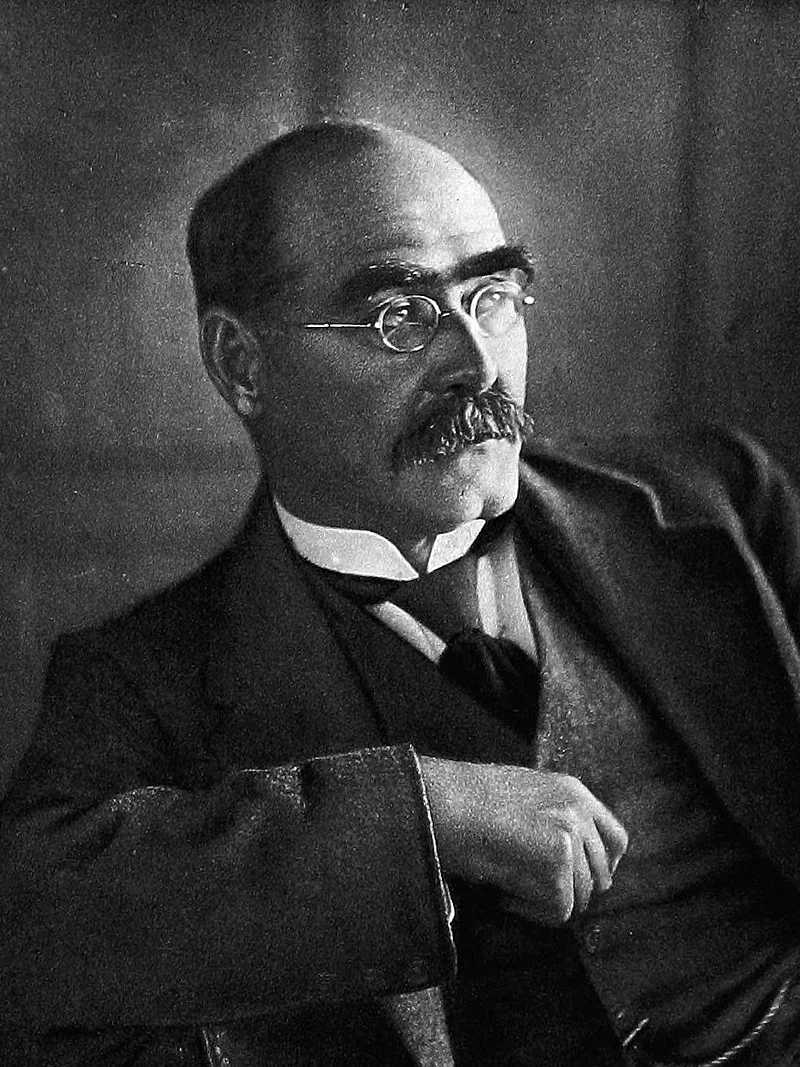
Attr: Inconnu, Public domain
| 33 Quotes | |
| Born as | Joseph Rudyard Kipling |
| Occup. | Writer |
| From | England |
| Born | December 30, 1865 Bombay, British India |
| Died | January 18, 1936 London, England |
| Aged | 70 years |
| Cite | |
Citation Formats
APA Style (7th ed.)
Rudyard kipling biography, facts and quotes. (2026, February 2). FixQuotes. https://fixquotes.com/authors/rudyard-kipling/
Chicago Style
"Rudyard Kipling biography, facts and quotes." FixQuotes. February 2, 2026. https://fixquotes.com/authors/rudyard-kipling/.
MLA Style (9th ed.)
"Rudyard Kipling biography, facts and quotes." FixQuotes, 2 Feb. 2026, https://fixquotes.com/authors/rudyard-kipling/. Accessed 4 Mar. 2026.
Early Life and Background
Joseph Rudyard Kipling was born on December 30, 1865, in Bombay, British India, at a moment when the Raj was hardening into a confident, bureaucratic empire after the 1857 rebellion. His father, John Lockwood Kipling, was an artist and educator associated with the Bombay School of Art; his mother, Alice Macdonald, came from a remarkable circle of Victorian intellectual and artistic families. Bombay gave him a first language of heat, street noise, vernacular rhythms, and layered belief - a sensory apprenticeship that later made his India feel overheard rather than invented.At five he was sent to England, as was common for Anglo-Indian children, and the severance marked him. From 1871 to 1877 he lived in Southsea with foster guardians in a house he later recalled as emotionally punitive; the experience seeded his lifelong attention to endurance, loyalty, and the private costs of respectability. Rescue came when he rejoined his parents briefly and then entered the United Services College at Westward Ho!, a school designed to feed the imperial services. There, among boys training for command, he learned the codes of masculine performance and the hunger for belonging - the psychological fuel of much of his fiction.
Education and Formative Influences
Kipling was not formed by university but by apprenticeship: school journalism, voracious reading, and the practical education of empire. In 1882 he returned to India as a young reporter for the Civil and Military Gazette in Lahore and later The Pioneer in Allahabad. Deadlines taught compression; the press taught him how power speaks - in proclamations, gossip, military slang, and courtroom phrasing. He absorbed Indian languages by ear, moved between cantonments and bazaars, and learned to see the Raj as a machine run by fallible men, not abstractions. Those years produced his early verse and sketches and trained his signature blend of documentary specificity and mythic reach.Career, Major Works, and Turning Points
Kipling burst onto the British literary scene after returning west in 1889, carrying a trove of Indian stories that culminated in Plain Tales from the Hills (1888) and, soon after, Barrack-Room Ballads (1892), which gave a voice - sometimes tender, sometimes brutal - to the enlisted man. In 1892 he married Caroline Balestier and settled in Vermont, where he wrote The Jungle Book (1894) and The Second Jungle Book (1895), as well as Captains Courageous (1897). After personal tragedy and public quarrels, he moved back to England, later living at Bateman's in Sussex, and produced Kim (1901), Puck of Pook's Hill (1906), and a stream of tales and poems that argued for duty, craft, and national memory. Awarded the Nobel Prize in Literature in 1907, he became both a laureate of empire and a lightning rod for critics. The First World War intensified his sense of obligation; his son John was killed at Loos in 1915, and Kipling's later work - including participation in the Imperial War Graves Commission and the book of mourning and warning, Epitaphs of the War (1919) - hardened into elegy and reckoning. He died in London on January 18, 1936, and was buried in Westminster Abbey.Philosophy, Style, and Themes
Kipling's inner life was a contest between enchantment and discipline: a child who loved the world's texture, and an adult who feared what happens when institutions fail. His prose listens like a reporter and arranges like an engineer - dialect, technical vocabulary, and sharp scene-setting that makes work feel holy and idleness morally dangerous. He admired competence and distrusted grand talk, which is why his heroes are often artisans, soldiers, and civil servants - people who keep systems running when no one applauds. Underneath, though, is a boyhood wound: separation, humiliation, and the longing for a law of loyalty that would not betray him.That tension animates the moral weather of his poems and stories. He could celebrate companionship, yet insist on the solitary burden of responsibility: “Down to Gehenna, or up to the Throne, He travels the fastest who travels alone”. The line is less bravado than self-diagnosis - a conviction that love is real but unreliable, and that the decisive moments of character happen when no comfort arrives. Even his famous counsel in "If-" turns endurance into a near-physical creed: “If you can force your heart and nerve and sinew to serve your turn long after they are gone, and so hold on when there is nothing in you except the will which says to them: 'Hold on!'”. That is Kipling converting pain into method, a worldview built to survive exile, public controversy, and bereavement. Yet he also kept a private reverence for maternal steadiness as a counterweight to masculine codes: “An ounce of mother is worth a pound of clergy”. In that preference for lived care over official piety lies a key to his psychology - the child who measured authority by whether it sheltered, not whether it preached.
Legacy and Influence
Kipling endures as one of the most technically influential English writers of his era: a master of narrative velocity, voice, and the short story's architecture, whose cadences shaped popular verse and whose storytelling strategies echo through later writers of adventure, spy fiction, and children's literature. His work also remains a central document of imperial imagination - brilliant in observation, often compromised in politics - and is read today with a double lens: as craft of the highest order and as evidence of how empire justified itself emotionally. The grief that runs from his early severances to the loss of his son gives his best pages their pressure and their truth: behind the public bard of duty stands a writer who turned vulnerability into form, and who made the costs of belonging - to family, to regiment, to nation - impossible to ignore.Our collection contains 33 quotes written by Rudyard, under the main topics: Witty One-Liners - Ethics & Morality - Wisdom - Art - Deep.
Other people related to Rudyard: Walter de La Mare (Poet), Dean Stockwell (Actor), Adela Florence Nicolson (Poet)
Rudyard Kipling Famous Works
- 1910 Rewards and Fairies (Collection)
- 1910 If, (Poetry)
- 1904 Traffics and Discoveries (Collection)
- 1902 Just So Stories (Children's book)
- 1901 Kim (Novel)
- 1899 Stalky & Co. (Collection)
- 1897 Captains Courageous (Novel)
- 1896 The Seven Seas (Poetry)
- 1895 The Second Jungle Book (Collection)
- 1894 The Jungle Book (Collection)
- 1893 Many Inventions (Collection)
- 1892 Barrack-Room Ballads (Poetry)
- 1892 The Naulahka: A Story of West and East (Novel)
- 1891 Life's Handicap (Collection)
- 1891 The Light That Failed (Novel)
- 1890 Gunga Din (Poetry)
- 1888 The Story of the Gadsbys (Play)
- 1888 The Man Who Would Be King (Short Story)
- 1888 Soldiers Three (Collection)
- 1888 Plain Tales from the Hills (Collection)