
Rush Limbaugh Biography Quotes 40 Report mistakes
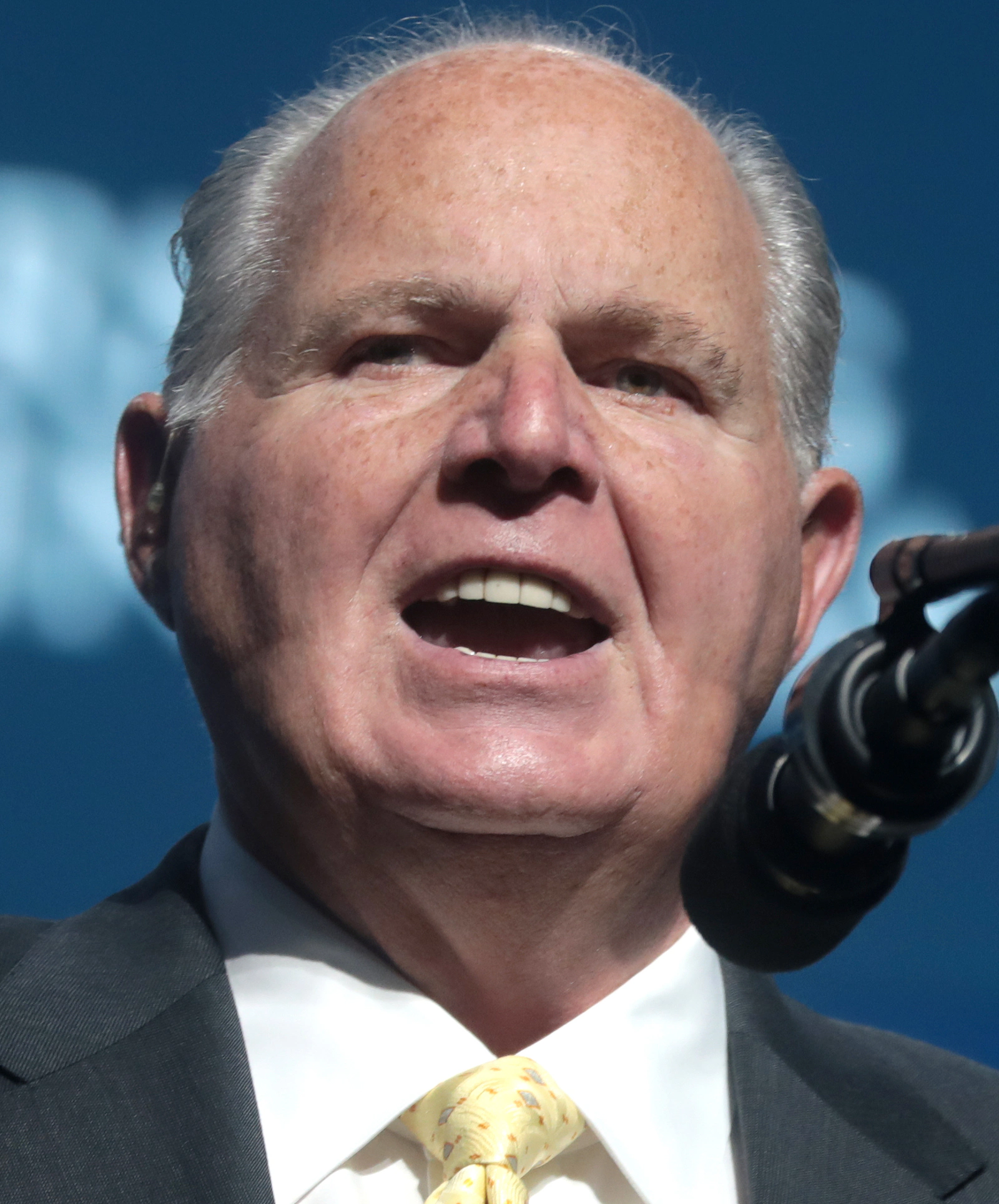
Attr: Gage Skidmore, CC BY-SA 2.0
| 40 Quotes | |
| Born as | Rush Hudson Limbaugh III |
| Occup. | Entertainer |
| From | USA |
| Spouses | Roxy Maxine McNeely (1977–1980) Michelle Sixta (1983–1990) Marta Fitzgerald (1994–2004) Kathryn Rogers (2010) |
| Born | January 12, 1951 Cape Girardeau, Missouri, USA |
| Age | 75 years |
| Cite | |
Citation Formats
APA Style (7th ed.)
Rush limbaugh biography, facts and quotes. (2026, February 11). FixQuotes. https://fixquotes.com/authors/rush-limbaugh/
Chicago Style
"Rush Limbaugh biography, facts and quotes." FixQuotes. February 11, 2026. https://fixquotes.com/authors/rush-limbaugh/.
MLA Style (9th ed.)
"Rush Limbaugh biography, facts and quotes." FixQuotes, 11 Feb. 2026, https://fixquotes.com/authors/rush-limbaugh/. Accessed 25 Mar. 2026.
Early Life and Background
Rush Hudson Limbaugh III was born January 12, 1951, in Cape Girardeau, Missouri, into a prominent local family whose name was tied to law and civic life. His father, Rush Limbaugh Jr., was an attorney; his mother, Millie, was active in community life; and a celebrated relative, Missouri Supreme Court Justice Stephen N. Limbaugh Sr., embodied the establishment seriousness that both grounded and irritated Rush. In a river town where reputation traveled fast, he grew up absorbing the rituals of courthouse respectability and the resentments of people who felt talked down to by distant cultural centers.From early on he was drawn less to consensus than to performance: radio felt like a private stage with a national-sized audience. The 1960s and early 1970s formed his emotional climate - Vietnam, Watergate, campus protest, and rapid shifts in manners and media - and he developed an instinct that politics was inseparable from entertainment. That instinct was not merely ideological; it was temperamental, a delight in argument and an appetite for attention that made him both magnetic and polarizing.
Education and Formative Influences
Limbaugh attended Cape Girardeau Central High School and briefly enrolled at Southeast Missouri State University before leaving college to pursue broadcasting full time. He started young, taking on-air jobs and learning the craft from the inside out - timing, voice, and how to build intimacy with listeners who could not see him. Those early stations, along with his fascination with popular music and the mechanics of ratings, taught him the essential lesson he never abandoned: an audience must feel spoken for, not spoken at.Career, Major Works, and Turning Points
After years moving through small and mid-size markets - including stints in Pittsburgh and elsewhere - Limbaugh reached a turning point in the 1980s as AM radio reinvented itself. In 1988 his nationally syndicated "The Rush Limbaugh Show" launched from New York via WABC, riding the new regulatory landscape after the Fairness Doctrine ended and proving that partisan talk could be mass entertainment. He became a defining voice of modern conservatism, expanding into best-selling books such as "The Way Things Ought to Be" (1992) and "See, I Told You So" (1993), and into television with a short-lived "Rush Limbaugh" TV show in the early 1990s. He courted controversy repeatedly - from heated rhetoric to public battles over media bias - and his influence peaked as his program became a daily agenda-setter for Republican politics. Later chapters mixed triumph and strain: public acknowledgment of prescription drug addiction in the early 2000s, ongoing health challenges including hearing loss treated with cochlear implants, and a final period shaped by advanced lung cancer before his death on February 17, 2021.Philosophy, Style, and Themes
Limbaughs public identity fused conviction with showmanship. He treated politics as narrative combat, with heroes, villains, and punch lines, and his studio persona - alternately genial, scornful, and mock-outraged - was engineered to keep listeners emotionally engaged. Beneath the swagger was a sharp understanding of status: he spoke to people who felt their values were portrayed as backward, and he offered them the pleasure of reversal. His psychology as a broadcaster rested on certainty, a self-appointed role as defender, and a talent for turning policy into personal drama.His themes were consistent: American exceptionalism, suspicion of bureaucratic power, and the belief that cultural elites distort ordinary reality. “I reject the notion that America is in a well-deserved decline, that she and her citizens are unexceptional. I do not believe America is the problem in the world. I believe America is the solution to the world's problems”. That sentence captures his inner engine - defiance against humiliation - and explains why he framed opponents not just as wrong but as corrosive to national self-respect. He also cast politics as a moral test: “Character matters; leadership descends from character”. Even when his own life was messy, the standard functioned as a rhetorical lever, a way to turn public events into lessons about virtue and authority. And he made liberty feel intimate and embattled: “I want anyone who believes in life, liberty, pursuit of happiness to succeed. And I want any force, any person, any element of an overarching Big Government that would stop your success, I want that organization, that element or that person to fail. I want you to succeed”. The emphasis is revealing: the listener is the protagonist, while government becomes a faceless antagonist, a framing that turned ideology into loyalty.
Legacy and Influence
Limbaugh helped create the template for modern American political audio: the host as movement entrepreneur, comic prosecutor, and daily interpreter of the news. He normalized a style that blended argument with entertainment, pushed Republican politicians to treat media as a base-mobilizing weapon, and proved that outrage and intimacy could coexist in a three-hour broadcast. Admired as a fearless advocate and condemned as a divisor, he left an enduring imprint on conservative communication, talk radio economics, and the broader culture of partisan identity, where persuasion often matters less than belonging.Our collection contains 40 quotes written by Rush, under the main topics: Witty One-Liners - Ethics & Morality - Justice - Sarcastic - Leadership.
Other people related to Rush: Jonathan Krohn (Author)
Source / external links