
Russell Baker Biography Quotes 29 Report mistakes
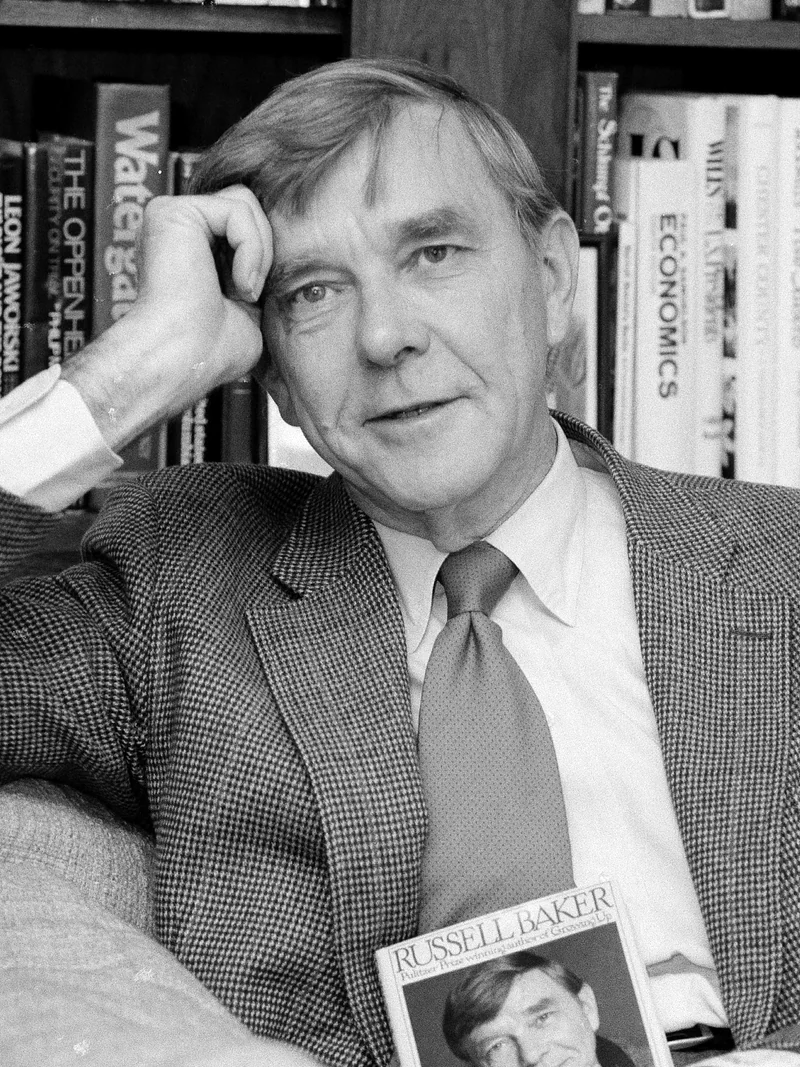
| 29 Quotes | |
| Born as | Russell Wayne Baker |
| Occup. | Journalist |
| From | USA |
| Spouse | Phyllis Baker |
| Born | August 14, 1925 Morrisonville, Virginia, USA |
| Died | January 21, 2019 Leesburg, Virginia, USA |
| Cause | Natural Causes |
| Aged | 93 years |
| Cite | |
Citation Formats
APA Style (7th ed.)
Russell baker biography, facts and quotes. (2026, February 11). FixQuotes. https://fixquotes.com/authors/russell-baker/
Chicago Style
"Russell Baker biography, facts and quotes." FixQuotes. February 11, 2026. https://fixquotes.com/authors/russell-baker/.
MLA Style (9th ed.)
"Russell Baker biography, facts and quotes." FixQuotes, 11 Feb. 2026, https://fixquotes.com/authors/russell-baker/. Accessed 11 Feb. 2026.
Early Life and Background
Russell Wayne Baker was born on August 14, 1925, in Loudoun County, Virginia, and grew up in the shadow of the Great Depression, an era that trained his ear for the gap between national myth and household reality. His father, a home-service worker for a power company, died when Baker was still a child, leaving the family to navigate grief, money worries, and the quiet humiliations of dependence. The loss hardened him without making him hard; it also gave him a lifelong sensitivity to how private sorrow is usually carried in public silence.His mother moved the family to Baltimore, Maryland, where Baker came of age amid row-house neighborhoods, wartime mobilization, and the daily spectacle of institutions that promised stability but often delivered paperwork, waiting rooms, and rules. The boy who watched adults improvise dignity under strain became the man who could translate social pressure into comedy without denying the pressure itself. He learned early that humor was not an escape from hardship so much as a method of describing it accurately enough to be endured.
Education and Formative Influences
After high school in Baltimore, Baker attended Johns Hopkins University, where he absorbed a disciplined prose culture and a skeptical, urban sensibility well suited to mid-century American journalism. College sharpened his taste for the essayistic tradition - the idea that a reporter could also be a narrator with a mind on the page - and it strengthened his instinct to treat grand themes (class, ambition, patriotism) through the small, telling detail. Those years also confirmed his suspicion of cant: he respected learning, but he trusted experience to puncture it.Career, Major Works, and Turning Points
Baker began as a working journalist on local papers before moving into national journalism, ultimately becoming one of the signature voices of The Washington Post and then The New York Times, where his column and essays made him a household name. In Washington he learned the choreography of power - the press conferences, euphemisms, and rituals of seriousness - and he learned to puncture them with mild-seeming sentences that landed like pins. His most enduring book, Growing Up (1982), a memoir of depression-era boyhood and a mother determined to keep the family afloat, won the Pulitzer Prize for Biography/Autobiography and showed how his comic timing could coexist with unembarrassed tenderness. He later won a second Pulitzer Prize (1983) for commentary, cementing him not only as a humorist but as a critic of American habits, and he extended his range with works such as The Good Times (1989), which traced the uneasy comedy of the 1950s, and later memoir and essay collections that returned to the themes of family, ambition, and the stories a nation tells itself.Philosophy, Style, and Themes
Baker wrote with the deceptively simple cadence of a man talking across the kitchen table - then, mid-sentence, he would slide in an angle of vision that made the familiar look absurd and therefore newly visible. His humor was rarely cruel; it was diagnostic. He treated American life as a system of incentives and exclusions, noting how status turns pleasure into a competitive sport: "People seem to enjoy things more when they know a lot of other people have been left out of the pleasure". The line captures a core Baker belief that society trains desire to seek not only enjoyment but advantage, and it explains why his columns so often revolve around queues, clubs, insider language, and the social theater of being admitted.At the same time, his best writing is animated by loss - the lost parent, the lost past, the lost chance to ask ordinary questions before it is too late. He understood the family as a private archive that vanishes quickly, and he gave that vanishing a blunt, elegiac formulation: "Children rarely want to know who their parents were before they were parents, and when age finally stirs their curiosity, there is no parent left to tell them". If his satire targets national pretension, his memoir targets time itself, the way it steals context and leaves people stranded with incomplete explanations. Even when he sounded breezy, he was arguing that adult wisdom is mostly the recognition of limits: "An educated person is one who has learned that information almost always turns out to be at best incomplete and very often false, misleading, fictitious, mendacious - just dead wrong". That epistemological modesty - a refusal to overclaim - shaped his style: he preferred the concrete scene to the grand theory, the observed irony to the sermon.
Legacy and Influence
Baker died on January 21, 2019, but his influence persists in the American essay and newspaper column as a model of how to be funny without being shallow and serious without being pompous. He helped legitimize a particular kind of public intelligence: civic-minded, suspicious of slogans, and willing to admit confusion as part of honesty. For later commentators, memoirists, and humorists, he offered a durable lesson from the 20th century - that the most revealing way to describe a nation is often to describe, with precision and restraint, how it behaves on an ordinary day.Our collection contains 29 quotes written by Russell, under the main topics: Witty One-Liners - Ethics & Morality - Wisdom - Sarcastic - Writing.
Other people related to Russell: Charlotte Curtis (Journalist)
Russell Baker Famous Works
- 1989 The Good Times (Memoir)
- 1982 Growing Up (Memoir)
- 1980 So This Is Depravity (Book)
- 1973 The Rescue of Miss Yaskell and Other Pipe Dreams (Book)
- 1972 Poor Russell's Almanac (Book)
Source / external links