
Saddam Hussein Biography Quotes 15 Report mistakes
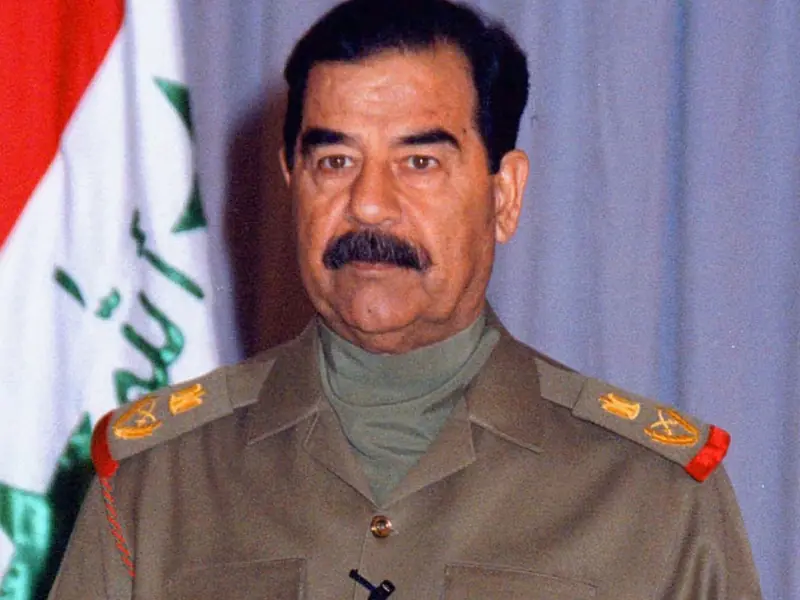
| 15 Quotes | |
| Born as | Saddam Hussein Abd al-Majid al-Tikriti |
| Occup. | Criminal |
| From | Iraq |
| Born | April 28, 1937 Al-Awja, Tikrit, Iraq |
| Died | December 30, 2006 Kadhimiya, Baghdad, Iraq |
| Cause | Execution by hanging |
| Aged | 69 years |
Saddam Hussein Abd al-Majid al-Tikriti was born on April 28, 1937, near Al-Awja outside Tikrit in Iraq's Salah al-Din province, a rural Sunni Arab milieu shaped by clan loyalties, poverty, and the hard arithmetic of survival under a monarchy increasingly challenged by coups and ideology. His father died or disappeared before his birth, and he was raised in a family environment marked by insecurity and violence, conditions that helped form a lifelong conviction that safety came only from dominance and preemption.
As a teenager he gravitated toward Baghdad's rough politics through kinship networks, including his uncle Khairallah Tulfah, a nationalist who fed him a narrative of humiliation and redemption: Iraq as a thwarted power that needed iron discipline. The era's turbulence - the 1958 overthrow of the Hashemite monarchy and the scramble among communists, pan-Arabists, and Baathists - offered an ambitious provincial youth a ladder, but it was a ladder built from secrecy, coercion, and the cultivation of fear.
Education and Formative Influences
Saddam moved between Tikrit and Baghdad, attending schools unevenly and absorbing politics more than formal learning; he later took law studies in Baghdad without completing a conventional legal career. His real education was the Baath Party's underground culture: cells, codes, surveillance, and the belief that history is made by conspirators who seize the state and then reforge society through force, propaganda, and patronage. Nasserism, Baathist Arab socialism, and anti-imperial rhetoric became his vocabulary, while tribal solidarity and the security apparatus became his method.
Career, Major Works, and Turning Points
He joined the Arab Socialist Baath Party in the late 1950s, participated in the failed 1959 attempt to assassinate Prime Minister Abd al-Karim Qasim, and fled to Syria and Egypt before returning after the Baath's brief 1963 coup; by the late 1960s he was a key operator in the party-security nexus that enabled the July 17, 1968 Baath takeover. As vice chairman under Ahmad Hasan al-Bakr, Saddam built overlapping intelligence and coercive institutions, then assumed the presidency in 1979, staging purges that signaled a new order centered on his person. He used 1970s oil revenues to expand education, health care, and infrastructure while entrenching a police state and elevating a cult of leadership. The Iran-Iraq War (1980-1988) brutalized the country and culminated in atrocities including the 1988 Anfal campaign against Kurds, while the 1990 invasion of Kuwait triggered the 1991 Gulf War, sanctions, uprisings, and a long siege that hollowed out Iraq. After the 2003 US-led invasion, Saddam was captured in December 2003, tried by the Iraqi Special Tribunal, convicted for crimes against humanity tied to the Dujail killings, and executed on December 30, 2006.
Philosophy, Style, and Themes
Saddam's governing psychology fused conspiratorial realism with theatrical certainty: politics as a closed contest in which sincerity is a liability and deception a civic duty. His own aphorism, "Politics is when you say you are going to do one thing while intending to do another. Then you do neither what you said nor what you intended". reads less like wit than self-portrait - a leader who understood power as continuous misdirection, multiplying threats so that rivals, neighbors, and citizens could never locate stable ground. The Baathist promise of modernization became, under him, a machine for personal rule: ministries, unions, and media disciplined into instruments, while kin and trusted Tikriti networks anchored the coercive core.
He framed conflict as sacred endurance and national destiny, binding sacrifice to legitimacy and making survival itself a political program. "We are ready to sacrifice our souls, our children and our families so as not to give up Iraq. We say this so no one will think that America is capable of breaking the will of the Iraqis with its weapons". is revealing not only as propaganda but as a moral inversion: private life conscripted into the state, suffering converted into proof of righteousness. Even at trial he clung to the metaphysics of office, insisting, "If you are Iraqi, you know who I am... and you know that I do not tire. I am the president of Iraq and I refuse to answer these questions because this court is illegitimate". The line captures his central theme - identity equated with sovereignty - and the refusal to concede that law could stand above the ruler.
Legacy and Influence
Saddam left behind a paradoxical record: periods of genuine state-building and social expansion, fused to mass repression, aggressive war, and crimes that scarred Iraq's demographic and moral landscape. His model of rule - oil-funded patronage, security-state omnipresence, and nationalist mythmaking - influenced regional autocrats and insurgent narratives alike, while his overthrow and execution reshaped the Middle East by accelerating sectarian polarization, empowering militias, and demonstrating both the reach and limits of external regime change. In biography he remains a study in how personal insecurity, ideological certainty, and institutionalized violence can merge into a durable tyranny - and how the collapse of that tyranny can unleash catastrophes of its own.
Our collection contains 15 quotes who is written by Saddam, under the main topics: Truth - Justice - Leadership - Sarcastic - War.
Other people realated to Saddam: Dan Rather (Journalist), Dick Cheney (Vice President), William J. Clinton (President), Donald Rumsfeld (Politician), Madeleine Albright (Statesman), Norman Schwarzkopf (Soldier), Tony Blair (Statesman), Jalal Talabani (Politician), Ramsey Clark (Public Servant), Mohammed Saeed al-Sahaf (Public Servant)
Saddam Hussein Famous Works
- 2003 Begone, Demons (Novel)
- 2002 Men and the City (Novel)
- 2001 The Fortified Castle (Novel)
- 2000 Zabibah and the King (Novel)
Source / external links