
Saint Teresa of Avila Biography Quotes 15 Report mistakes
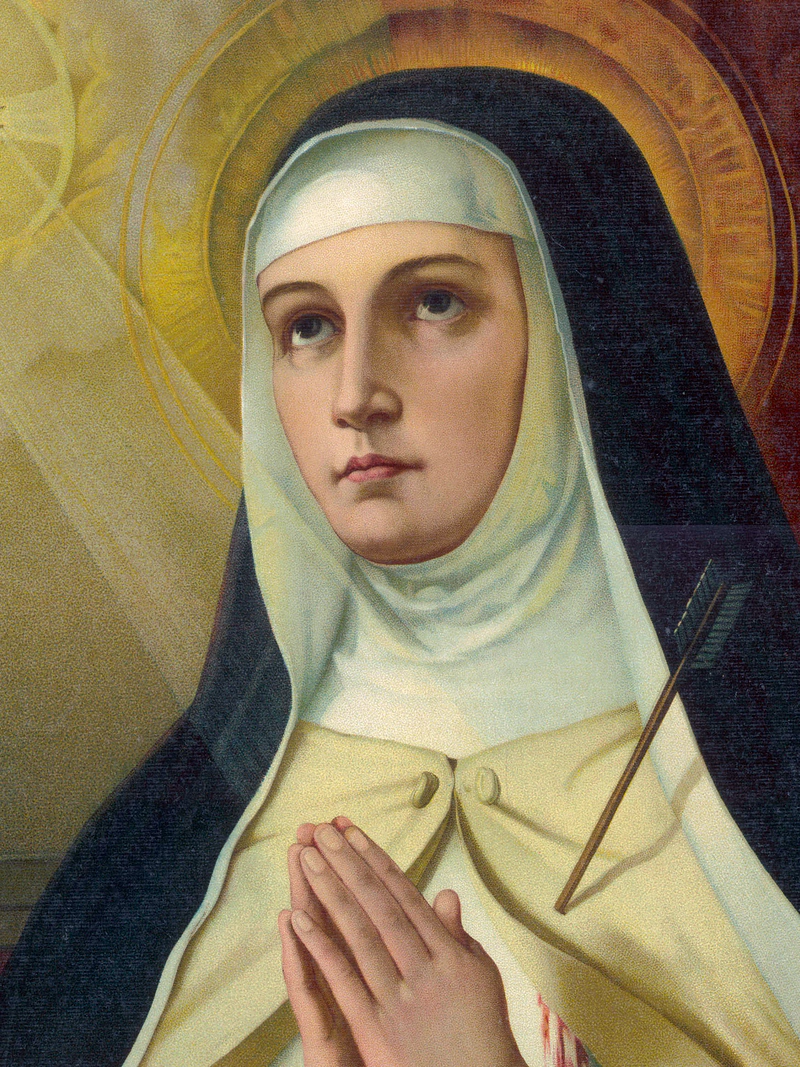
Attr: thetimes.com
| 15 Quotes | |
| Born as | Teresa Sanchez de Cepeda y Ahumada |
| Known as | Teresa of Jesus |
| Occup. | Saint |
| From | Spain |
| Born | March 28, 1515 Avila, Spain |
| Died | October 4, 1582 Alba de Tormes, Spain |
| Aged | 67 years |
| Cite | |
Citation Formats
APA Style (7th ed.)
Saint teresa of avila biography, facts and quotes. (2026, February 11). FixQuotes. https://fixquotes.com/authors/saint-teresa-of-avila/
Chicago Style
"Saint Teresa of Avila biography, facts and quotes." FixQuotes. February 11, 2026. https://fixquotes.com/authors/saint-teresa-of-avila/.
MLA Style (9th ed.)
"Saint Teresa of Avila biography, facts and quotes." FixQuotes, 11 Feb. 2026, https://fixquotes.com/authors/saint-teresa-of-avila/. Accessed 31 Mar. 2026.
Early Life and Background
Teresa Sanchez de Cepeda y Ahumada was born on 1515-03-28 in Avila, a walled Castilian town where the aftermath of the Reconquista mixed with the new anxieties of imperial Spain. Her father, Alonso Sanchez de Cepeda, was a prosperous wool merchant and a man of disciplined piety; her mother, Beatriz de Ahumada, cultivated in her children a taste for saints lives and romances alike. The household carried a delicate social burden: on her fathers side the family had converso roots, a fact that in 16th-century Spain could sharpen scrutiny and intensify the drive toward irreproachable Catholic identity.As a child Teresa was fervent, imaginative, and wilful, drawn to stories of martyrdom and glory. She later recalled youthful attempts at extreme devotion, followed by adolescent fascination with social charm and books of chivalry - an oscillation that would become part of her lifelong psychological realism about spiritual desire and self-deception. Her mother died when Teresa was young (1529), and the loss deepened her interior life; she famously turned to the Virgin Mary as a new maternal protector, a gesture that reveals both her need for attachment and her instinct to transmute grief into vocation.
Education and Formative Influences
Teresa received a literate lay education at home and then, as a teenager, spent time with the Augustinian nuns at Santa Maria de Gracia in Avila, where she absorbed convent rhythms and the Spanish tradition of affective devotion. In the charged religious climate shaped by Erasmus debates, the Inquisition, and the Catholic Reformation, she encountered the classics of interior prayer that would anchor her: Augustine, Franciscan and Dominican preaching, and later the language of recollection taught by reform-minded confessors. Her entrance in 1535 into the Carmelite convent of the Incarnation in Avila was both a decisive break and a refuge, chosen against family reluctance and carried by a temperament that needed both structure and an arena for moral heroism.Career, Major Works, and Turning Points
At the Incarnation, Teresa endured prolonged illness (including a near-death crisis in the late 1530s) and a long struggle with distraction and divided commitments; the convents relatively relaxed observance and constant visitors pulled her outward even as she yearned for depth. A turning point came in the mid-1550s with an intense reawakening of prayer and a series of mystical experiences, including the famed moment before an image of the wounded Christ and later episodes she interpreted as divine initiative rather than self-generated rapture. From this interior pressure emerged a public reformer: in 1562 she founded San Jose in Avila, inaugurating the Discalced Carmelite reform with stricter poverty, enclosure, and a small-community ideal. Over the next two decades she founded convents across Spain, navigated suspicion from civic authorities and ecclesiastical politics, partnered with John of the Cross, and wrote under obedience and surveillance: the Vida (Life), Camino de perfeccion (Way of Perfection), and Las moradas or Castillo interior (Interior Castle), works that turned private experience into a map for others. She died while traveling for the reform on 1582-10-04 at Alba de Tormes.Philosophy, Style, and Themes
Teresa is both a mystic and a strategist of conscience. Her central conviction is that God is encountered not primarily in extraordinary phenomena but in steady, embodied fidelity - prayer as friendship, tested in community, illness, administration, and misunderstanding. She insists that grace moves through the psyche as it is, not as it is imagined to be, and she distrusts pious theater; even ecstasy is weighed by its fruits in humility, charity, and courage. Her phrase “Pain is never permanent”. fits her lived pattern: suffering is neither romanticized nor denied, but reinterpreted as a passage that can purify attention and widen compassion.Her prose is colloquial, ironic, and fiercely concrete - the voice of a woman managing builders, patrons, travel permits, and confessors while charting interior states with clinical precision. She repeatedly returns to the paradox that answered prayer can wound as much as it consoles: “There are more tears shed over answered prayers than over unanswered prayers”. In her psychology, desire is dangerous because it is powerful; when God grants what the soul begs for, it may discover the cost of intimacy, detachment, and truth. Yet her mysticism is not escapist. “The feeling remains that God is on the journey, too”. , a line that captures her mature balance - God accompanies the reformer on roads, in negotiations, and in the slow work of learning oneself. The Interior Castle frames the soul as a many-roomed dwelling where self-knowledge and divine love advance together, and where the highest union intensifies practical love rather than dissolving it.
Legacy and Influence
Canonized in 1622 and later named a Doctor of the Church (1970), Teresa of Avila became a defining voice of Catholic interiority in the Counter-Reformation and beyond, offering a disciplined vocabulary for mystical experience that could withstand theological scrutiny. Her reform reshaped the Carmelite order and helped set a model for female religious agency within restrictive structures: she negotiated power through obedience, humor, and administrative skill, leaving an archive of letters that reveal a mind as competent as it was contemplative. In literature and psychology her influence persists through her unsentimental self-scrutiny, her insistence on integrating prayer with temperament and circumstance, and her enduring image of the spiritual life as an inward architecture built, room by room, through courage, honesty, and love.Our collection contains 15 quotes written by Saint, under the main topics: Wisdom - Hope - Resilience - Faith - Forgiveness.